


Double-blind, randomized pilot clinical trial targeting alpha oscillations with transcranial alternating current stimulation (tACS) for the treatment of major depressive disorder (MDD)
- PMID: 30837453
- PMCID: PMC6401041
- DOI: 10.1038/s41398-019-0439-0
Double-blind, randomized pilot clinical trial targeting alpha oscillations with transcranial alternating current stimulation (tACS) for the treatment of major depressive disorder (MDD)
Abstract
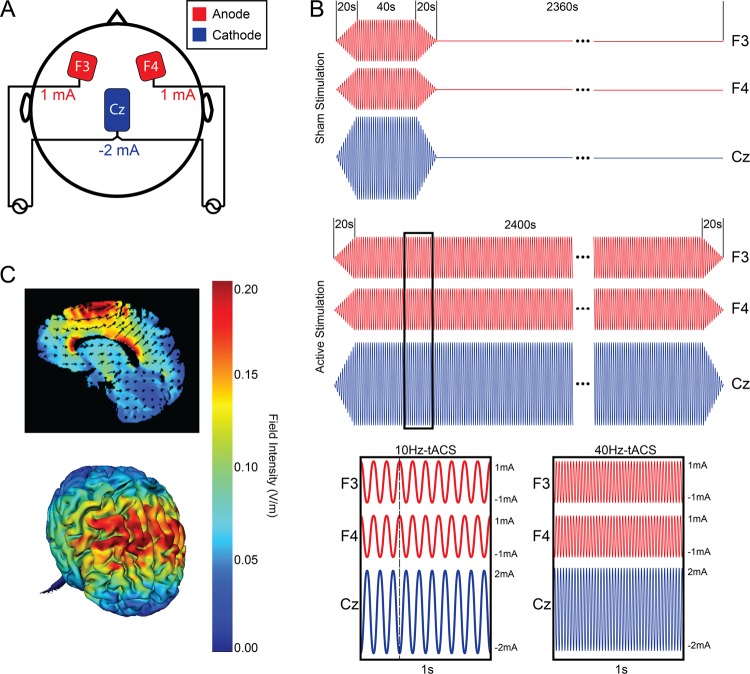
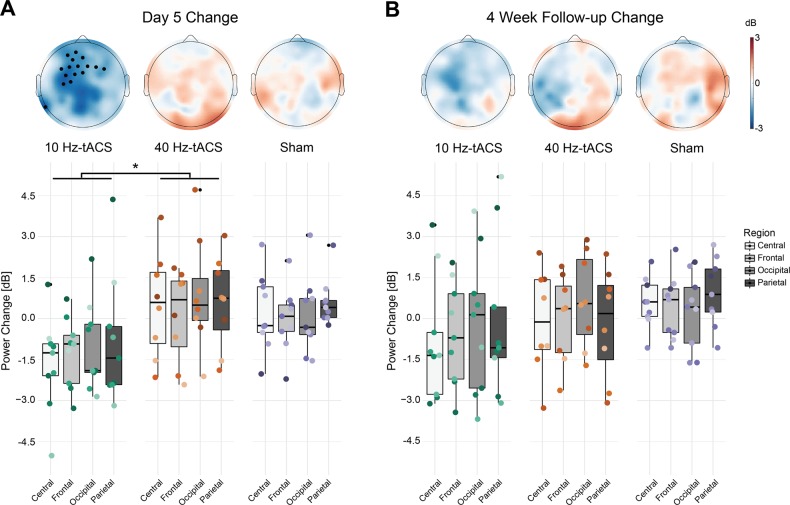
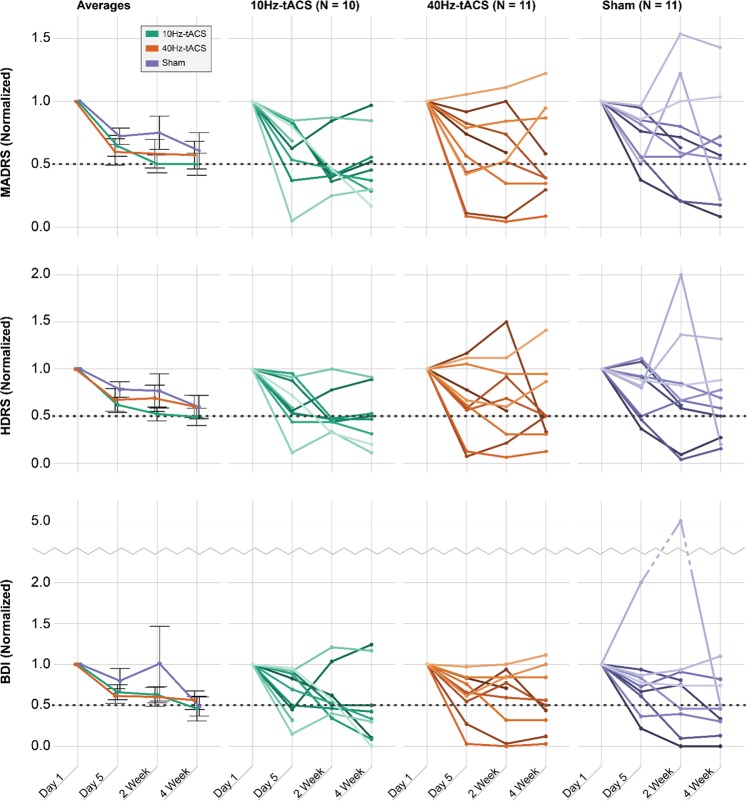
Major depressive disorder (MDD) is one of the most common psychiatric disorders, but pharmacological treatments are ineffective in a substantial fraction of patients and are accompanied by unwanted side effects. Here we evaluated the feasibility and efficacy of transcranial alternating current stimulation (tACS) at 10 Hz, which we hypothesized would improve clinical symptoms by renormalizing alpha oscillations in the left dorsolateral prefrontal cortex (dlPFC). To this end, 32 participants with MDD were randomized to 1 of 3 arms and received daily 40 min sessions of either 10 Hz-tACS, 40 Hz-tACS, or active sham stimulation for 5 consecutive days. Symptom improvement was assessed using the Montgomery-Åsberg Depression Rating Scale (MADRS) as the primary outcome. High-density electroencephalograms (hdEEGs) were recorded to measure changes in alpha oscillations as the secondary outcome. For the primary outcome, we did not observe a significant interaction between treatment condition (10 Hz-tACS, 40 Hz-tACS, sham) and session (baseline to 4 weeks after completion of treatment); however, exploratory analyses show that 2 weeks after completion of the intervention, the 10 Hz-tACS group had more responders (MADRS and HDRS) compared with 40 Hz-tACS and sham groups (n = 30, p = 0.026). Concurrently, we found a significant reduction in alpha power over the left frontal regions in EEG after completion of the intervention for the group that received per-protocol 10 Hz-tACS (n = 26, p < 0.05). Our data suggest that targeting oscillations with tACS has potential as a therapeutic intervention for treatment of MDD.
Conflict of interest statement
F.F. is the lead inventor of an IP filed by UNC. The clinical studies performed in the Frohlich Lab have originally received a designation as conflict of interest with administrative considerations that was subsequently removed. F.F. is the founder, CSO, and majority owner of Pulvinar Neuro LLC. The company had no role in this study. F.F. is also an author under Elsevier and receives royalty payments. D.R.R. reports consulting fees, travel reimbursement, and stock options as a member of the Clinical Advisory Board of Sage Therapeutics. D.R.R. also received compensation as a member of the Editorial Board of Dialogues in Clinical Neurosciences (Servier). All other authors declare that they have no conflict of interest.
Figures
References
Publication types
MeSH terms
Grants and funding
LinkOut - more resources
Full Text Sources
Medical
