. 2019 Mar 5;9(1):3466.
doi: 10.1038/s41598-019-39683-4.

Inhibition of avian-origin influenza A(H7N9) virus by the novel cap-dependent endonuclease inhibitor baloxavir marboxil

Affiliations

Inhibition of avian-origin influenza A(H7N9) virus by the novel cap-dependent endonuclease inhibitor baloxavir marboxil

Keiichi Taniguchi et al. Sci Rep. .

Abstract

Human infections with avian-origin influenza A(H7N9) virus represent a serious threat to global health; however, treatment options are limited. Here, we show the inhibitory effects of baloxavir acid (BXA) and its prodrug baloxavir marboxil (BXM), a first-in-class cap-dependent endonuclease inhibitor, against A(H7N9), in vitro and in vivo. In cell culture, BXA at four nanomolar concentration achieved a 1.5-2.8 log reduction in virus titers of A(H7N9), including the NA-R292K mutant virus and highly pathogenic avian influenza viruses, whereas NA inhibitors or favipiravir required approximately 20-fold or higher concentrations to achieve the same levels of reduction. A(H7N9)-specific amino acid polymorphism at position 37, implicated in BXA binding to the PA endonuclease domain, did not impact on BXA susceptibility. In mice, oral administration of BXM at 5 and 50 mg/kg twice a day for 5 days completely protected from a lethal A/Anhui/1/2013 (H7N9) challenge, and reduced virus titers more than 2-3 log in the lungs. Furthermore, the potent therapeutic effects of BXM in mice were still observed when a higher virus dose was administered or treatment was delayed up to 48 hours post infection. These findings support further investigation of BXM for A(H7N9) treatment in humans.


Conflict of interest statement

The authors K.T., Y.A., H.N., S.T., T.N., M. Kawai., R.Y., A.S., T.S. and A.N. are employees of Shionogi & Co., Ltd. The authors K.M., M.O., Y.S. and H.K. were provided financial support from Shionogi & Co., Ltd. for the studies performed in the manuscript. The author M. Kobayashi. was an employee of Shionogi & Co., Ltd., and now declares no potential conflict of interest. All works reported here were financially supported by Shionogi & Co., Ltd..

Figures
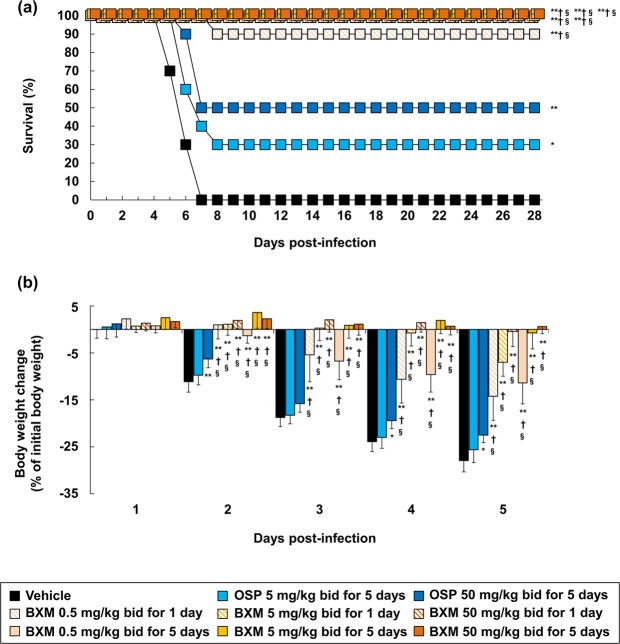
Figure 1
Figure 1
Therapeutic effects of BXM on survival and weight loss in a lethal infection model of mice infected with a low dose of the A(H7N9) virus. Mice were intranasally inoculated with 4.0 × 105 TCID50/mouse (10.4 MLD50) of A/Anhui/1/2013 (H7N9) viruses, and treatment was started immediately after virus inoculation (n = 10/group). Survival time (a) and body weight loss (b) were monitored through a 28-day period after the infection. bid (bis in die): twice a day. The log-rank test was applied for comparison of the survival time between each group (*p < 0.05, **p < 0.001 compared to vehicle, p < 0.01 compared to OSP at 5 mg/kg twice a day, §p < 0.05 compared to OSP at 50 mg/kg twice a day). Dunnett’s multiple-comparison method was applied for statistical analysis of body weight changes (*p < 0.01, **p < 0.001 compared to vehicle, p < 0.001 compared to OSP at 5 mg/kg twice a day, §p < 0.001 compared to OSP at 50 mg/kg twice a day). The body weights at 5 dpi were calculated from nine mice in vehicle-treated group because one of the ten mice showed more than 30% reduction and was euthanized.
Figure 2
Figure 2
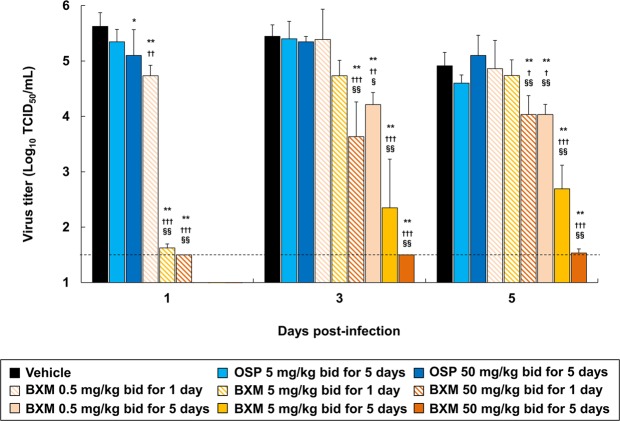
Inhibitory effect of BXM on virus titers in the lungs of mice infected with a low dose of the A(H7N9) virus. Mice were inoculated with 4.0 × 105 TCID50/mouse (10.4 MLD50) of A/Anhui/1/2013 (H7N9) virus and treatment was started immediately after virus inoculation (n = 5/group). The virus titers (TCID50) in lungs of mice at 1, 3 and 5 dpi were measured in MDCK cells. The lower limit of quantification of the virus titer is indicated by a dotted line (1.5 Log10 TCID50/mL). Dunnett’s multiple-comparison method was conducted for statistical comparison (*p < 0.05, **p < 0.001 compared to vehicle, p < 0.05, ††p < 0.01, †††p < 0.001 compared to OSP at 5 mg/kg twice a day, §p < 0.01, §§p < 0.001 compared to OSP at 50 mg/kg twice a day).
Figure 3
Figure 3
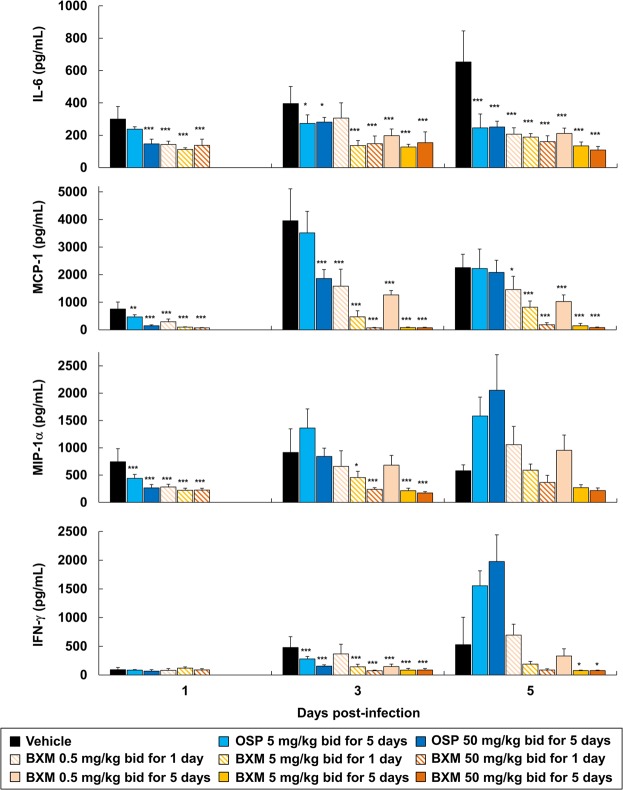
Suppressive effects of BXM on proinflammatory cytokine and chemokine production in the lungs of mice infected with a low dose of the A(H7N9) virus. Mice were intranasally infected with 4.0 × 105 TCID50/mouse (10.4 MLD50) of A/Anhui/1/2013 (H7N9) virus, and treatment was started immediately after virus inoculation (n = 5/group). The proinflammatory cytokines and chemokines, IL-6, MCP-1, MIP-1α and IFN-γ, in the lungs at 1, 3 and 5 dpi were quantified. Dunnett’s multiple-comparison method was employed for the comparison (*p < 0.05, **p < 0.01, ***p < 0.001 compared to vehicle).
Figure 4
Figure 4
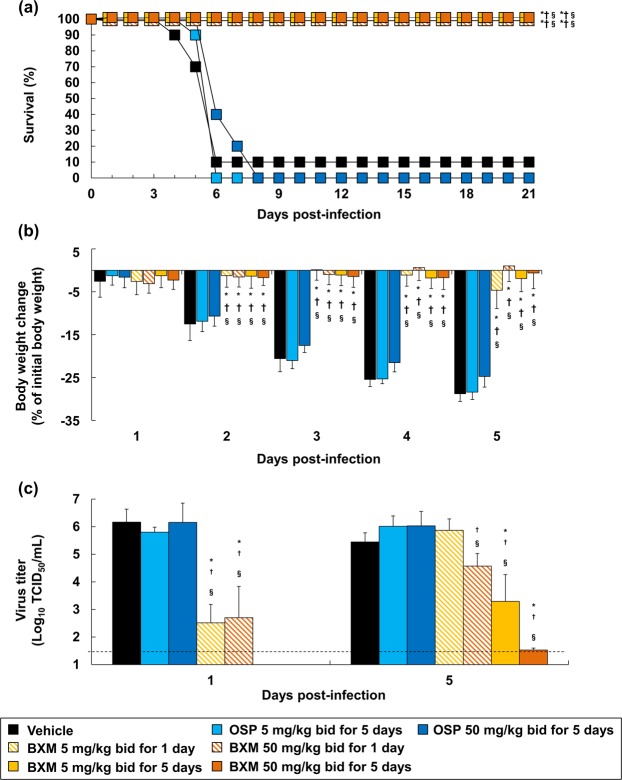
Effects of BXM on survival, weight loss and virus titers in the lungs in mice infected with a high dose of the A(H7N9) virus. Mice intranasally infected with 1.2 × 106 TCID50/mouse (31.1 MLD50) of A/Anhui/1/2013 (H7N9) virus were administrated with treatment started immediately after virus inoculation, and survival time (a) and body weight loss (b) were analyzed. The log-rank test was applied for survival time (*p < 0.001 compared to vehicle, p < 0.001 compared to OSP at 5 mg/kg twice a day, §p < 0.001 compared to OSP at 50 mg/kg twice a day). Dunnett’s multiple-comparison method was employed for body weight changes (*p < 0.001 compared to vehicle, p < 0.001 compared to OSP at 5 mg/kg twice a day, §p < 0.001 compared to OSP at 50 mg/kg twice a day). Body weights at 4 and 5 dpi were calculated from nine mice because one of the ten mice in vehicle-treated group showed more than 30% reduction and was euthanized. (c) The virus titers (TCID50) in the lungs of mice at 1 and 5 dpi were measured. The lower limit of quantification of the virus titer is indicated by a dotted line (1.5 Log10 TCID50/mL). Dunnett’s multiple-comparison method was applied for the comparison (*p < 0.05, **p < 0.001 compared to vehicle, p < 0.05, ††p < 0.01, †††p < 0.001 compared to OSP at 5 mg/kg twice a day, §p < 0.01, §§p < 0.001 compared to OSP at 50 mg/kg twice a day).
Figure 5
Figure 5
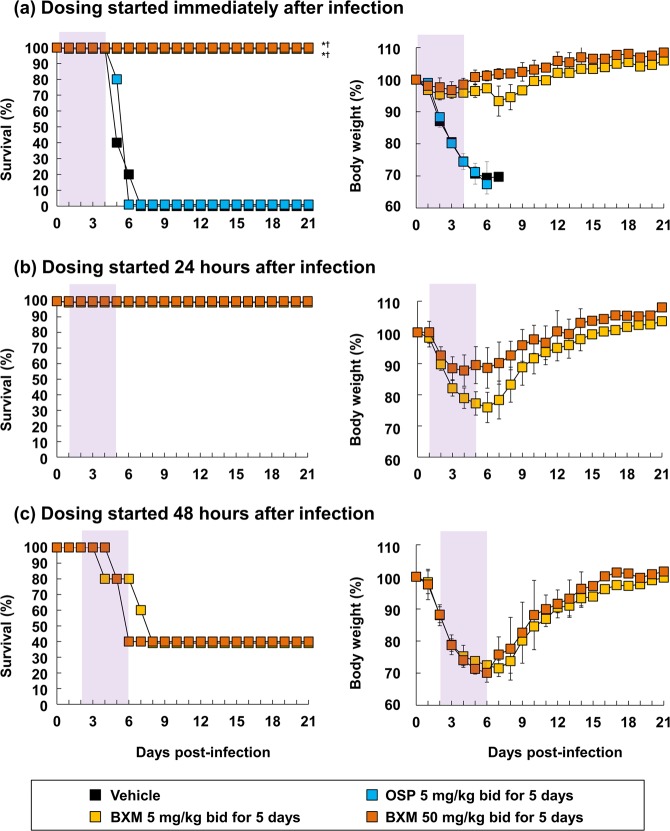
Effects of delayed treatment of BXM on a low dose of A(H7N9) infection. Mice were intranasally inoculated with 4.0 × 105 TCID50/mouse (10.4 MLD50) of A/Anhui/1/2013 (H7N9) viruses, and BXM treatment was started at (a) immediately, (b) 24 or (c) 48 hours after virus inoculation (n = 5/group). Vehicle or OSP treatment was started immediately after virus inoculation (n = 5/group). Survival time and body weight loss were monitored through a 21-day period after the infection. The shaded area represents the treatment period. The log-rank test was applied for comparison of the survival time between each group (*p < 0.01 compared to vehicle, p < 0.01 compared to OSP at 5 mg/kg twice a day).

References

    1. Taubenberger JK, Morens DM. Influenza: the once and future pandemic. Public Health Rep. 2010;125:16–26. doi: 10.1177/00333549101250S305. - DOI - PMC - PubMed
    1. Su S, et al. Epidemiology, Evolution, and Pathogenesis of H7N9 Influenza Viruses in Five Epidemic Waves since 2013 in China. Trends Microbiol. 2017;25:713–728. doi: 10.1016/j.tim.2017.06.008. - DOI - PubMed
    1. Gao R, et al. Human infection with a novel avian-origin influenza A (H7N9) virus. N. Engl. J. Med. 2013;368:1888–97. doi: 10.1056/NEJMoa1304459. - DOI - PubMed
    1. Zaraket H, et al. Mammalian adaptation of influenza A(H7N9) virus is limited by a narrow genetic bottleneck. Nat. Commun. 2015;6:1–10. doi: 10.1038/ncomms7553. - DOI - PMC - PubMed
    1. Watanabe T, et al. Characterization of H7N9 influenza A viruses isolated from humans. Nature. 2013;501:551–555. doi: 10.1038/nature12392. - DOI - PMC - PubMed

Publication types

MeSH terms