Review
. 2019 Feb 19:10:122.
doi: 10.3389/fneur.2019.00122. eCollection 2019.

Inflammation, Infectious Triggers, and Parkinson's Disease

Affiliations
Review

Inflammation, Infectious Triggers, and Parkinson's Disease

Elisa Caggiu et al. Front Neurol. .

Abstract

Parkinson's disease is a neurodegenerative disorder characterized by progressive loss of dopaminergic neurons of the substantia nigra pars compacta with a reduction of dopamine concentration in the striatum. The complex interaction between genetic and environmental factors seems to play a role in determining susceptibility to PD and may explain the heterogeneity observed in clinical presentations. The exact etiology is not yet clear, but different possible causes have been identified. Inflammation has been increasingly studied as part of the pathophysiology of neurodegenerative diseases, corroborating the hypothesis that the immune system may be the nexus between environmental and genetic factors, and the abnormal immune function can lead to disease. In this review we report the different aspects of inflammation and immune system in Parkinson's disease, with particular interest in the possible role played by immune dysfunctions in PD, with focus on autoimmunity and processes involving infectious agents as a trigger and alpha-synuclein protein (α-syn).

Keywords: Parkinson's disease; alpha-synuclein; autoantibodies; autoimmunity; immune system; microglia activation; neurodegenerative disease; neuroinflammation.


Figures
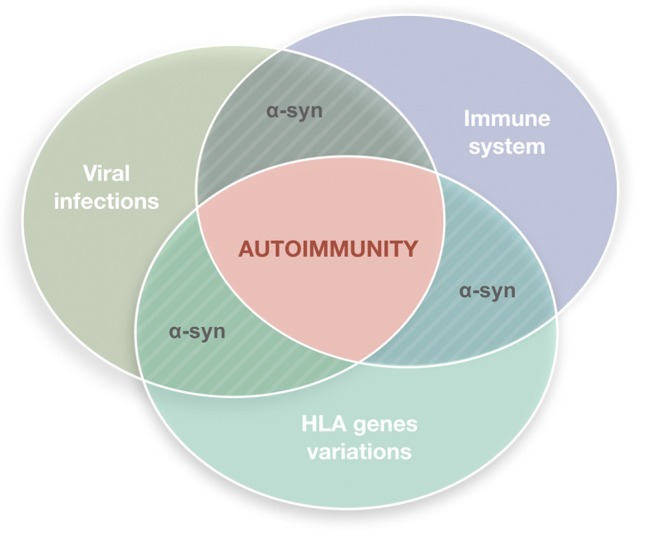
Figure 1
Figure 1
Autoimmune dysfunction in the etiology of Parkinson's disease (PD). The etiology of PD is multifactorial. It has been hypothesized that inflammation may underly the neurodegenerative process, with the immune system playing a key role. Viral infections are plausible triggers able to stimulate the immune system in genetically susceptible individuals inducing reactions that lead to autoimmune responses.
Figure 2
Figure 2
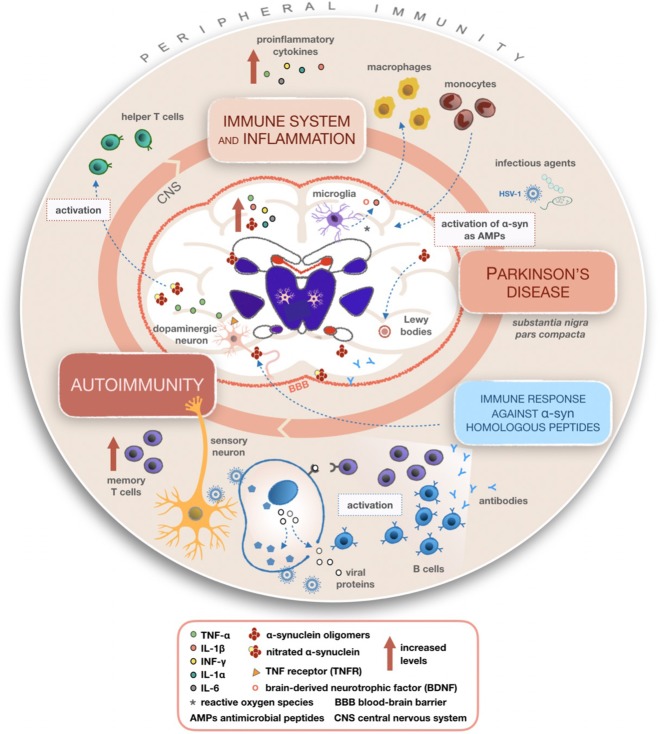
Mechanisms summarizing the involvement of inflammatory and immune processes in Parkinson's disease (PD). Once activated, microglial cells produce cytokines able to recruit macrophages and monocytes from peripheral compartments to the CNS, leading to altered peripheral immunity and various inflammatory processes within the CNS in PD patients. A possible mechanism of action giving rise to autoimmunity involves the reactivation of latent HSV-1 on infected sensory neurons and production of antibodies targeting alpha-synuclein (α-syn) fragments homologous to viral proteins. It is plausible that α-syn acting as an AMP becomes dysregulated during recurring infections with its consequent accumulation in the CNS.

References

    1. Kalia LV, Lang AE. Parkinson's disease. Lancet. (2015) 386:896–912. 10.1016/S0140-6736(14)61393-3 - DOI - PubMed
    1. Amor S, Woodroofe MN. Innate and adaptive immune responses in neurodegeneration and repair. Immunology (2014) 141:287–91. 10.1111/imm.12134 - DOI - PMC - PubMed
    1. Cardoso V, Chesné J, Ribeiro H, Garcia-Cassani B, Carvalho T, Bouchery T, et al. . Neuronal regulation of type 2 innate lymphoid cells via neuromedin U. Nature (2017) 549:277–81. 10.1038/nature23469 - DOI - PMC - PubMed
    1. Kipnis J. Multifaceted interactions between adaptive immunity and the central nervous system. Science (2016) 353:766–71. 10.1126/science.aag2638 - DOI - PMC - PubMed
    1. Steinman L. Elaborate interactions between the immune and nervous systems. Nat Immunol. (2004) 5:575–81. 10.1038/ni1078 - DOI - PubMed