


Impact of Tumor Location and Variables Associated With Overall Survival in Patients With Colorectal Cancer: A Mayo Clinic Colon and Rectal Cancer Registry Study
- PMID: 30838175
- PMCID: PMC6389639
- DOI: 10.3389/fonc.2019.00076
Impact of Tumor Location and Variables Associated With Overall Survival in Patients With Colorectal Cancer: A Mayo Clinic Colon and Rectal Cancer Registry Study
Abstract
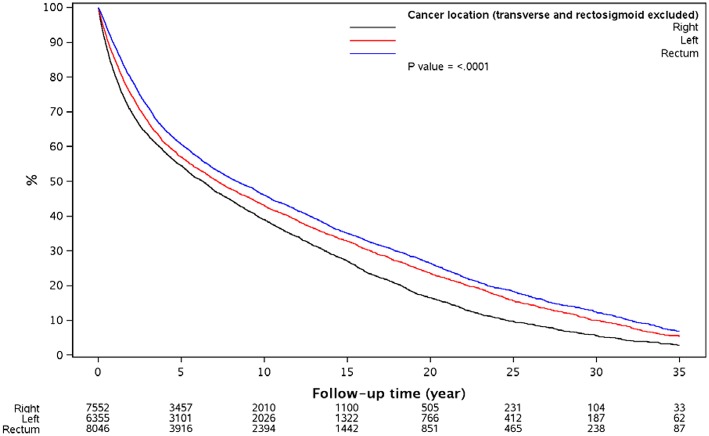
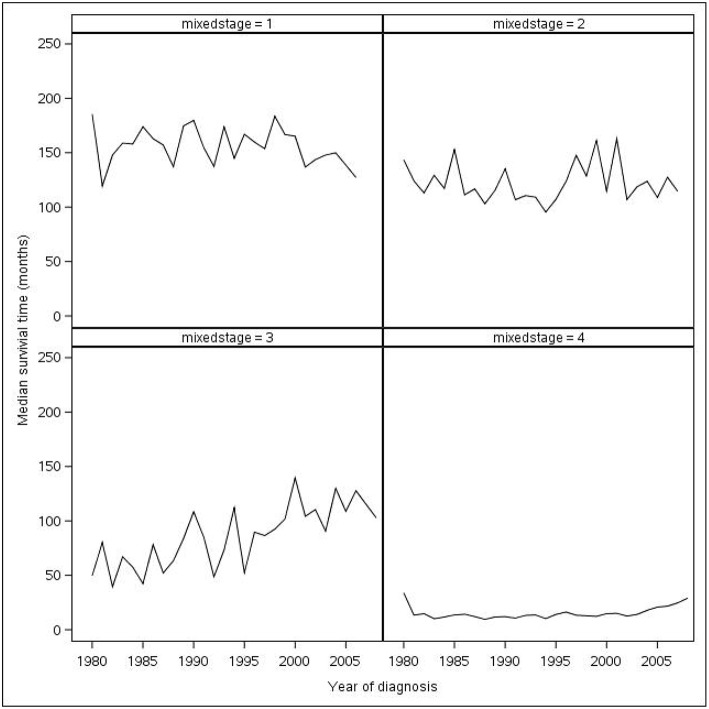
Background: Our study investigated the demographic characteristics of Mayo Clinic Colon and Rectal Cancer Registry patients and sought to associate tumor location with overall survival. Methods: Using the cohort of patients seen at Mayo Clinic (Minnesota, Arizona, Florida) from 1972 to 2017, we obtained 26,908 colorectal adenocarcinoma patient records. Overall survival of patients with colorectal cancer was analyzed by sidedness (right vs. left) and location (right vs. left vs. rectum). Kaplan-Meier method was used to analyze all demographic and cancer variables available within the dataset to trace survival over a 35-year period. Subgroups within variables were compared to each other using log-rank test and considered significantly different at P < 0.05. Cox proportional hazards regression model was used to assess impact of tumor location while controlling for age, year of diagnosis, sex, tumor stage, and tumor grade. Cox regression models were used to evaluate the independent effect of cancer location on overall survival after adjusting for age, gender, year of diagnosis, and cancer stage. To further explore the potential interaction effect of cancer location with cancer stage and year of diagnosis, similar multivariable Cox model was fit stratified by cancer stage (1-3 vs. 4) and by year of diagnosis (<1980, 1980-2000, >2000). Results: Overall survival differed significantly within all variables studied after Kaplan-Meier method analysis (P < 0.0001). Survival was higher in the left-side group when evaluated by tumor sidedness, and rectal cancer patients had the highest median survival (101.3 months). Right-sided cancer patients had the worst prognosis in both tumor location and sidedness analyses, with a median survival of 76.6 months. However, the stratified analysis showed that, the difference in survival between left- and right-sided cancer only existed in late cancer stage (stage 4) patients but not in early cancer stage; therefore, screening for CRC to pick cancer at an early stage can influence overall survival significantly. Conclusion: These observations confirm some of the previous and recent studies on sidedness of colorectal cancer patients. Our analysis is novel in that it included patients of all stages rather than just stage IV metastatic patients. This initial study provides a platform to investigate more biologic and clinical factors associated with tumor location. Merging this dataset with other available datasets and previously conducted studies within the institution will provide a robust platform for multiple future studies and collaborations. Finally, appropriate screening can result in a decrease in incidence and mortality of CRC.
Keywords: colorectal cancer; survival; tumor heterogeneity; tumor location; tumor sidedness.
Figures
References
-
- Sadler TW, Langman J. Langman's Medical Embryology. Philadelphia, PA: : Wolters Kluwer Health, Lippincott Williams & Wilkins; (2012).
-
- Moretto R, Cremolini C, Rossini D, Pietrantonio F, Battaglin F, Mennitto A, et al. Location of primary tumor and benefit from anti-epidermal growth factor receptor monoclonal antibodies in patients with RAS and BRAF wild-type metastatic colorectal cancer. Oncologist (2016) 21:988–94. 10.1634/theoncologist.2016-0084 - DOI - PMC - PubMed
LinkOut - more resources
Full Text Sources
