Lower limb muscle strength in patients with low back pain: a systematic review and meta-analysis
- PMID: 30839305
- PMCID: PMC6454257
Lower limb muscle strength in patients with low back pain: a systematic review and meta-analysis
Abstract
Objective: To systematically review the published studies that compare lower limb muscle strength in patients with low back pain to matched healthy controls.
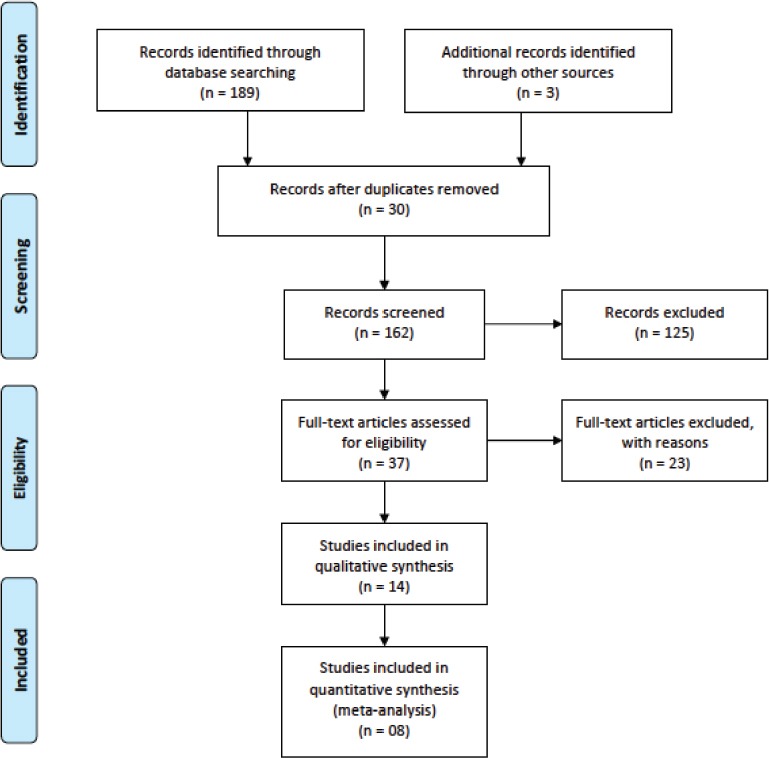
Methods: We searched Medline, SciELO, Cumulative Index to Nursing and Allied Health (CINAHL), and Scopus up until December 2017. Studies comparing lower limb muscle strength in people diagnosed with low back pain to healthy control participants were included in the systematic review.
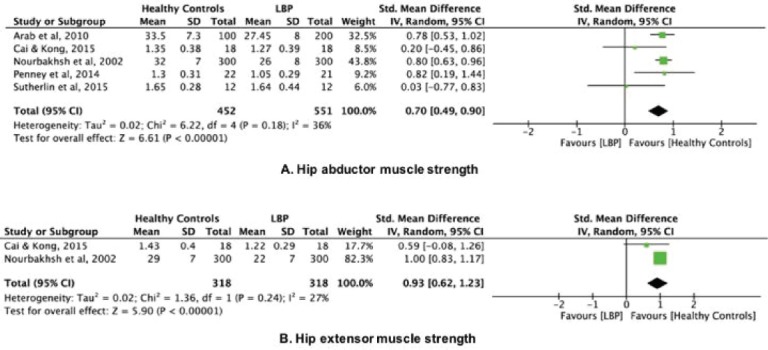
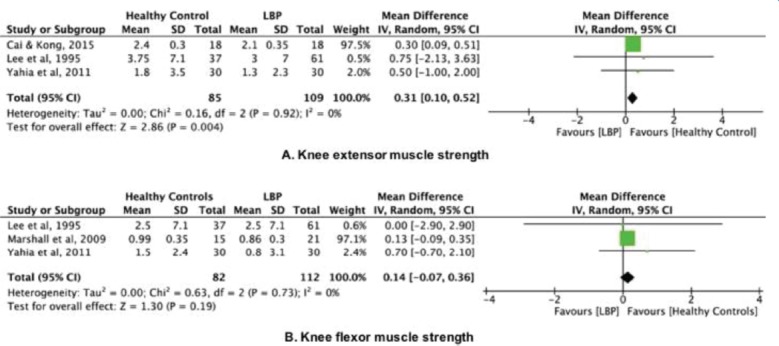
Results: 14 studies, which included 951 healthy controls and 919 patients with low back pain, fulfilled the inclusion criteria. Meta-analysis revealed a lower muscle strength of hip abductor/extensors and knee extensors in patients with low back pain in comparison to healthy controls. The average strength of hip abductors (Five studies, SMD=0.7 95% CI: 0.49 to 0.9) and hip extensors (Two studies, SMD=0.93, 95% CI: 0.62 to 1.23) was significantly lower in patients with low back pain compared to that of healthy controls. Knee extensor muscle strength was significantly lower in patients with low back pain compared to healthy controls (Three studies, WMD=0.31 Nm/kg, 95% CI: 0.1 to 0.5). The meta-analysis indicated a no significant difference in knee flexor muscle strength in patients with low back pain compared to healthy controls.
Conclusions: Lower limb muscle is impaired in patients with low back pain.
Conflict of interest statement
This study was supported in part by the Fundo de Amparo à Pesquisa do Estado de São Paulo (FAPESP). The authors have no conflict of interest.
Figures
References
-
- Panjabi MM. The stabilizing system of the Spine. Part 1. Function, Dysfunction, Adaptation, and Enhancement. Journal of Spinal Disorders. 1992;5(4):383–389. - PubMed
-
- Nadler SF, Wu KD, Galski T, Feinberg JH. Low back pain in college athletes:a prospective study correlating lower extremity overuse or acquired ligamentous laxity with low back pain. Spine. 1998;23:828–833. - PubMed
-
- Vanti C, Conti C, Faresin F, Ferrari S, Piccarreta R. The Relationship Between Clinical Instability and Endurance Tests, Pain, and Disability in Nonspecific Low Back Pain. J Manipulative Physiol Ther. 2016;39(5):359–68. - PubMed
-
- Hodges PW, Richardson CA. Inefficient muscular stabilization of the lumbar spine associated with low back pain:A motor control evaluation of transversus abdominus. Spine. 1996;21:2640–2650. - PubMed