Assessment of Quality of Life and Treatment Outcomes of Patients With Persistent Postchemotherapy Alopecia
- PMID: 30840033
- PMCID: PMC6563563
- DOI: 10.1001/jamadermatol.2018.5071
Assessment of Quality of Life and Treatment Outcomes of Patients With Persistent Postchemotherapy Alopecia
Erratum in
-
Missing Conflict of Interest Disclosure.JAMA Dermatol. 2019 Jun 1;155(6):757. doi: 10.1001/jamadermatol.2019.0673. JAMA Dermatol. 2019. PMID: 30969343 Free PMC article. No abstract available.
Abstract
Importance: Persistent alopecia occurs in a subset of patients undergoing chemotherapy, yet the quality of life (QOL) of these patients and their response to therapy have not been described in a large patient cohort.
Objective: To characterize the clinical presentation of patients with persistent chemotherapy-induced alopecia (pCIA) or endocrine therapy-induced alopecia after chemotherapy (EIAC) and their QOL and treatment outcomes.
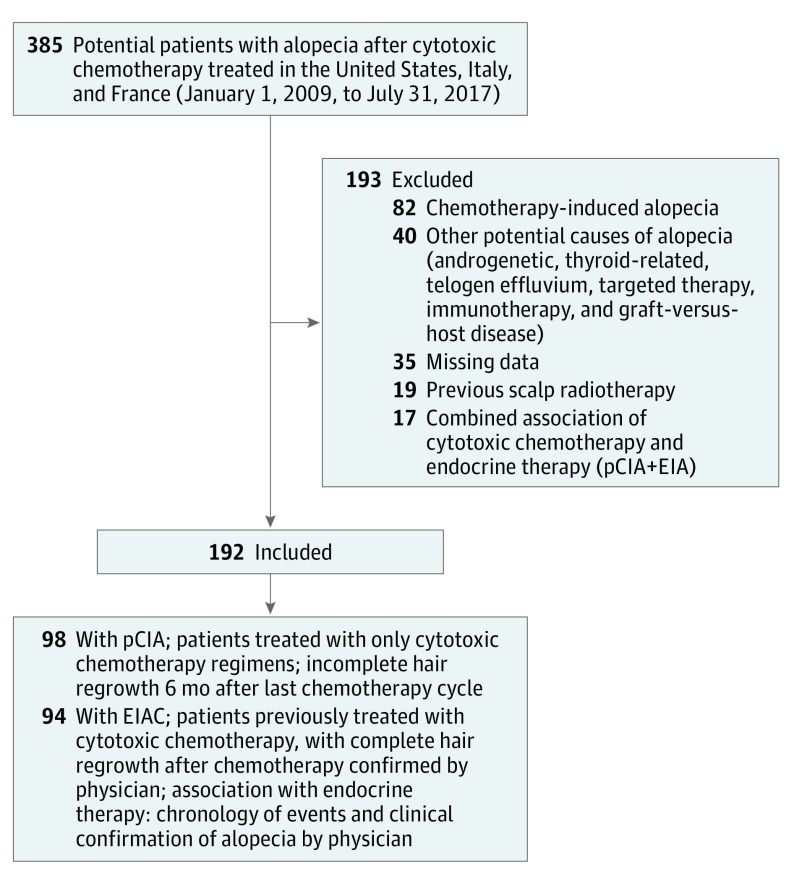
Design, setting, and participants: A retrospective multicenter cohort of 192 women with cancer treated with cytotoxic agents who received a clinical diagnosis of persistent alopecia (98 with pCIA and 94 with EIAC) between January 1, 2009, and July 31, 2017, was analyzed. All patients were from the dermatology service in 2 comprehensive cancer centers and 1 tertiary-care hospital. Data on demographics, chemotherapy regimens, severity, clinical patterns, and response to hair-growth promoting agents were assessed. Data from the Hairdex questionnaire were used to assess the QOL of patients with alopecia.
Main outcomes and measures: The clinical presentation, response to dermatologic therapy, and QOL of patients with pCIA were assessed and compared with those of patients with EIAC.
Results: A total of 98 women with pCIA (median age, 56.5 years [range, 18-83 years]) and 94 women with EIAC (median age, 56 years [range, 29-84 years]) were included. The most common agents associated with pCIA were taxanes for 80 patients (82%); the most common agents associated with EIAC were aromatase inhibitors for 58 patients (62%). Diffuse alopecia was predominant in patients with pCIA compared with patients with EIAC (31 of 75 [41%] vs 23 of 92 [25%]; P = .04), with greater severity (Common Terminology Criteria for Adverse Events, version 4.0, grade 2) among patients with pCIA (29 of 75 [39%] vs 12 of 92 [13%]; P < .001). A negative emotional effect was reported by both groups. After treatment with topical minoxidil or spironolactone, moderate to significant improvement was observed for 36 of 54 patients with pCIA (67%) and for 32 of 42 patients with EIAC (76%).
Conclusions and relevance: Persistent chemotherapy-induced alopecia is frequently more severe and diffuse when compared with EIAC, and both groups of patients experienced a negative effect. A modest benefit was observed with dermatologic therapy. Additional studies are warranted to develop effective strategies for prevention and effective therapy for pCIA and EIAC.
Conflict of interest statement
Figures
References
-
- Freites-Martinez A, Shapiro J, van den Hurk C, et al. CME part 2: hair disorders in cancer survivors: persistent chemotherapy-induced alopecia, persistent radiotherapy-induced alopecia, and hair growth disorders related to endocrine therapy or cancer surgery [published online April 13, 2018]. J Am Acad Dermatol. doi: 10.1016/j.jaad.2018.03.056 - DOI - PMC - PubMed
-
- Kang D, Kim I-R, Lee D-Y, et al. Incidence of permanent chemotherapy-induced alopecia among breast cancer patients: a five-year prospective cohort study. Ann Oncol. 2017;28(suppl_10):mdx655.022. doi: 10.1093/annonc/mdx655.022 - DOI
-
- Fonia A, Cota C, Setterfield JF, Goldberg LJ, Fenton DA, Stefanato CM. Permanent alopecia in patients with breast cancer after taxane chemotherapy and adjuvant hormonal therapy: clinicopathologic findings in a cohort of 10 patients. J Am Acad Dermatol. 2017;76(5):948-957. doi: 10.1016/j.jaad.2016.12.027 - DOI - PubMed