


Initial Assessment of Post-traumatic Stress in a US Cohort of Inflammatory Bowel Disease Patients
- PMID: 30840762
- PMCID: PMC7534390
- DOI: 10.1093/ibd/izz032
Initial Assessment of Post-traumatic Stress in a US Cohort of Inflammatory Bowel Disease Patients
Abstract
Background: Post-traumatic stress (PTS), or the psycho-physiological response to a traumatic or life-threatening event, is implicated in medical patient outcomes. Emerging evidence suggests a complex relationship between PTS, the brain-gut axis, the gut microbiome, and immune function. Inflammatory bowel disease (IBD) may be susceptible to PTS and its subsequent impacts. To date, no study has evaluated PTS in IBD in the United States.
Methods: Adult patients with IBD were recruited from an outpatient gastroenterology practice, via social media, and via a research recruitment website. Patients with irritable bowel syndrome (IBS) were recruited as a comparison group. Participants completed demographic and disease information, surgical and hospitalization history, and the PTSD Checklist-Civilian Version (PCL-C). Statistical analyses evaluated rates of PTS in IBD and IBS, including differences between groups for PTS severity. Regression analyses determined potential predictors of PTS.
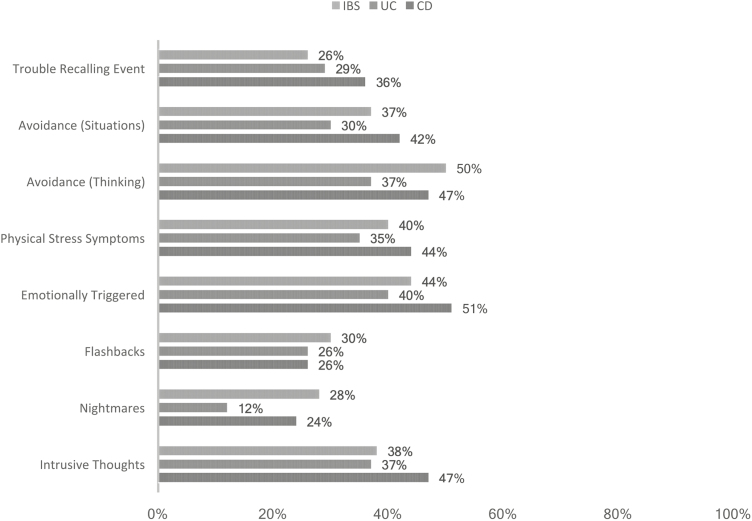
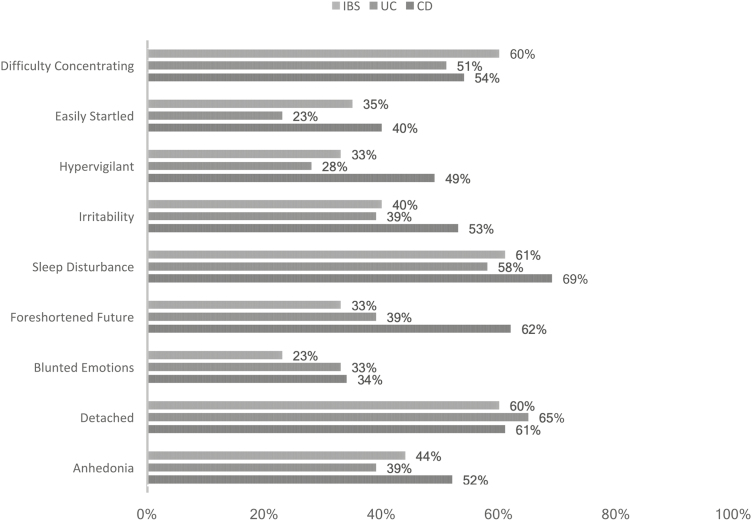
Results: One hundred eighty-eight participants (131 IBD, 57 IBS) completed the study. Thirty-two percent of IBD and 26% of IBS patients met the criteria for significant PTS symptoms based on PCL-C cutoffs. Inflammatory bowel disease patients are more likely to attribute PTS to their disease than IBS patients. Crohn's disease (CD) patients appear to be the most likely to experience PTS, including those being hospitalized or undergoing ileostomy surgery. Symptom severity is the greatest predictor of PTS for ulcerative colitis and IBS.
Conclusions: Although PTS is relevant in both IBS and IBD, IBD patients are seemingly more susceptible to PTS due their disease experiences, especially CD patients. The nature of PTS symptoms may contribute to IBD disease processes, most notably through sleep disturbance and ANS arousal. Clinicians should assess for PTS in IBD patients as standard of care, especially after a hospitalization or surgery.
Keywords: PTSD; inflammatory bowel disease; post-traumatic stress.
© 2019 Crohn’s & Colitis Foundation. Published by Oxford University Press. All rights reserved. For permissions, please e-mail: journals.permissions@oup.com.
Figures
References
-
- Neuendorf R, Harding A, Stello N, et al. Depression and anxiety in patients with inflammatory bowel disease: a systematic review. J Psychosom Res. 2016;87:70–80. - PubMed
-
- Knowles SR, Graff LA, Wilding H, et al. Quality of life in inflammatory bowel disease: a systematic review and meta-analyses-part I. Inflamm Bowel Dis. 2018;24:742–751. - PubMed
-
- Knowles SR, Keefer L, Wilding H, et al. Quality of life in inflammatory bowel disease: a systematic review and meta-analyses-part II. Inflamm Bowel Dis. 2018;24:966–976. - PubMed
Publication types
MeSH terms
Grants and funding
LinkOut - more resources
Full Text Sources
Other Literature Sources
Medical
Miscellaneous
