Cup-Shaped Tooth Wear Defects: More than Erosive Challenges?
- PMID: 30840963
- PMCID: PMC7050669
- DOI: 10.1159/000496983
Cup-Shaped Tooth Wear Defects: More than Erosive Challenges?
Abstract
Background/aim: The underlying mechanism of the development of cups and grooves on occlusal tooth surfaces is still unclear. The aim of this study was to evaluate factors contributing to in vitro cup formation, in order to elucidate the clinical process.
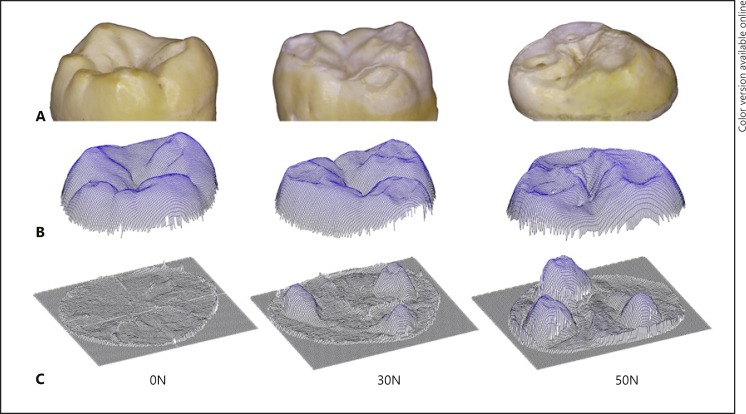
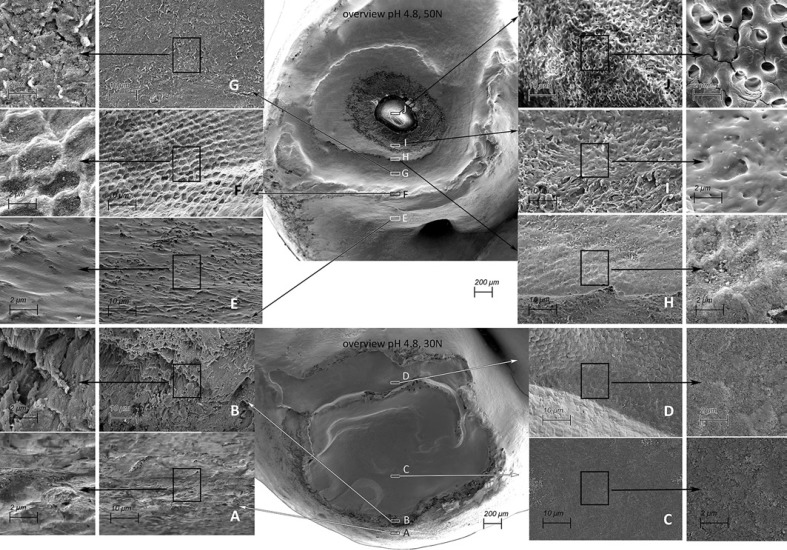
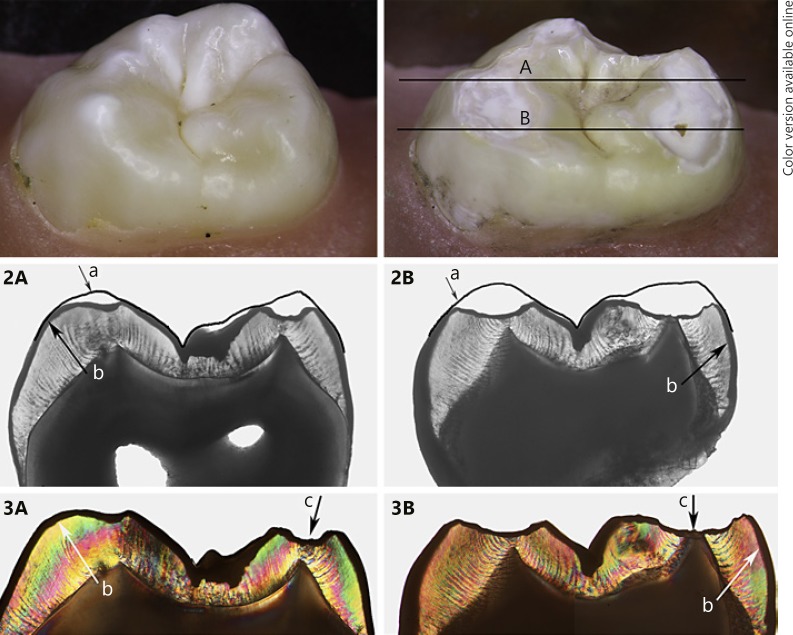
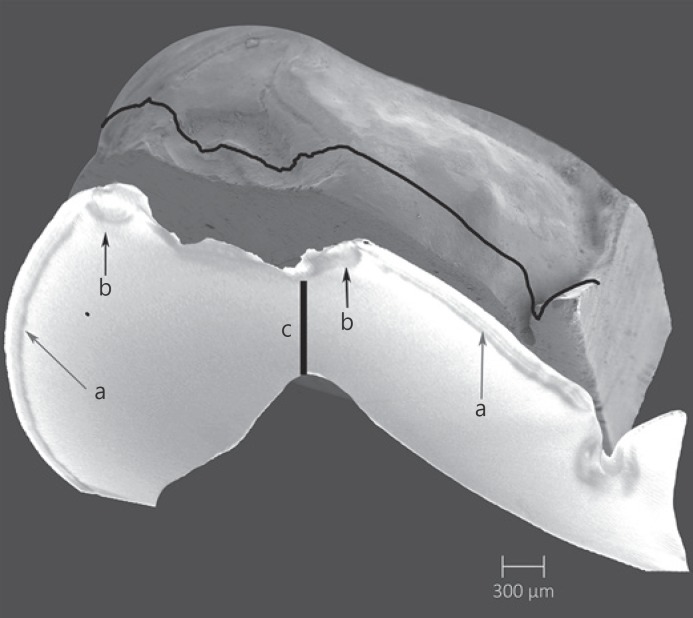
Methods: A total of 48 extracted human molar teeth were exposed to acidic aqueous solutions at pH of 4.8 and 5.5 in constant motion, in combination with different loading conditions: no load (0N group, control), 30 N (30N group) or 50 N (50N group) (n = 8 per group). Before and after 3 months of exposure (1,422,000 loading cycles), the samples were scanned using a non-contact profilometer. Pre- and post-exposure scans were subtracted and height loss and volume tissue loss were calculated. Representative samples with wear and cupping lesions were imaged using scanning electron microscopy, light microscopy and micro-computed tomography.
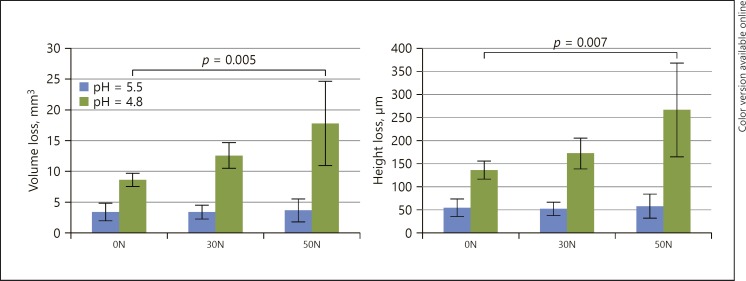
Results: Average height and volume tissue loss at pH 5.5 was 54 µm and 3.4 mm3 (0N), 52 µm and 3.4 mm3 (30N) and 58 µm and 3.7 mm3 (50N), respectively, with no statistically significant differences. Average height and volume loss at pH 4.8 were 135 µm and 8.7 mm3 (0N), 172 µm and 12.6 mm3 (30N) and 266 µm and 17.8 mm3 (50N), respectively, with a statistically significant difference between 0N and 50N (p < 0.002). Cup-shaped lesions had formed only at pH of 4.8, in the 30N and 50N groups.
Conclusion: The study showed that a cup can arise fully in enamel and that mechanical loading in addition to erosive challenges are required.
Keywords: Bite force; Profilometry; Tooth abrasion; Tooth erosion; Tooth wear.
© 2019 S. Karger AG, Basel.
Conflict of interest statement
The authors have no conflicts of interest to declare. They received no funding relevant to this study.
Figures
References
-
- Abrahamsen TC. The worn dentition—pathognomonic patterns of abrasion and erosion. Int Dent J. 2005;55((4 Suppl 1)):268–76. - PubMed
-
- Dawes C. What is the critical pH and why does a tooth dissolve in acid? J Can Dent Assoc. 2003 Dec;69((11)):722–4. - PubMed
-
- De Medeiros RC, Soares JD, De Sousa FB. Natural enamel caries in polarized light microscopy: differences in histopathological features derived from a qualitative versus a quantitative approach to interpret enamel birefringence. J Microsc. 2012 May;246((2)):177–89. - PubMed
-
- Eisenburger M, Addy M. Erosion and attrition of human enamel in vitro part I: interaction effects. J Dent. 2002 Sep-Nov;30((7-8)):341–7. - PubMed