Review
. 2019 Mar 5;7(3):70.
doi: 10.3390/microorganisms7030070.

MmpL Proteins in Physiology and Pathogenesis of M. tuberculosis

Affiliations
Review

MmpL Proteins in Physiology and Pathogenesis of M. tuberculosis

Geoff Melly et al. Microorganisms. .

Abstract

Mycobacterium tuberculosis (Mtb) remains an important human pathogen. The Mtb cell envelope is a critical bacterial structure that contributes to virulence and pathogenicity. Mycobacterial membrane protein large (MmpL) proteins export bulky, hydrophobic substrates that are essential for the unique structure of the cell envelope and directly support the ability of Mtb to infect and persist in the host. This review summarizes recent investigations that have enabled insight into the molecular mechanisms underlying MmpL substrate export and the role that these substrates play during Mtb infection.

Keywords: MmpL; Mycobacterium tuberculosis; cell envelope; lipid transport; lipids.


Conflict of interest statement

The authors declare no conflict of interest.

Figures
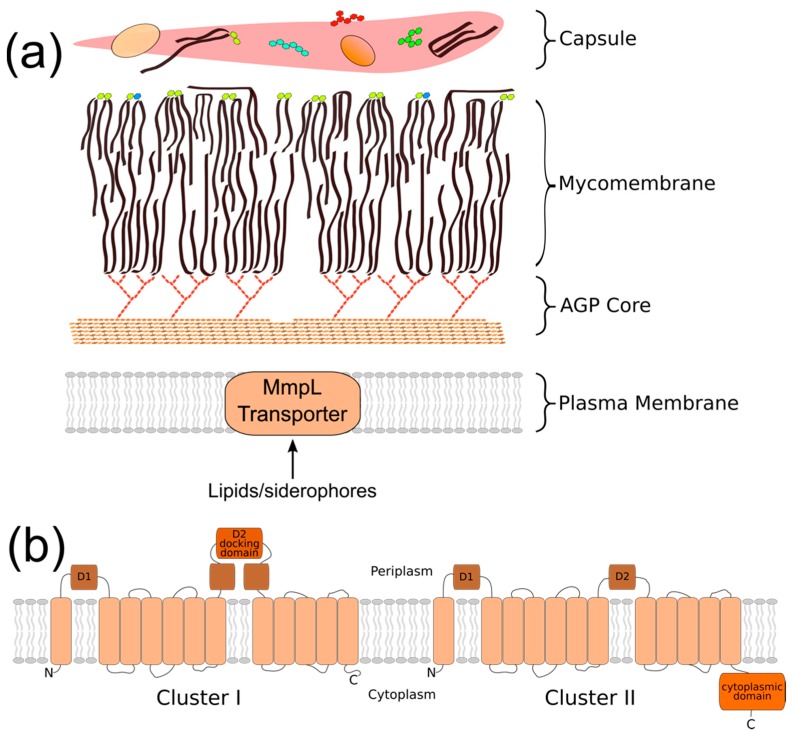
Figure 1
Figure 1
Mycobacterial membrane protein large (MmpL) proteins are topologically complex membrane proteins that export cell envelope components across the plasma membrane. (a) Cartoon representation of the mycobacterial cell envelope; (b) M. tuberculosis (Mtb) MmpL can be classified into two clusters based on the complexity of the D2 periplasmic domain and the presence of a cytoplasmic C-terminal domain. Cluster I = MmpL1/2/4/5/6/7/8/9/10/12; cluster II = MmpL3/11/13a/b.
Figure 2
Figure 2
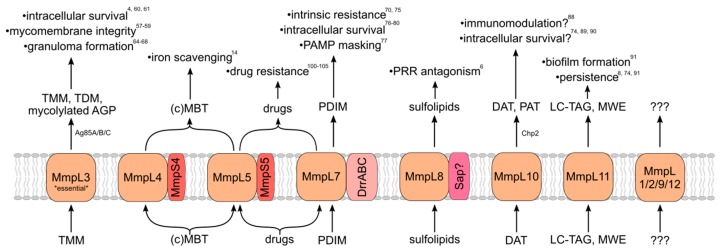
MmpL transporters export substrates that are important for virulence and pathogenicity. MmpL proteins and membrane-associated transport partners, exported substrates, and contributions to virulence/pathogenicity of the mature exported substrates. TMM/TDM—trehalose mono/di-mycolate; AGP—arabinogalactan/peptidoglycan complex; (c)MBT—(carboxy)mycobactin; PDIM—phthiocerol dimycocerosate; PAMP—pathogen-associated molecular pattern; PRR—pattern recognition receptor; DAT/PAT—di/poly-acyl trehalose; LC-TAG—long-chain triacylglycerol; and MWE—mycolate wax ester.

References

    1. Chiaradia L., Lefebvre C., Parra J., Marcoux J., Burlet-Schiltz O., Etienne G., Tropis M., Daffe M. Dissecting the mycobacterial cell envelope and defining the composition of the native mycomembrane. Sci. Rep. 2017;7:12807. doi: 10.1038/s41598-017-12718-4. - DOI - PMC - PubMed
    1. Brennan P.J., Nikaido H. The Envelope of Mycobacteria. Annu. Rev. Biochem. 1995;64:29–63. doi: 10.1146/annurev.bi.64.070195.000333. - DOI - PubMed
    1. Indrigo J. Cord factor trehalose 6,6’-dimycolate (TDM) mediates trafficking events during mycobacterial infection of murine macrophages. Microbiology. 2003;149:2049–2059. doi: 10.1099/mic.0.26226-0. - DOI - PubMed
    1. Patin E.C., Geffken A.C., Willcocks S., Leschczyk C., Haas A., Nimmerjahn F., Lang R., Ward T.H., Schaible U.E. Trehalose dimycolate interferes with FcγR-mediated phagosome maturation through Mincle, SHP-1 and FcγRIIB signalling. PLoS ONE. 2017;12:e0174973. doi: 10.1371/journal.pone.0174973. - DOI - PMC - PubMed
    1. Vergne I., Chua J., Lee H.-H., Lucas M., Belisle J., Deretic V. Mechanism of phagolysosome biogenesis block by viable Mycobacterium tuberculosis. Proc. Natl. Acad. Sci. USA. 2005;102:4033–4038. doi: 10.1073/pnas.0409716102. - DOI - PMC - PubMed

LinkOut - more resources