. 2019 Mar 6;10(1):1066.
doi: 10.1038/s41467-019-08981-w.

Halide lead perovskites for ionizing radiation detection

Affiliations

Halide lead perovskites for ionizing radiation detection

Haotong Wei et al. Nat Commun. .

Abstract

Halide lead perovskites have attracted increasing attention in recent years for ionizing radiation detection due to their strong stopping power, defect-tolerance, large mobility-lifetime (μτ) product, tunable bandgap and simple single crystal growth from low-cost solution processes. In this review, we start with the requirement of material properties for high performance ionizing radiation detection based on direct detection mechanisms for applications in X-ray imaging and γ-ray energy spectroscopy. By comparing the performances of halide perovskites radiation detectors with current state-of-the-art ionizing radiation detectors, we show the promising features and challenges of halide perovskites as promising radiation detectors.


Conflict of interest statement

The authors declare no competing interests.

Figures
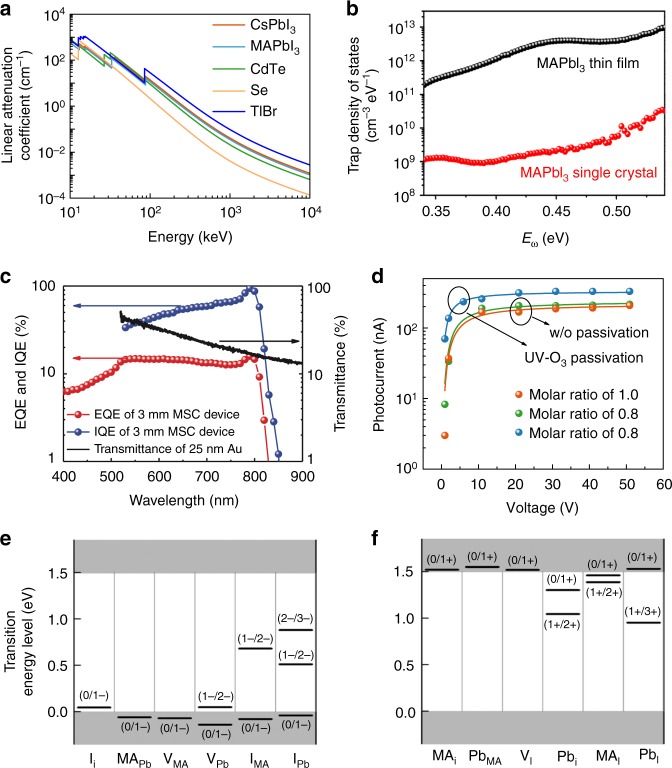
Fig. 1
Fig. 1
Electronic properties of halide perovskites. a Linear attenuation coefficient of MAPbI3, MAPbBr3, CdTe, Se, and TlBr versus photons energy. b Trap density of states of the MAPbI3 single crystal (red dots) and the thin film (black dots) measured by thermal admittance spectroscopy at room temperature. c External quantum efficiency (EQE) and internal quantum efficiency (IQE) spectra of a 3-mm-thick MAPbI3 single crystal along with the transmittance of 25-nm-thick gold electrode. d The µτ product of MAPbBr3 crystal devices with different raw materials feeding ratio and surface passivation procedure. The transition energy levels of e intrinsic acceptors and f intrinsic donors in CH3NH3PbI3 perovskite. b, c are adapted with permission from ref. , AAAS. d is adapted with permission from ref. , Springer Nature. e, f are adapted with permission from ref. , American Institute of Physics
Fig. 2
Fig. 2
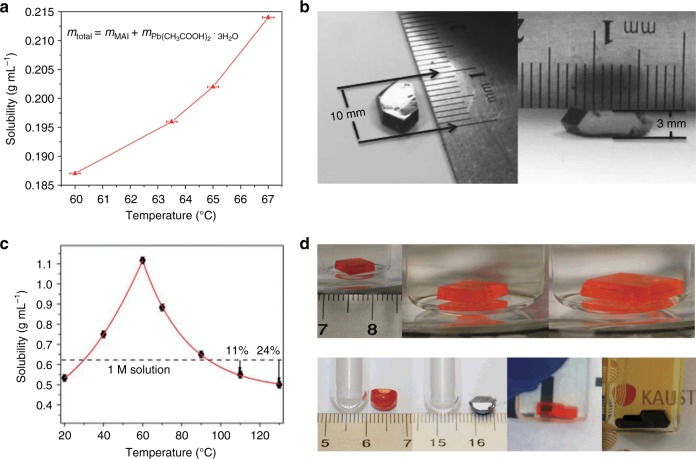
Perovskite single crystals growth. a Solubility of MAPbI3 perovskite versus temperature in HI acid. b Photos of as-grown single crystal by top-seeded solution growth method. c Reverse solubility of MAPbI3 perovskite versus temperature in γ-butyrolactone (GBL). d Photos of as-grown halide perovskite single crystal by inverse temperature method. a is adapted with permission from ref. , RSC Publishing. b is adapted with permission from ref. , AAAS. c is adapted with permission from ref. , American Institute of Physics. d is adapted with permission from ref. , Springer Nature
Fig. 3
Fig. 3
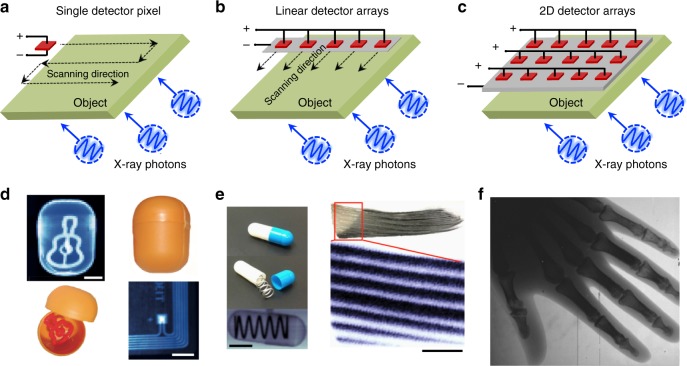
X-ray imaging by single pixel, linear arrays, and two-dimensional (2D) arrays scanning. a–c Scheme of three different X-ray imaging processes: a single pixel scanning, b linear detector array (LDA) scanning, c 2D detector arrays scanning. d Optical and X-ray images of a plastic toy and an electronic key card. e Optical and X-ray images of an encapsulated metallic spring as well as a portion of a fish caudal fin (top, right) and X-ray image of a section of it (bottom, right). f A hand phantom X-ray image obtained from a muon piston calorimeter (MPC) detector (using 100kVp and 5mGyair s−1 for 5 ms exposure, resulting in a dose of 25μGyair and a bias voltage of 50 V). Scale bars in d are 10 mm and the ones in e are 5 mm. d (ref. ), e (ref. ), and f (ref. ) are all adapted with permission from Springer Nature
Fig. 4
Fig. 4
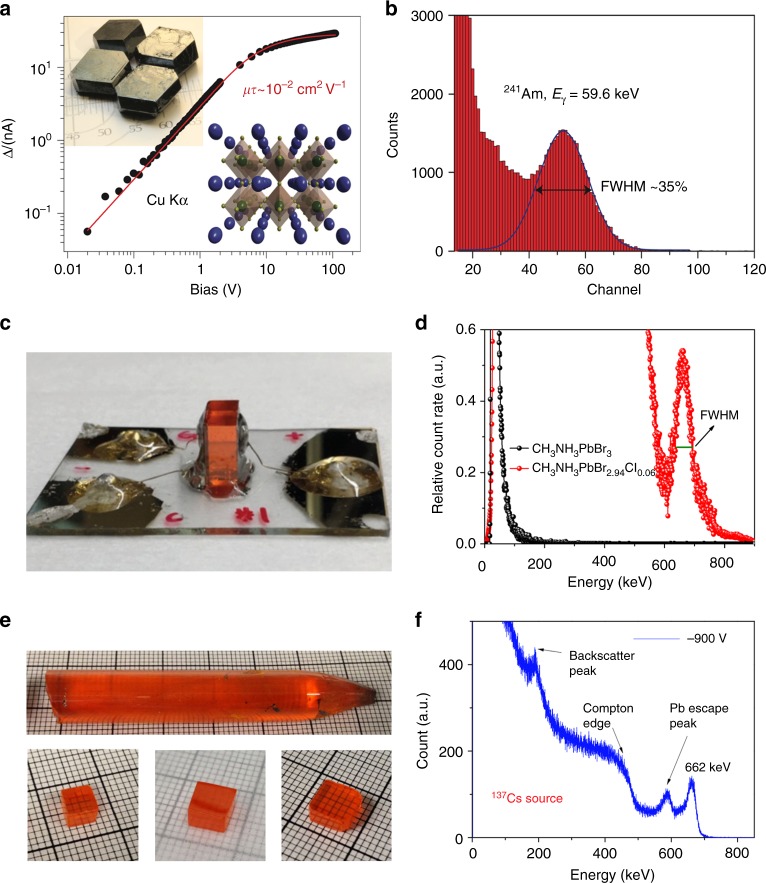
γ-Ray spectrum detection by halide perovskites. a The bias dependence of the photocurrent generated by Cu Kα X-ray in a MAPbI3 single crystal (SC); the red line indicates a fit with the Hecht model. Top inset: Photograph of typical MAPbI3 perovskite SCs grown from a non-aqueous method. Bottom inset: Schematic of the three-dimensional interconnection of PbI6 octahedra in a perovskite lattice (green, Pb; yellow, I; blue, MA). b Energy-resolved spectrum of 241Am recorded with a FAPbI3 SC. c Side view of a CH3NH3PbBr2.94Cl0.06 SC detector, and electrode sides were encapsulated with epoxy. d Enlarged photopeak region of the 137Cs energy spectrum obtained by CH3NH3PbBr2.94Cl0.06 and CH3NH3PbBr3 SC detectors. e As-grown CsPbBr3 SC ingot with a diameter of 11 mm, and the SC wafers with different sizes. f Energy-resolved spectrum of 137Cs γ-ray source with the characteristic energy of 662 keV obtained by a CsPbBr3 detector. a, b (ref. ), c, d (ref. ), and e, f (ref. ) are all adapted with permission from Springer Nature

References

    1. Spahn M. X-ray detectors in medical imaging. Nucl. Instrum. Meth. A. 2013;731:57–63.
    1. Carel WEVE. Inorganic scintillators in medical imaging. Phys. Med. Biol. 2002;47:R85. - PubMed
    1. Duan X, et al. X-ray cargo container inspection system with few-view projection imaging. Nucl. Instrum. Meth. A. 2009;598:439–444.
    1. Haff RP, Toyofuku N. X-ray detection of defects and contaminants in the food industry. Sens. Instrum. Food Qual. 2008;2:262–273.
    1. Chapman HN, et al. Femtosecond X-ray protein nanocrystallography. Nature. 2011;470:73. - PMC - PubMed

Publication types