Review
. 2019 Feb 20:10:125.
doi: 10.3389/fgene.2019.00125. eCollection 2019.

MicroRNAs, Hypoxia and the Stem-Like State as Contributors to Cancer Aggressiveness

Affiliations
Review

MicroRNAs, Hypoxia and the Stem-Like State as Contributors to Cancer Aggressiveness

Lucy Wanjiku Macharia et al. Front Genet. .

Abstract

MicroRNAs (miRNAs) are small non-coding RNA molecules that play key regulatory roles in cancer acting as both oncogenes and tumor suppressors. Due to their potential roles in improving cancer prognostic, predictive, diagnostic and therapeutic approaches, they have become an area of intense research focus in recent years. Several studies have demonstrated an altered expression of several miRNAs under hypoxic condition and even shown that the hypoxic microenvironment drives the selection of a more aggressive cancer cell population through cellular adaptations referred as the cancer stem-like cell. These minor fractions of cells are characterized by their self-renewal abilities and their ability to maintain the tumor mass, suggesting their crucial roles in cancer development. This review aims to highlight the interconnected role between miRNAs, hypoxia and the stem-like state in contributing to the cancer aggressiveness as opposed to their independent contributions, and it is based in four aggressive tumors, namely glioblastoma, cervical, prostate, and breast cancers.

Keywords: cancer; cancer aggressiveness; hypoxia; microRNAs; microenvironment; stem-like state.


Figures
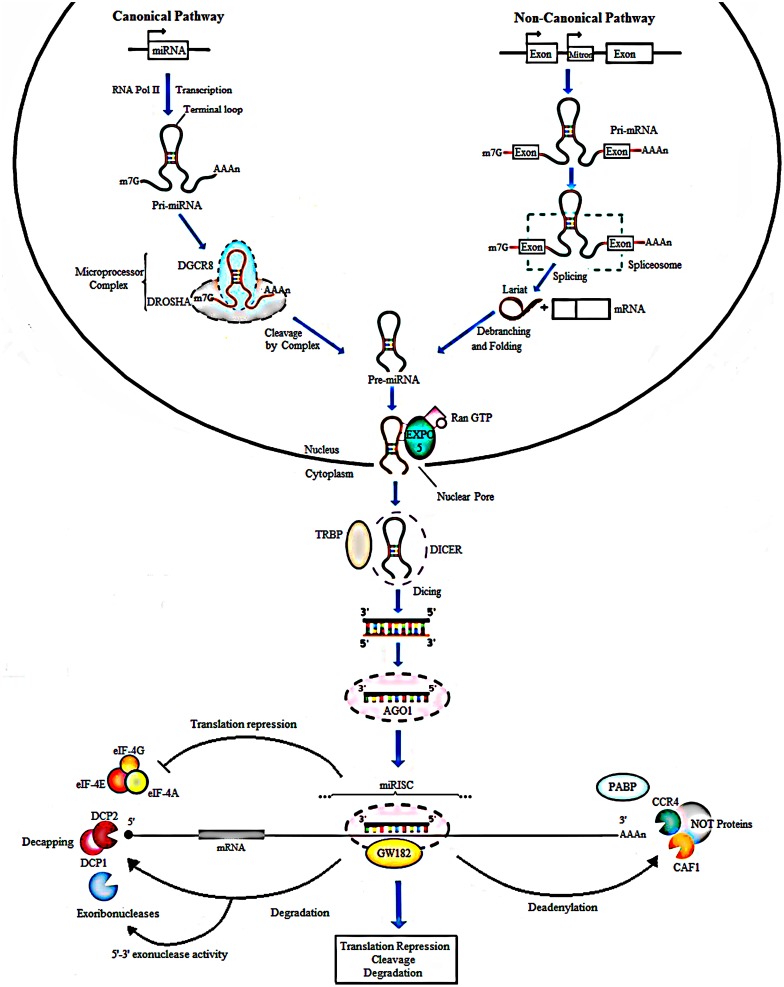
FIGURE 1
FIGURE 1
Biogenesis of miRNAs. In the canonical pathway, miRNAs are transcribed from their loci by RNA polymerase II into a long primary transcript of about 80 nucleotides called the pri-miRNA. Cleavage follows and is done by Drosha, a type III RNase along with the DGCR8 protein to produce pre-miRNA. In the non-canonical pathway, Mirtrons are spliced by the spliceosome to form looped intermediates referred to as lariat which then refold into pre-miRNAs. Next, the exportin 5, a RAN-GTP dependent transporter, mediates the movement of pre-miRNAs from the nucleus into the cytoplasm. Further processing by Dicer and TARBP2 protein generates mature miRNAs, producing double-stranded structure of miRNA of about 21-22 nt in length. The duplex is loaded into an AGO protein. The passenger strand (miRNA) is degraded, whereas the guide strand is incorporated by the Ago into the miRNA-induced silencing complex (miRISC). In animals, imperfect complementarity occurs when the miRNA seed region, nucleotides 2-8, BPs perfectly with the complementary seed match site in the 3′ UTR of the target mRNA resulting in translational repression or degradation. GW182 a core component of miRISC, mediates deadenylation of mRNAs by interacting with AGO and PABP consequently leading to recruitment of deadenylases like CCR4 and CAF1. Translation repression can result from inhibited binding of PABP to the poly (A) tail of the mRNA, responsible for attracting the elFs to mRNA to initiate translation. The formation of the CCR4-CAF1-NOT complex, a poly A tail-truncating enzyme, mediated by binding of miRISC to mRNA results in truncation of the downstream poly A tail, reduced binding of translation initiation factors and translation repression. The shortening or complete removal of the poly (A) tail induces the removal of the 5′ cap of the mRNA. Decapping is also mediated by DCP1 and DCP2. Consequently, the uncapped mRNA is rapidly degraded by 5′-3′ exoribonucleases.
FIGURE 2
FIGURE 2
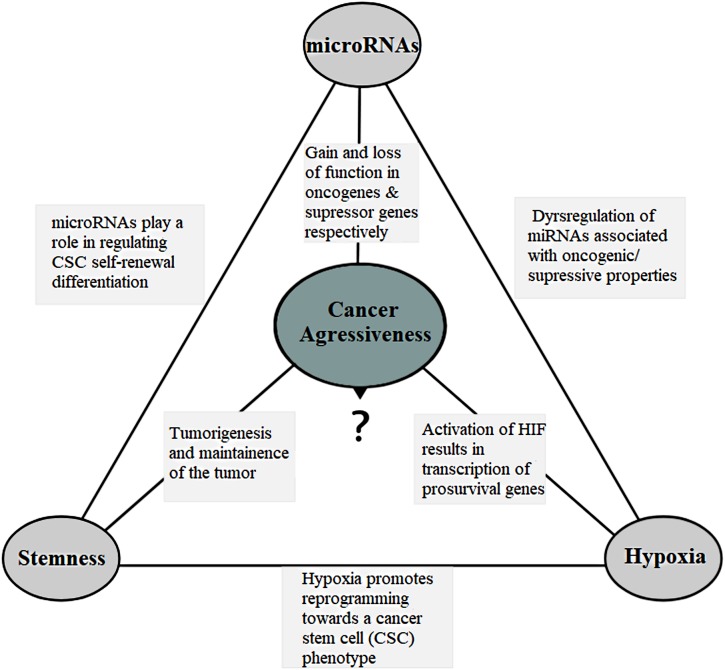
The connection triangle. The miRNAs, hypoxia and the stem-like state all play a connected role that eventually culminates in the tumor aggressiveness. miRNAs and aggressiveness: miRNAs are often found dysregulated and have gain-of-function mutations in the miRNAs associated with the oncogenic property and loss-of-function mutations in the miRNAs with the tumor suppressor properties. miRNAs and stemness: miRNAs play a role in the regulation of cell self-renewal, differentiation and regulation of transcription factors including Nanog, SOX2 and OCT4 among others associated with the stem-like state. They also help the stem-like cells to override the G1/S checkpoint to sustain continual division. miRNAs and hypoxia: miRNAs assist forming hypoxic microenvironment and regulate the HIF switch during hypoxia. Switch of HIF-1 to HIF-2 and HIF-3 is required in order to adapt the cells to prolonged or chronic hypoxia that may otherwise lead to apoptosis. Hypoxia and aggressiveness: In intratumoral hypoxia, a phenomenon of the aggressive cancers, hypoxia inducible factor 1α (HIF-1α) is stabilized, and in turn, HIF-1 results in transcription of pro-survival target genes involved with tumor angiogenesis, invasion, cell survival, EMT, and metabolism among others. Hypoxic pseudopalisading zones are protected from chemoradiation because of vascular stasis and depletion of molecular oxygen cells contributing to aggressiveness. Hypoxia and miRNAs: under hypoxia, a group of miRNAs, hypoxia regulated miRNAs-HRMs, are deregulated modulating processes involved in tumor survival. Hypoxia and stemness: Hypoxia promotes reprogramming towards a cancer stem-like cell (CSC) phenotype and expansion of CSC populations, a population thought to be responsible for the maintenance and recurrence of the tumor. It is in the hypoxic regions also that the CSCs go into quiescence to escape from targeted therapy. Stemness and aggressiveness: It is believed that stem-like cells have the capacity to sustain tumorigenesis by maintaining the tumor growth. They also contribute to therapy resistance, invasion and metastasis. Stemness and miRNAs: Evidences have shown that stem-like cells fine tune the miRNA expression. This includes “inhibitory-like” role of the miRNAs associated with tumor differentiation to restore “stemness” a probable source for tumor recurrence.

References

    1. Aldaz B., Sagardoy A., Nogueira L., Guruceaga E., Grande L., Huse J. T., et al. (2013). Involvement of miRNAs in the differentiation of human glioblastoma multiforme stem-like cells. PLoS One 8:e77098. 10.1371/journal.pone.0077098 - DOI - PMC - PubMed
    1. Alexander R. P., Fang G., Rozowsky J., Snyder M., Gerstein M. B. (2010). Annotating non-coding regions of the genome. Nat. Rev. Genet. 11 559–571. 10.1038/nrg2814 - DOI - PubMed
    1. Arpino G., Milano M., De Placido S. (2015). Features of aggressive breast cancer. Breast 24 594–600. 10.1016/j.breast.2015.06.001 - DOI - PubMed
    1. Augoff K., McCue B., Plow E. F., Sossey-Alaoui K. (2012). miR-31 and its host gene lncRNA LOC554202 are regulated by promoter hypermethylation in triple-negative breast cancer. Mol. Cancer 11:5. 10.1186/1476-4598-11-5 - DOI - PMC - PubMed
    1. Babae N., Bourajjaj M., Liu Y., Van Beijnum J. R., Cerisoli F., Scaria P. V., et al. (2014). Systemic miRNA-7 delivery inhibits tumor angiogenesis and growth in murine xenograft glioblastoma. Oncotarget 5 6687–6700. 10.18632/oncotarget.2235 - DOI - PMC - PubMed

LinkOut - more resources