


Tick-borne Encephalitis Vaccine Failures: A 10-year Retrospective Study Supporting the Rationale for Adding an Extra Priming Dose in Individuals Starting at Age 50 Years
- PMID: 30843030
- PMCID: PMC6938976
- DOI: 10.1093/cid/ciz176
Tick-borne Encephalitis Vaccine Failures: A 10-year Retrospective Study Supporting the Rationale for Adding an Extra Priming Dose in Individuals Starting at Age 50 Years
Abstract
Background: Southern Sweden is endemic for tick-borne encephalitis (TBE), with Stockholm County as one of the high-risk areas. Our aim in this study was to describe cases of vaccine failures and to optimize future vaccination recommendations.
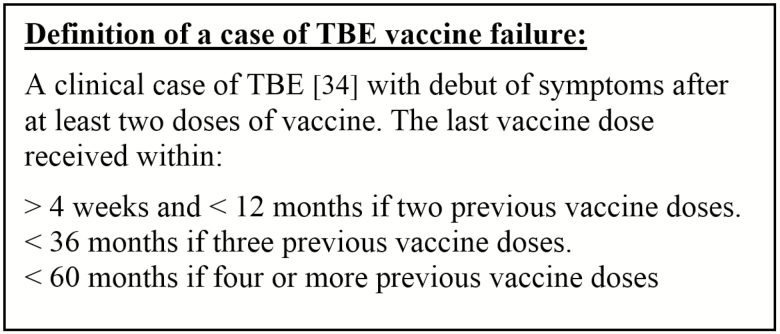
Methods: Patients with TBE were identified in the notification database at the Department of Communicable Disease Control and Prevention in Stockholm County during 2006-2015. Vaccine failure was defined as TBE despite adherence to the recommended vaccination schedule with at least 2 doses. Clinical data were extracted from medical records.
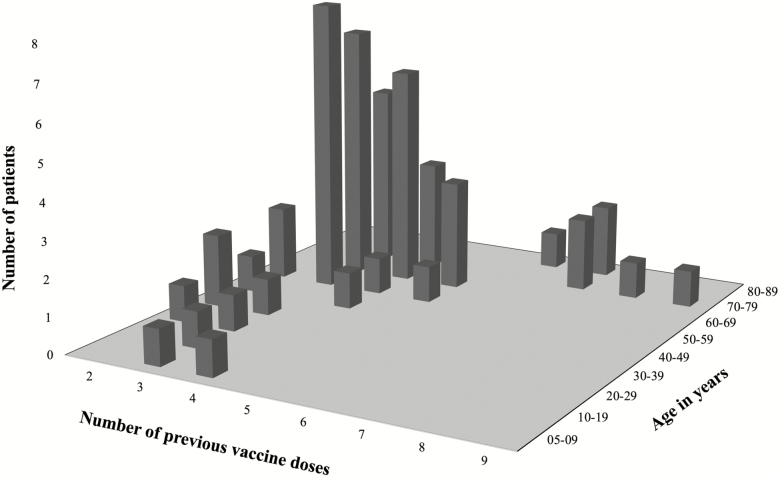
Results: A total of 1004 TBE cases were identified, 53 (5%) were defined as vaccine failures. In this latter group, the median age was 62 years (6-83). Forty-three (81%) patients were aged >50 years and 2 were children. Approximately half of the patients had comorbidities, with diseases affecting the immune system accounting for 26% of all cases. Vaccine failures following the third or fourth vaccine dose accounted for 36 (68%) of the patients. Severe and moderate TBE disease affected 81% of the cases.
Conclusions: To our knowledge, this is the largest documented cohort of TBE vaccine failures. Vaccine failure after 5 TBE vaccine doses is rare. Our data provide rationale for adding an extra priming dose to those aged ≥50 years.
Keywords: TBE; TBEV; vaccination; vaccine failure.
© The Author(s) 2019. Published by Oxford University Press for the Infectious Diseases Society of America.
Figures
References
-
- Süss J. Tick-borne encephalitis 2010: epidemiology, risk areas, and virus strains in Europe and Asia—an overview. Ticks Tick Borne Dis 2011; 2:2–15. - PubMed
-
- Lindquist L, Vapalahti O. Tick-borne encephalitis. Lancet 2008; 371:1861–71. - PubMed
-
- Donoso Mantke O, Escadafal C, Niedrig M, Pfeffer M; Working Group for Tick-Borne Encephalitis Virus C . Tick-borne encephalitis in Europe, 2007 to 2009. Euro Surveill 2011; 16. pii:19976. - PubMed
-
- Günther G, Haglund M, Lindquist L, Forsgren M, Sköldenberg B. Tick-borne encephalitis in Sweden in relation to aseptic meningo-encephalitis of other etiology: a prospective study of clinical course and outcome. J Neurol 1997; 244:230–8. - PubMed
Publication types
MeSH terms
Substances
LinkOut - more resources
Full Text Sources
Medical
