


"It would be so much easier": health system-led genetic risk notification-feasibility and acceptability of cascade screening in an integrated system
- PMID: 30843145
- PMCID: PMC6754469
- DOI: 10.1007/s12687-019-00412-z
"It would be so much easier": health system-led genetic risk notification-feasibility and acceptability of cascade screening in an integrated system
Abstract
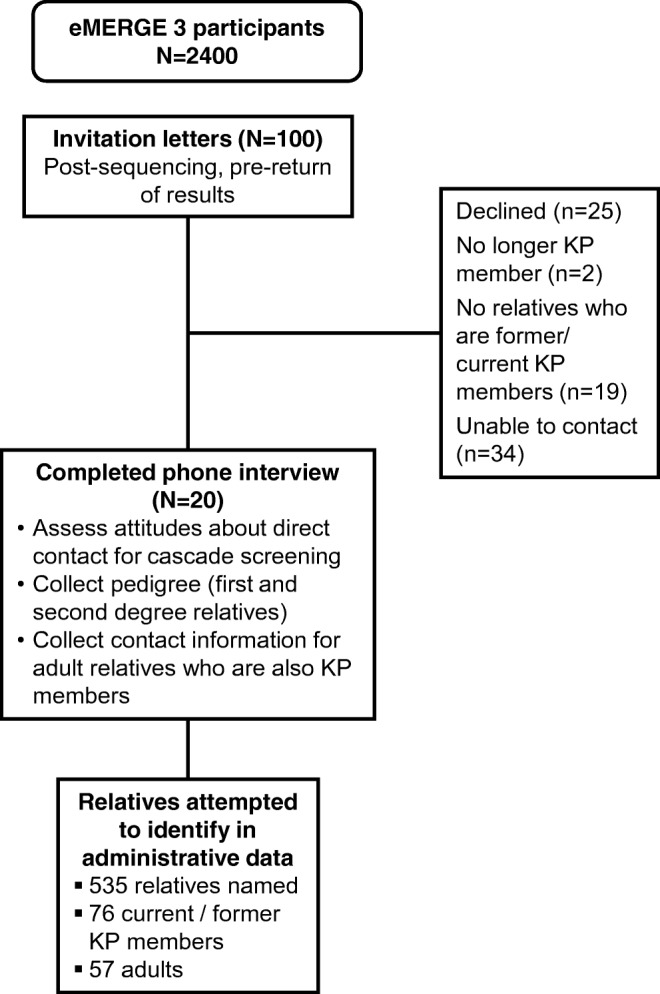
Assess the feasibility and acceptability of health system-led genetic risk notification in a US integrated health system. We conducted semi-structured phone interviews with individuals age 40-64 years who had undergone genetic sequencing, but had not yet received their results, assessing attitudes to direct outreach to relatives. During each interview, we collected contact information for adult relatives identified as members of the same system and attempted to identify each relative in administrative data. We conducted 20 interviews. Most participants expressed support for Kaiser Permanente Washington involvement in familial risk notification. Direct outreach to relatives received the most unqualified support; outreach to the relatives' physician or interaction with the relatives' electronic medical record received more tempered support. Support was motivated by the desire to have risk communicated accurately and quickly. The most common caveat was a desire to alert relatives before the health system contacted them. Of 57 named relatives who were members of the same health system, we retrieved a single match for 40 (70.2%) based on name or birthdate. Health system involvement in familial risk notification received support in a sample of patients in a US integrated health system, and identification of relatives is feasible.
Keywords: Bioethics; Cascade testing; Communication; Genetic testing; Risk notification.
Conflict of interest statement
The authors declare that they have no competing interests.
References
-
- Aktan-Collan K, Haukkala A, Pylvanainen K, Jarvinen HJ, Aaltonen LA, Peltomaki P, Rantanen E, Kaariainen H, Mecklin JP. Direct contact in inviting high-risk members of hereditary colon cancer families to genetic counselling and DNA testing. J Med Genet. 2007;44:732–738. doi: 10.1136/jmg.2007.051581. - DOI - PMC - PubMed
-
- Benkendorf JL, Reutenauer JE, Hughes CA, Eads N, Willison J, Powers M, Lerman C. Patients' attitudes about autonomy and confidentiality in genetic testing for breast-ovarian cancer susceptibility. Am J Med Genet. 1997;73:296–303. doi: 10.1002/(SICI)1096-8628(19971219)73:3<296::AID-AJMG13>3.0.CO;2-E. - DOI - PubMed
-
- Clayton EW. Genetics, public health, and the law. In: Khoury MJ, Burke W, Thomson EJ, editors. Genetics and public health in the 21st century: using genetic information to improve health and prevent disease. New York: Oxford University Press; 2000. pp. 489–504.
Grants and funding
LinkOut - more resources
Full Text Sources
