


Review
doi: 10.1016/j.neuron.2019.02.005.
Ketamine: A Paradigm Shift for Depression Research and Treatment
Affiliations
- PMID: 30844397
- PMCID: PMC6560624
- DOI: 10.1016/j.neuron.2019.02.005
Item in Clipboard
Review
Ketamine: A Paradigm Shift for Depression Research and Treatment
Neuron.
.
Abstract
Ketamine is the first exemplar of a rapid-acting antidepressant with efficacy for treatment-resistant symptoms of mood disorders. Its discovery emerged from a reconceptualization of the biology of depression. Neurobiological insights into ketamine efficacy shed new light on the mechanisms underlying antidepressant efficacy.
Published by Elsevier Inc.
Figures
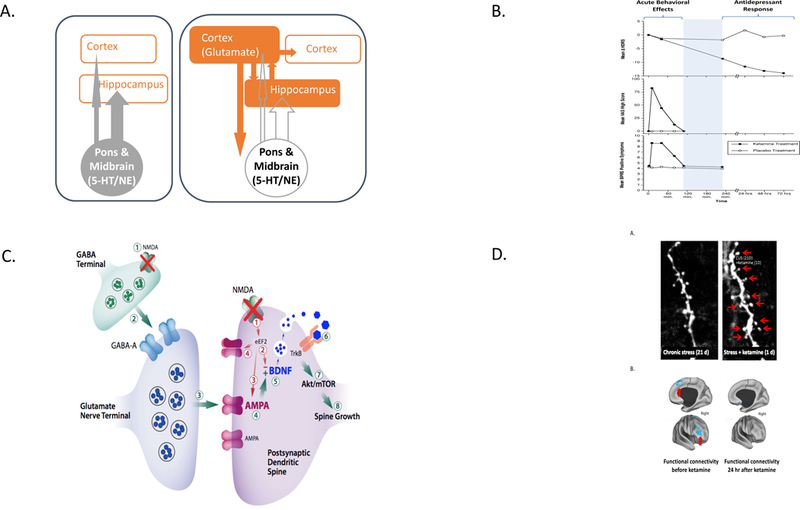
The Path to the Identification of the Antidepressant Effects of Ketamine and Its Therapeutic Mechanisms of Action (A) This figure illustrates the perspective shift that set the stage for testing ketamine effects in depressed patients. The left side of the figure presents the historically dominant theory, i.e., that deficits in serotonin (5-HT) and norepinephrine (NE) signaling contribute to the biology of depression and that pharmacotherapy aims to reverse these deficits. 5-HT and NE neurons are based in the midbrain and pons, respectively, and modulate the activity of higher brain centers. The right side of the figure highlights the shift in perspective to cortical and limbic mechanisms. The neurons in the higher brain centers release glutamate and GABA predominately. If one viewed depression as a disorder of cortico-limbic function, then glutamatergic and GABAergic signaling would be implicated. This perspective shift led us to test the effects of the NMDA glutamate receptor antagonist as a probe of alterations in glutamate signaling associated with depression. (B) This figure highlights the temporal dissociation of the acute behavioral effects of ketamine, which are observed in healthy humans and patient populations, and the rapidly emerging antidepressant effects of ketamine, which occur only in individuals with psychiatric symptoms (n = 7, modified from Berman et al., 2000). It presents mean changes from baseline in the 25-item Hamilton Depression Rating Scale scores (HDRS), the mean Visual Analog Scale “high” scores (VAS-high, 0–100 mm), and mean positive symptom scores of the Brief Psychiatric Rating Scale (BPRS-positive) after ketamine (0.5 mg/kg over 40 min) and saline infusions. The emergence of antidepressant effects after the abatement of the transient pharmacologic effects of ketamine is consistent with the hypothesis that these antidepressant effects reflect a reaction to ketamine exposure rather than a property of ketamine intoxication. (C) This cartoon illustrates emerging mechanistic hypotheses related to the antidepressant effects of ketamine. Some effects may emerge directly as a downstream consequence of NMDA glutamate receptor antagonism. These effects are illustrated by blockade of postsynaptic, presumably GluN2B-containing NMDA receptors. When overstimulated, these receptors activate eukaryotic elongation factor-2 (eEF2) and depress BDNF levels. Blockade of these NMDA receptors raises BDNF levels and shuttles AMPA glutamate receptors to the synapse, enhancing synaptic efficacy. Ketamine also may generate its antidepressant effects indirectly by blocking NMDA receptors on GABA interneurons. In this way, ketamine reduces inhibition of glutamate release and, in turn, results in enhanced stimulation of AMPA glutamate receptors. AMPA receptor activation activates a signaling cascade that raises BDNF levels. Local release of BDNF is thought to stimulate TrkB receptors, engaging relevant signaling cascades and resulting in the activation of the molecular target of rapamycin complex 1 (mTORC1). This step, in turn, activates local protein synthesis necessary for increasing dendritic spine formation and restoring synaptic connectivity. In this figure, AMPA, BDNF, and mTORC1 are highlighted because blockade of these steps in the pathway prevents the emergence of the antidepressant effects of ketamine (Duman et al., 2016, Krystal et al., 2013). Please note the convergence of the direct and indirect effects of ketamine on some common mechanisms may constitute elements of a common pathway for antidepressant efficacy, i.e., enhancement of synaptic efficacy and connectivity in key circuits involved in the regulation of mood. (D) These figures present data suggesting that the ability of ketamine to increase cortical structural connectivity in animals and restore cortical functional connectivity in depressed patients is related to its clinical efficacy. (Da) This figure illustrates the depletion of dendritic spines on prefrontal cortical pyramidal (glutamate-releasing) neurons in animals exposed to repeated stresses (Li et al., 2010). (Db) This figure presents functional MRI data collected in symptomatic depression patients prior to (left figure) and 24 h after (right figure) ketamine. Areas in blue show reduced functional connectivity (degree of correlation of activity with other brain regions). Following ketamine administration, the reductions in functional connectivity (areas in blue) are ameliorated, associated with alleviation of depression symptoms (Abdallah et al., 2017)
References
-
- Berman RM, Cappiello A, Anand A, Oren DA, Heninger GR, Charney DS, and Krystal JH (2000). Antidepressant effects of ketamine in depressed patients. Biol Psychiatry 47, 351–354. - PubMed
-
- Fava M, Freeman M, Flynn M, Judge H, Hoeppner B, Cusin C, Ionescu D, Mathew S, Chang L, Iosifescu D, et al. (2017). Double-blind, placebo-controlled trial of ketamine therapy in treatment resistant depression (TRD). In American Society of Clinical Psychopharmacology (Miami, Florida), p. 84 (#W28).
Publication types
MeSH terms
Substances
Grants and funding
LinkOut - more resources
Full Text Sources
Other Literature Sources
Medical
