


Tricho-hepatic-enteric syndrome (THES) without intractable diarrhoea
- PMID: 30844479
- PMCID: PMC7872052
- DOI: 10.1016/j.gene.2019.02.059
Tricho-hepatic-enteric syndrome (THES) without intractable diarrhoea
Abstract
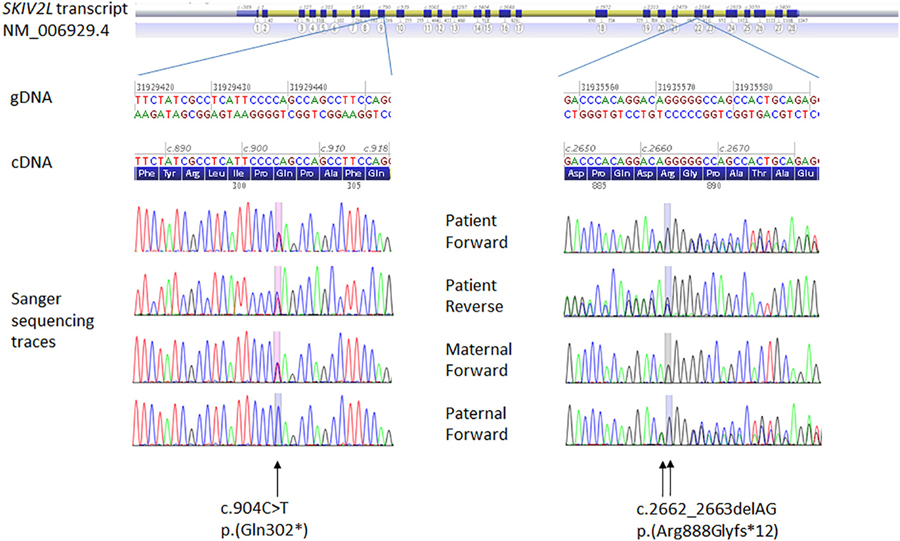
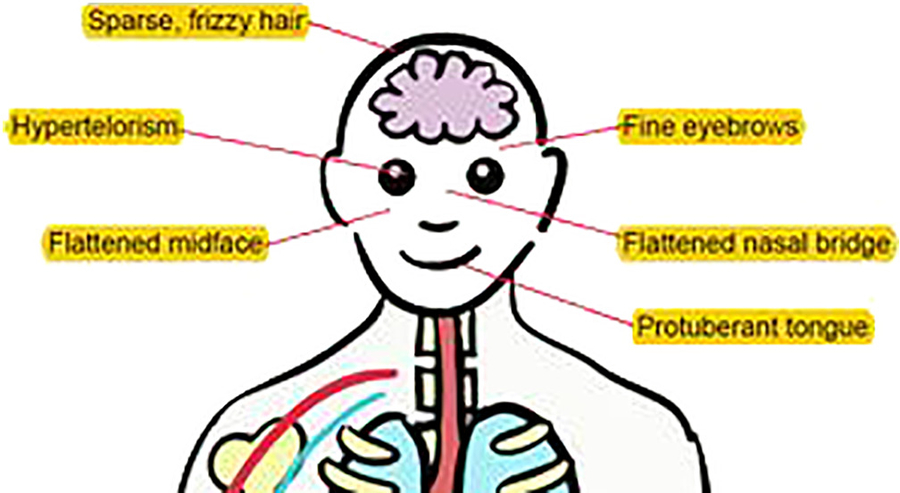
Tricho-hepatic-enteric syndrome (THES) is a genetically heterogeneous rare syndrome (OMIM: 222470 (THES1) and 614602 (THES2)) that typically presents in the neonatal period with intractable diarrhoea, intra-uterine growth retardation (IUGR), facial dysmorphism, and hair and skin changes. THES is associated with pathogenic variants in either TTC37 or SKIV2L; both are components of the human SKI complex, an RNA exosome cofactor. We report an 8 year old girl who was diagnosed with THES by the Undiagnosed Disease Program-WA with compound heterozygous pathogenic variants in SKIV2L. While THES was considered in the differential diagnosis, the absence of protracted diarrhoea delayed definitive diagnosis. We therefore suggest that SKIV2L testing should be considered in cases otherwise suggestive of THES, but without the characteristic diarrhoea. We expand the phenotypic spectrum while reviewing the current knowledge on SKIV2L.
Keywords: Next generation sequencing; RNA exosome; SKI complex; SKIV2L; Undiagnosed.
Copyright © 2019. Published by Elsevier B.V.
Conflict of interest statement
Declaration of interests
The authors declare that they have no known competing financial interests or personal relationships that could have appeared to influence the work reported in this paper.
Figures
References
-
- Baynam G, Broley S, Bauskis A, Pachter N, McKenzie F, Townshend S, Slee J, Kiraly-Borri C, Vasudevan A, Hawkins A, Schofield L, Helmholz P, Palmer R, Kung S, Walker CE, Molster C, Lewis B, Mina K, Beilby J, Pathak G, Poulton C, Groza T, Zankl A, Roscioli T, Dinger ME, Mattick JS, Gahl W, Groft S, Tifft C, Taruscio D, Lasko P, Kosaki K, Wilhelm H, Melegh B, Carapetis J, Jana S, Chaney G, Johns A, Owen PW, Daly F, Weeramanthri T, Dawkins H, Goldblatt J, 2017. Initiating an undiagnosed diseases program in the Western Australian public health system. Orphanet J. Rare Dis 12. - PMC - PubMed
-
- Bourgeois P, Esteve C, Chaix C, Béroud C, Lévy N, Fabre A, Badens C, 2018. Tricho-Hepato-Enteric Syndrome mutation update: mutations spectrum of TTC37 and SKIV2L, clinical analysis and future prospects. Hum. In: Mutat - PubMed
-
- Fabre A, Charroux B, Martinez-Vinson C, Roquelaure B, Odul E, Sayar E, Smith H, Colomb V, Andre N, Hugot J-P, Goulet O, Lacoste C, Sarles J, Royet J, Levy N, Badens C, 2012. REPORT SKIV2L mutations cause syndromic diarrhea, or trichohepatoenteric syndrome. Am. J. Hum. Genet 90, 689–692. - PMC - PubMed
Publication types
MeSH terms
Substances
Supplementary concepts
Grants and funding
LinkOut - more resources
Full Text Sources
Medical
