


Organoid models for translational pancreatic cancer research
- PMID: 30844513
- PMCID: PMC6722026
- DOI: 10.1016/j.gde.2019.02.003
Organoid models for translational pancreatic cancer research
Abstract
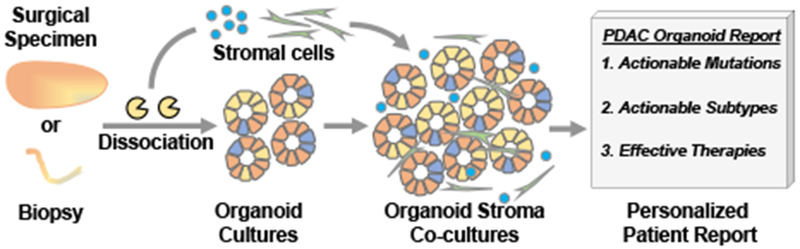
Despite recent advances in the treatment of cancer, pancreatic ductal adenocarcinoma (PDAC) still retains the worst survival rate of common malignancies. Late diagnosis and lack of curative therapeutic options are the most pressing clinical problems for this disease. Therefore, there is a need for patient models and biomarkers that can be applied in the clinic to identify the most effective therapy for a patient. Pancreatic ductal organoids are ex-vivo models of PDAC that can be established from very small biopsies, enabling the study of localized, advanced, and metastatic patients. Organoids models have been applied to pancreatic cancer research and offer a promising platform for precision medicine approaches.
Copyright © 2019 Elsevier Ltd. All rights reserved.
Figures
References
-
- Siegel RL, Miller KD, and Jemal A, Cancer statistics, 2018. CA Cancer J Clin, 2018. 68(1): p. 7–30. - PubMed
-
- Khorana AA, et al. , Potentially Curable Pancreatic Cancer: American Society of Clinical Oncology Clinical Practice Guideline. J Clin Oncol, 2016. 34(21): p. 2541–56. - PubMed
-
- Winter JM, et al. , 1423 pancreaticoduodenectomies for pancreatic cancer: A single-institution experience. J Gastrointest Surg, 2006. 10(9): p. 1199–210; discussion 1210-1. - PubMed
-
- Groot VP, et al. , Patterns, Timing, and Predictors of Recurrence Following Pancreatectomy for Pancreatic Ductal Adenocarcinoma. Ann Surg, 2017. - PubMed
-
- Neoptolemos JP, et al. , Comparison of adjuvant gemcitabine and capecitabine with gemcitabine monotherapy in patients with resected pancreatic cancer (ESPAC-4): a multicentre, open-label, randomised, phase 3 trial. Lancet, 2017. 389(10073): p. 1011–1024. - PubMed
Publication types
MeSH terms
Grants and funding
LinkOut - more resources
Full Text Sources
Medical
