Observational Study
. 2019 Mar 7;14(3):e0209452.
doi: 10.1371/journal.pone.0209452. eCollection 2019.

Arterial carboxyhaemoglobin levels in children admitted to PICU: A retrospective observational study

Affiliations
Observational Study

Arterial carboxyhaemoglobin levels in children admitted to PICU: A retrospective observational study

Ankur Chawla et al. PLoS One. .

Abstract

While carbon monoxide (CO) is considered toxic, low levels of endogenously produced CO are protective against cellular injury induced by oxidative stress. Carboxyhaemoglobin (COHb) levels have been associated with outcomes in critically ill adults. We aimed to describe the distribution of carboxyhaemoglobin in critically ill children and the relationship of these levels with clinical outcomes. This retrospective observational study was conducted at a large tertiary paediatric intensive care unit (PICU). We included all children admitted to the PICU over a two-year period who underwent arterial blood gas analysis. We measured the following: (i) Population and age-related differences in COHb distribution; (ii) Change in COHb over the first week of admission using a multi-level linear regression analysis; (iii) Uni- and multivariable relationships between COHb and length of ventilation and PICU survival. Arterial COHb levels were available for 559/2029 admissions. The median COHb level was 1.20% (IQR 1.00-1.60%). Younger children had significantly higher COHb levels (p-value <2 x 10-16). Maximum Carboxyhaemoglobin was associated with survival 1.67 (95% CI: 1.01-2.57; p-value = 0.02) and length of ventilation (OR 5.20, 95% CI: 3.07-7.30; p-value = 1.8 x 10⁻⁶) following multi-variable analysis. First measured and minimum COHb values were weakly associated with length of ventilation, but not survival. In conclusion, children have increased COHb levels in critical illness, which are greater in younger children. Higher COHb levels are associated with longer length of ventilation and death in PICU. This may reflect increased oxidative stress in these children.


Conflict of interest statement

The authors have declared that no competing interests exist.

Figures
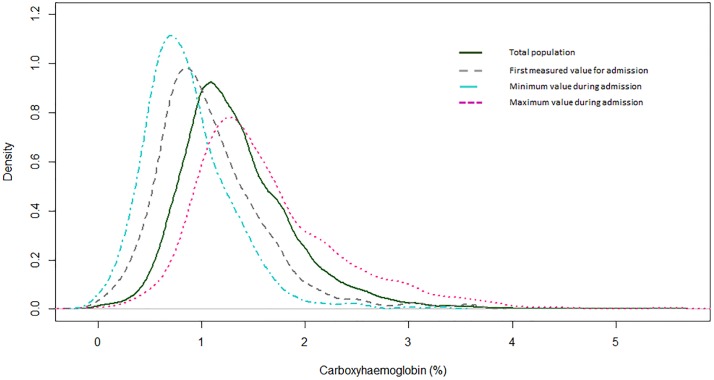
Fig 1
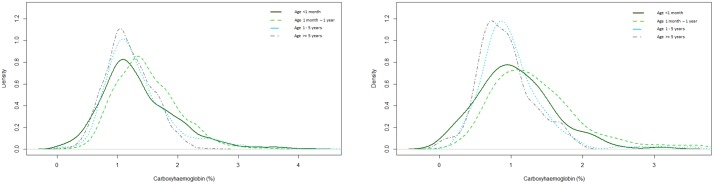
Fig 1. Distribution of carboxyhaemoglobin (COHb) for children admitted to the paediatric intensive care unit in 2015–16 who underwent arterial blood gas analysis.
The continuous line shows the overall distribution for the cohort. The grey dashed line shows the distribution for the first measured COHb value; the pink dotted line shows the distribution of maximum values during admission and the blue dashed line the minimum values during admission.
Fig 2
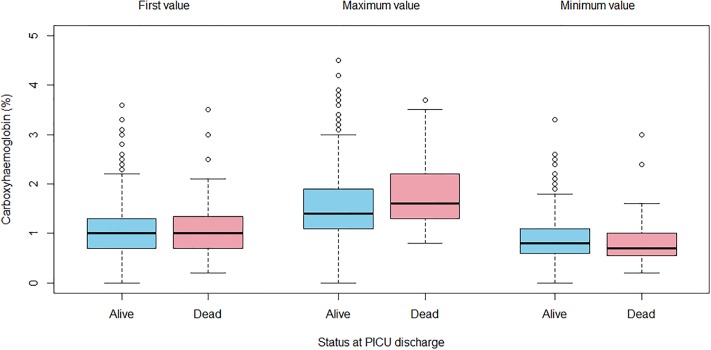
Fig 2. The distribution of (A) all carboxyhaemoglobin (COHb) values throughout PICU stay (left), and (B) the first measured value of COHb (right), according to age groups.
There is a statistically significant difference between the groups for all COHb values (Kruskal-Wallis chi-squared 538.8; p-value <2 x 10⁻¹⁶) and first measured COHb values (Kruskal-Wallis chi-squared 47.1; p-value = 3.2 x 10⁻¹⁰).
Fig 3
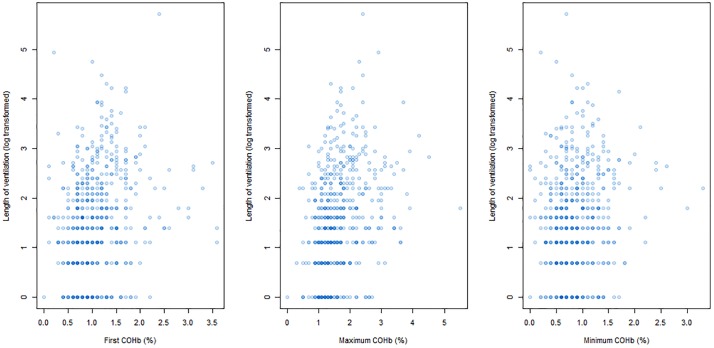
Fig 3. Box plot of measured COHb values and survival status at PICU discharge.
The first, minimum and maximum COHb values (%) and the survival status at PICU discharge are represented. Neither the first nor the minimum COHb values predicted survival status at ICU discharge. The maximum COHb values were slightly better at predicting survival status at PICU discharge.
Fig 4
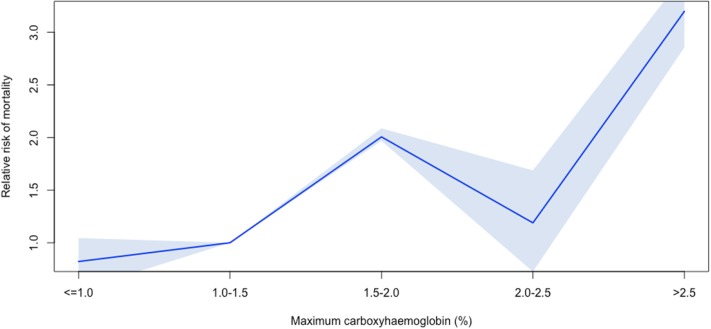
Fig 4. Scatter plot of measured COHb values and length of ventilation (log transformed).
The first, minimum and maximum COHb values (%) and the length of ventilation in hours are represented.
Fig 5
Fig 5. Risk adjusted mortality according to categories of maximum COHb, relative to a maximum COHb value between 1.0–1.5%.
The shaded blue area represents the 95% confidence interval. Risk of mortality is adjusted for PIM-3, age, and length of ventilation. The U-shaped relationship described by Melley et al in adults is not seen—COHb values < = 1.0 have a non-significantly lower risk adjusted mortality relative to children with a maximum COHb between 1.0–1.5%.

References

    1. Ghosh S, Gal J, Marczin N. Carbon monoxide: endogenous mediator, potential diagnostic and therapeutic target. Ann Med. 2010;42(1):1–12. 10.3109/07853890903482877 - DOI - PubMed
    1. Ryter SW, Choi AM. Targeting heme oxygenase-1 and carbon monoxide for therapeutic modulation of inflammation. Transl Res. 2016. January;167(1):7–34. 10.1016/j.trsl.2015.06.011 - DOI - PMC - PubMed
    1. Otterbein LE, Bach FH, Alam J, Soares M, Lu HT, Wysk M, et al. Carbon monoxide has anti-inflammatory effects involving the mitogen-activated protein kinase pathway. Nat Med. 2000. April;6(4):422–8. 10.1038/74680 - DOI - PubMed
    1. Kim SK, Joe Y, Chen Y, Ryu J, Lee J-H, Cho GJ, et al. Carbon monoxide decreases interleukin-1β levels in the lung through the induction of pyrin. Cell Mol Immunol. 2017. April;14(4):349–359. 10.1038/cmi.2015.79 - DOI - PMC - PubMed
    1. Wang X, Wang Y, Kim HP, Nakahira K, Ryter SW, Choi AMK. Carbon monoxide protects against hyperoxia-induced endothelial cell apoptosis by inhibiting reactive oxygen species formation. J Biol Chem. 2007. January 19;282(3):1718–26. 10.1074/jbc.M607610200 - DOI - PubMed

Publication types

Substances