Review
. 2019 May;13(5):981-1001.
doi: 10.1002/1878-0261.12473. Epub 2019 Mar 22.

ΔNp63 in squamous cell carcinoma: defining the oncogenic routes affecting epigenetic landscape and tumour microenvironment

Affiliations
Review

ΔNp63 in squamous cell carcinoma: defining the oncogenic routes affecting epigenetic landscape and tumour microenvironment

Veronica Gatti et al. Mol Oncol. 2019 May.

Abstract

Squamous cell carcinoma (SCC) is a treatment-refractory tumour which arises from the epithelium of diverse anatomical sites such as oesophagus, head and neck, lung and skin. Accumulating evidence has revealed a number of genomic, clinical and molecular features commonly observed in SCC of distinct origins. Some of these genetic events culminate in fostering the activity of ΔNp63, a potent oncogene which exerts its pro-tumourigenic effects by regulating specific transcriptional programmes to sustain malignant cell proliferation and survival. In this review, we will describe the genetic and epigenetic determinants underlying ΔNp63 oncogenic activities in SCC, and discuss some relevant transcriptional effectors of ΔNp63, emphasizing their impact in modulating the crosstalk between tumour cells and tumour microenvironment (TME).

Keywords: p63; squamous cell carcinoma; transcription factor; tumour microenvironment.


Conflict of interest statement

The authors declare no conflict of interest.

Figures
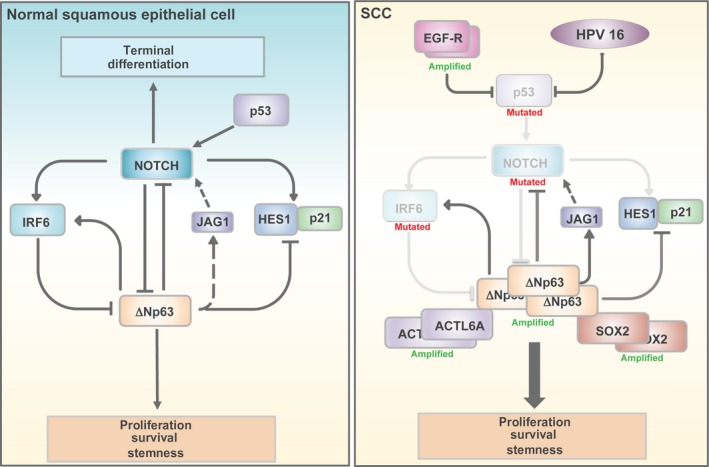
Figure 1
Figure 1
Schematic diagram of the molecular circuitry connecting squamous differentiation‐related genes in SCC. The genetic alterations of these genes are also reported.
Figure 2
Figure 2
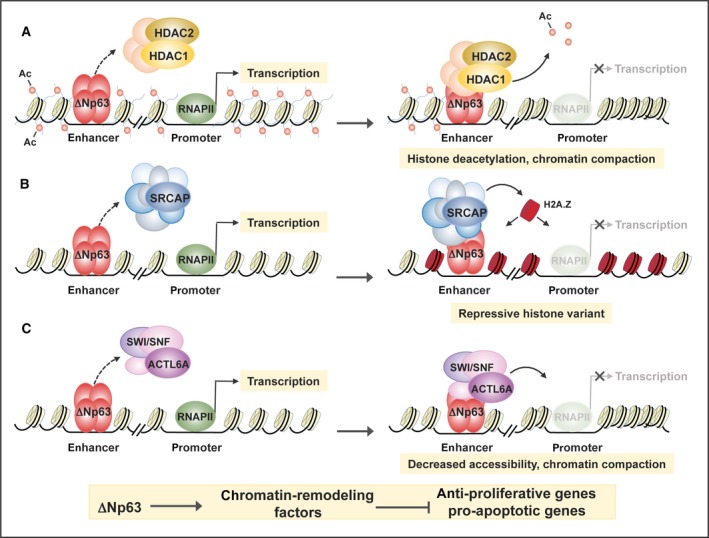
Model of the epigenetic mechanisms exploited by ΔNp63 to repress transcription in various SCC. (A) In HNSCC cells, ΔNp63 may recruit the histone deacetylates HDAC1 and HDAC2 to chromatin, preventing transcription factor binding to the promoters of pro‐apoptotic genes, such as PUMA. (B) In lung SCC cells, ΔNp63 is able to repress the transcription of anti‐proliferative genes by promoting H2A.Z incorporation. (C) In HNSCC cells, ΔNp63 interacts with the SWI/SNF subunit ACTL6A, inducing the repression of anti‐proliferative genes.
Figure 3
Figure 3
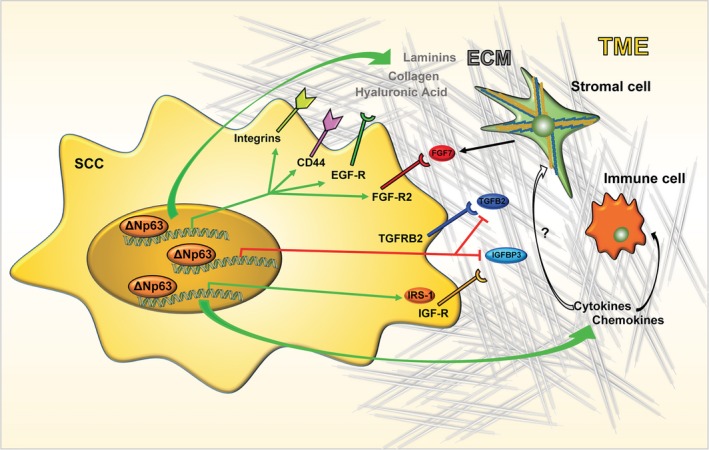
Schematic model of the ΔNp63 oncogenic routes in SCC. The green and red arrows indicate the pathways under positive and negative regulation by ΔNp63, respectively. See text for details.

References

    1. Abraham CG, Ludwig MP, Andrysik Z, Pandey A, Joshi M, Galbraith MD, Sullivan KD and Espinosa JM (2018) ΔNp63α suppresses TGFB2 expression and RHOA activity to drive cell proliferation in squamous cell carcinomas. Cell Rep 24, 3224–3236. - PMC - PubMed
    1. Adams JM and Cory S (2018) The BCL‐2 arbiters of apoptosis and their growing role as cancer targets. Cell Death Differ 25, 27–36. - PMC - PubMed
    1. Agrawal N, Frederick MJ, Pickering CR, Bettegowda C, Chang K, Li RJ, Fakhry C, Xie TX, Zhang J, Wang J et al (2011) Exome sequencing of head and neck squamous cell carcinoma reveals inactivating mutations in NOTCH1. Science 333, 1154–1157. - PMC - PubMed
    1. Agrawal N, Jiao Y, Bettegowda C, Hutfless SM, Wang Y, David S, Cheng Y, Twaddell WS, Latt NL, Shin EJ et al (2012) Comparative genomic analysis of esophageal adenocarcinoma and squamous cell carcinoma. Cancer Discov 2, 899–905. - PMC - PubMed
    1. Alexandrova EM, Mirza SA, Xu S, Schulz‐Heddergott R, Marchenko ND and Moll UM (2017) p53 loss‐of‐heterozygosity is a necessary prerequisite for mutant p53 stabilization and gain‐of‐function in vivo. Cell Death Dis 8, e2661. - PMC - PubMed

Publication types

MeSH terms