


Association of childhood pulmonary tuberculosis with exposure to indoor air pollution: a case control study
- PMID: 30845944
- PMCID: PMC6407209
- DOI: 10.1186/s12889-019-6604-9
Association of childhood pulmonary tuberculosis with exposure to indoor air pollution: a case control study
Abstract
Background: Crude measures of exposure to indicate indoor air pollution have been associated with the increased risk for acquiring tuberculosis. Our study aimed to determine an association between childhood pulmonary tuberculosis (PTB) and exposure to indoor air pollution (IAP), based on crude exposure predictors and directly sampled and modelled pollutant concentrations.
Methods: In this case control study, children diagnosed with PTB were compared to children without PTB. Questionnaires about children's health; and house characteristics and activities (including household air pollution) and secondhand smoke (SHS) exposure were administered to caregivers of participants. A subset of the participants' homes was sampled for measurements of PM10 over a 24-h period (n = 105), and NO2 over a period of 2 to 3 weeks (n = 82). IAP concentrations of PM10 and NO2 were estimated in the remaining homes using predictive models. Logistic regression was used to look for association between IAP concentrations, crude measures of IAP, and PTB.
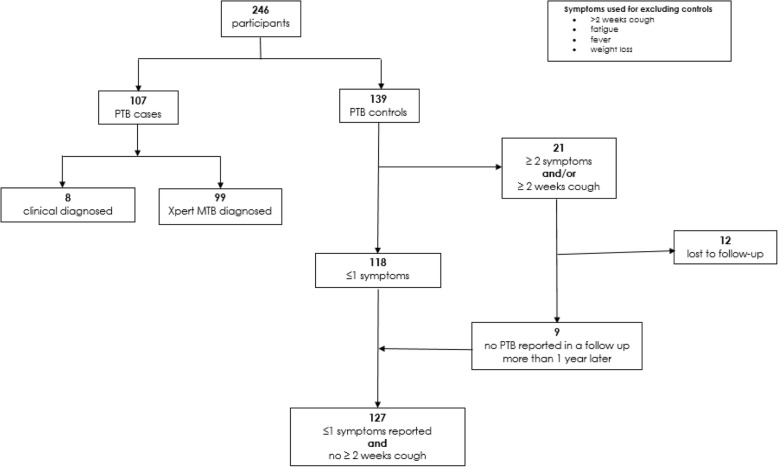
Results: Of the 234 participants, 107 were cases and 127 were controls. Pollutants concentrations (μg/m3) for were PM10 median: 48 (range: 6.6-241) and NO2 median: 16.7 (range: 4.5-55). Day-to-day variability within- household was large. In multivariate models adjusted for age, sex, socioeconomic status, TB contact and HIV status, the crude exposure measures of pollution viz. cooking fuel type (clean or dirty fuel) and SHS showed positive non-significant associations with PTB. Presence of dampness in the household was a significant risk factor for childhood TB acquisition with aOR of 2.4 (95% CI: 1.1-5.0). The crude exposure predictors of indoor air pollution are less influenced by day-to-day variability. No risk was observed between pollutant concentrations and PTB in children for PM10 and NO2.
Conclusion: Our study suggests increased risk of childhood tuberculosis disease when children are exposed to SHS, dirty cooking fuel, and dampness in their homes. Yet, HIV status, age and TB contact are the most important risk factors of childhood PTB in this population.
Keywords: Childhood tuberculosis; Dampness; Exposure assessment; Indoor air pollution; Risk factors; Secondhand smoke.
Conflict of interest statement
Ethics approval and consent to participate
The purpose and procedures of the study were explained to caregivers and written consent was obtained from all individual caregivers before they were recruited into the study. Verbal consent was obtained from those potential participants who could not give a written consent because of illiteracy or were not comfortable in having their signature in the consent. The protocol for this study was approved by the Biomedical Research Ethics Committee of University of KwaZulu-Natal (Ref. number: BREC 104/09) and permission was obtained from the health institutions involved.
Consent for publication
N/A
Competing interests
Rajen Naidoo is an Editorial Board Member for BMC Public health. The authors declare that they have no competing interests.
Publisher’s Note
Springer Nature remains neutral with regard to jurisdictional claims in published maps and institutional affiliations.
Figures
References
-
- World Health Organisation. 2000-2015 WHO TB burden estimates dataset. TB burden estimates. https://extranet.who.int/tme/generateCSV.asp?ds=estimates. Accessed 03 Sept 2017.
-
- World Health Organisation. Global Tuberculosis Report 2014: Key indicators for the WHO region. http://www.who.int/tb/data. Accessed 03 Sept 2017.
-
- World Health Organisation. Global tuberculosis report 2017. World Health Organisation. Geneva: WHO; 2017. 1–262 p. http://apps.who.int/iris/bitstream/10665/259366/1/9789241565516-eng.pdf?.... Accessed 01 Aug 2018.
MeSH terms
Substances
Grants and funding
LinkOut - more resources
Full Text Sources
Medical
Research Materials
