


Using brain-computer interfaces: a scoping review of studies employing social research methods
- PMID: 30845952
- PMCID: PMC6407281
- DOI: 10.1186/s12910-019-0354-1
Using brain-computer interfaces: a scoping review of studies employing social research methods
Abstract
Background: The rapid expansion of research on Brain-Computer Interfaces (BCIs) is not only due to the promising solutions offered for persons with physical impairments. There is also a heightened need for understanding BCIs due to the challenges regarding ethics presented by new technology, especially in its impact on the relationship between man and machine. Here we endeavor to present a scoping review of current studies in the field to gain insight into the complexity of BCI use. By examining studies related to BCIs that employ social research methods, we seek to demonstrate the multitude of approaches and concerns from various angles in considering the social and human impact of BCI technology.
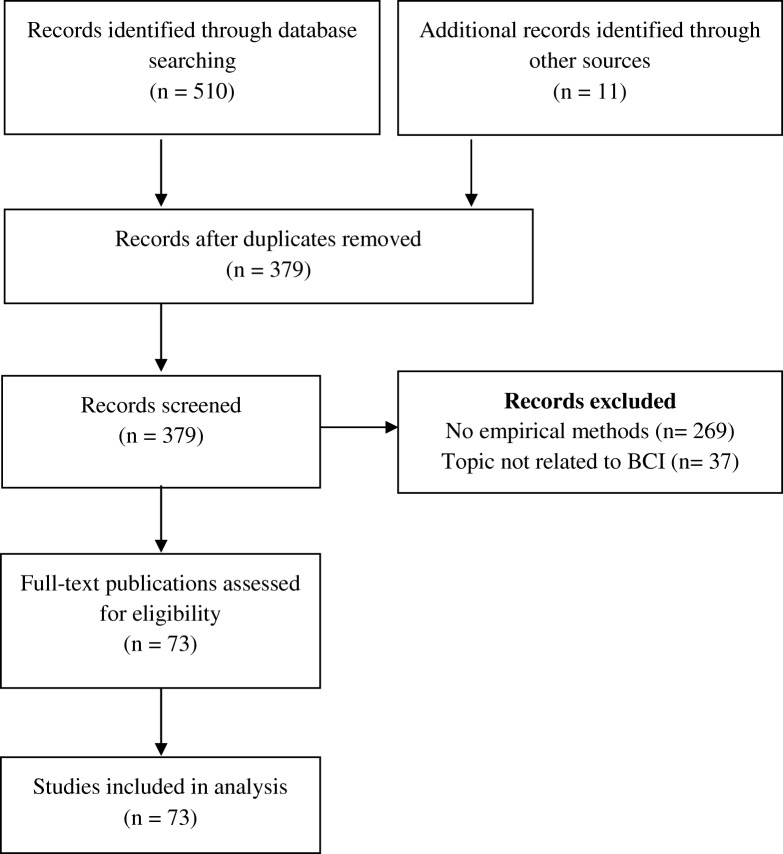
Methods: For this scoping review of research on BCIs' social and ethical implications, we systematically analyzed six databases, encompassing the fields of medicine, psychology, and the social sciences, in order to identify empirical studies on BCIs. The search yielded 73 publications that employ quantitative, qualitative, or mixed methods.
Results: Of the 73 publications, 71 studies address the user perspective. Some studies extend to consideration of other BCI stakeholders such as medical technology experts, caregivers, or health care professionals. The majority of the studies employ quantitative methods. Recurring themes across the studies examined were general user opinion towards BCI, central technical or social issues reported, requests/demands made by users of the technology, the potential/future of BCIs, and ethical aspects of BCIs.
Conclusions: Our findings indicate that while technical aspects of BCIs such as usability or feasibility are being studied extensively, comparatively little in-depth research has been done on the self-image and self-experience of the BCI user. In general there is also a lack of focus or examination of the caregiver's perspective.
Keywords: Brain-computer interfaces; Empirical research; Neuroethics; Qualitative methods; Quantitative methods; User experience.
Conflict of interest statement
Ethics approval and consent to participate
Not applicable.
Consent for publication
Not applicable.
Competing interests
JK, JS and OF declare that they have no competing interests. RJ is member of the Editorial Board for BMC Medical Ethics.
Publisher’s Note
Springer Nature remains neutral with regard to jurisdictional claims in published maps and institutional affiliations.
References
-
- Brunner C, Birbaumer N, Blankertz B, Guger D, Kübler A, Mattia D, et al. BNCI Horizon 2020: towards a roadmap for the BCI community. Brain-Comput Interfaces. 2015. 10.1080/2326263X.2015.1008956 e-pub 10 Feb 2015.
-
- Bouton CE, Shaikhouni A, Annetta NV, Bockbrader MA, Friedenberg DA, Nielson DM, et al. Restoring cortical control of functional movement in a human with quadriplegia. Nature. 2016;533(7602):247–250. - PubMed
-
- Daly JJ, Wolpaw JR. Brain–computer interfaces in neurological rehabilitation. Lancet Neurol. 2008;7(11):1032–1043. - PubMed
-
- Graimann B, Allison B, Pfurtscheller G. Brain–Computer Interfaces: A Gentle Introduction. In: Graimann B, Pfurtscheller G, Allison B, editors. Brain-Computer Interfaces. Berlin, Heidelberg: Heidelberg: Springer; 2009.
Publication types
MeSH terms
LinkOut - more resources
Full Text Sources
Medical
