. 2019 Mar 7;7(1):36.
doi: 10.1186/s40478-019-0691-9.

Tau exhibits unique seeding properties in globular glial tauopathy

Affiliations

Tau exhibits unique seeding properties in globular glial tauopathy

Dah-Eun Chloe Chung et al. Acta Neuropathol Commun. .

Abstract

Tauopathies are neurodegenerative disorders characterized by aggregation of microtubule associated tau protein in neurons and glia. They are clinically and pathologically heterogeneous depending on the isoform of tau protein that accumulates (three or four 31-to-32-amino-acid repeats [3R or 4R] in the microtubule binding domain), as well as the cellular and neuroanatomical distribution of tau pathology. Growing evidence suggests that distinct tau conformers may contribute to the characteristic features of various tauopathies. Globular glial tauopathy (GGT) is a rare 4R tauopathy with globular cytoplasmic inclusions within neurons and glial cells. Given the unique cellular distribution and morphology of tau pathology in GGT, we sought to determine if tau species in GGT had distinctive biological properties. To address this question, we performed seeding analyses with postmortem brain tissues using a commercial tau biosensor cell line. We found that brain lysates from GGT cases had significantly higher seeding competency than other tauopathies, including corticobasal degeneration (CBD), progressive supranuclear palsy (PSP), and Alzheimer's disease (AD). The robust seeding activity of GGT brain lysates was independent of phosphorylated tau burden and diminished upon removal of tau from samples, suggesting that seeding properties were indeed mediated by tau in the lysates. In addition, cellular inclusions in the tau biosensor cell line induced by GGT had a distinct, globular morphology that was markedly different from inclusions induced by other tauopathies, further highlighting the unique nature of tau species in GGT. Characterization of different tau species in GGT showed that detergent-insoluble, fibril-like tau contained the highest seeding activity, as reflected in its ability to increase tau aggregation in primary glial cultures. Taken together, our data suggest that unique seeding properties differentiate GGT-tau from other tauopathies, which provides new insight into pathogenic heterogeneity of primary neurodegenerative tauopathies.

Keywords: Aggregation; Globular glial tauopathy; Seeding; Tau; Tauopathy.


Conflict of interest statement

Ethics approval and consent to participate

This study was conducted in compliance with institutional guidelines and approved by the appropriate institutional committees.

Consent for publication

Not applicable.

Competing interests

The authors have no competing interests to disclose.

Publisher’s Note

Springer Nature remains neutral with regard to jurisdictional claims in published maps and institutional affiliations.

Figures
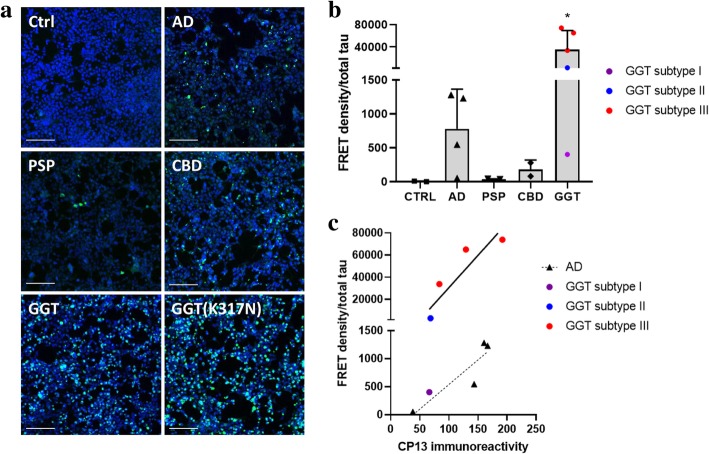
Fig. 1
Fig. 1
GGT brain lysates contain significantly higher tau seeding potency compared to other tauopathies. a Incubation of the tau biosensor cell line with brain lysates of sporadic or mutant (p.K317 N) GGT cases, resulted in induction of numerous GFP-positive puncta that are indicative of robust tau seeding. Representative confocal microscopy images are shown (scale bar = 100 μm). b Significant tau seeding activity of GGT brain lysates was measured by the FRET flow cytometry assay. FRET density was normalized to the amount of total tau present in the sample. Data are presented as mean ± SD (*p < 0.05 compared to control). c Analysis of p-tau burden from corresponding GGT and AD brain sections stained with CP13 p-tau antibody (pS202) demonstrated that GGT cases with similar p-tau burden to AD cases still induced robust FRET signals (R = 1, p = 0.0167 [GGT]; R = 0.8, p = ns [AD])
Fig. 2
Fig. 2
Tau is the main contributor of tau seeding competency of GGT brain lysates. a A schematic diagram depicting the process of immunodepletion of tau from GGT brain lysates. b Successful removal of tau from the sample confirmed by Western blot using a human tau-specific antibody E1 (19–33 amino acid). c Representative confocal images showing formation of much fewer seeding-induced puncta in the tau biosensor cell line upon incubation with tau-immunodepleted GGT brain lysates (scale bar = 100 μm). d A significant decrease in tau seeding activity following immunodepletion of tau from GGT brain lysates, as quantified by the FRET flow cytometry assay. Data are presented as mean ± SD (**p < 0.01)
Fig. 3
Fig. 3
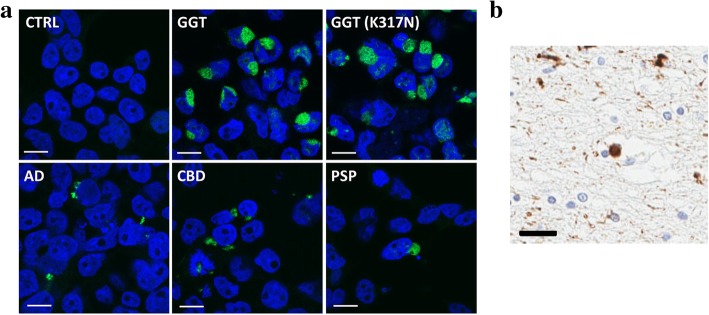
Tau aggregates induced by GGT brain lysates display distinct morphology. a A large, distinctively globular morphology of tau aggregates in the tau biosensor cell line induced by sporadic or mutant GGT brain lysates. Representative confocal images illustrate their markedly different morphology compared to those induced by AD, CBD, or PSP brain lysates (scale bar = 10 μm). b Tau-immunopositive, globular cytoplasmic inclusion in GGT brain sections stained with CP13 p-tau antibody (pS202) (scale bar = 10 μm)
Fig. 4
Fig. 4
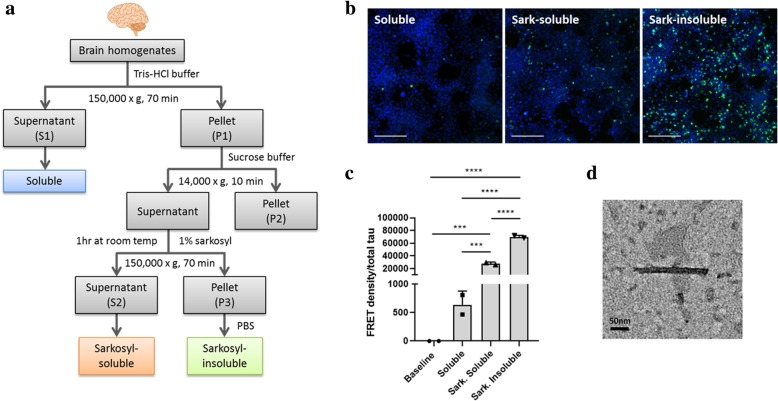
Sarkosyl-insoluble, fibril-like tau species implicated in GGT has the strongest seeding property. a A schematic diagram depicting the isolation method for different tau species from the brain samples. b Representative confocal images showing formation of the most seeding-induced puncta in the tau biosensor cell line upon incubation with sarkosyl-insoluble GGT-tau (scale bar = 100 μm). c The strongest tau seeding activity was detected in sarkosyl-insoluble GGT-tau as measured by the FRET flow cytometry assay. FRET density was normalized to the amount of total tau present in the sample. Data are presented as mean ± SD (***p < 0.001; ****p < 0.0001). d A representative electron microscopy (EM) image showing straight tau filaments in the sarkosyl-insoluble GGT-tau fraction
Fig. 5
Fig. 5
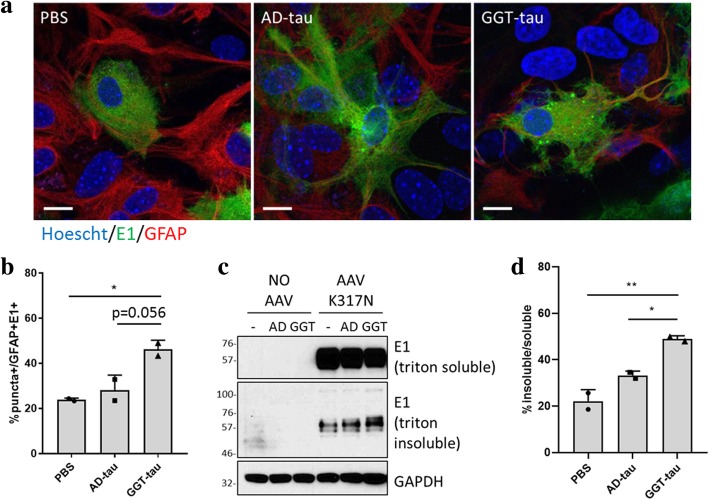
Sarkosyl-insoluble GGT-tau promotes intracellular tau aggregation in primary mouse astrocytes. a Representative confocal images showing primary mouse astrocytes transduced with AAV-TauK317N and subsequently treated with sarkosyl-insoluble GGT-tau or AD-tau for comparison. E1 staining for human tau is in green and GFAP staining for astrocytes is in red. Nuclei were stained with Hoechst (scale bar = 10 μm). b Quantification of percentage of astrocytes that are transduced with AAV-TauK317N and display tau seeding-like puncta (*p < 0.05). c-d Changes in the level of tau aggregation in AAV-transduced astrocytes upon treatment with either sarkosyl-insoluble GGT-tau or AD-tau were detected by Western blot (c) and quantified based on band intensity (*p < 0.05; **p < 0.01) (d)

References

    1. Adams SJ, DeTure MA, McBride M, Dickson DW, Petrucelli L. Three repeat isoforms of tau inhibit assembly of four repeat tau filaments. PLoS One. 2010;5:e10810. doi: 10.1371/journal.pone.0010810. - DOI - PMC - PubMed
    1. Ahmed Z, Bigio EH, Budka H, Dickson DW, Ferrer I, Ghetti B, et al. Globular glial tauopathies (GGT): consensus recommendations. Acta Neuropathol. 2013;126:537–544. doi: 10.1007/s00401-013-1171-0. - DOI - PMC - PubMed
    1. Ahmed Z, Doherty KM, Silveira-Moriyama L, Bandopadhyay R, Lashley T, Mamais A, et al. Globular glial tauopathies (GGT) presenting with motor neuron disease or frontotemporal dementia: an emerging group of 4-repeat tauopathies. Acta Neuropathol. 2011;122:415–428. doi: 10.1007/s00401-011-0857-4. - DOI - PubMed
    1. Carlomagno Y, Chung DC, Yue M, Castanedes-Casey M, Madden BJ, Dunmore J, et al. An acetylation-phosphorylation switch that regulates tau aggregation propensity and function. J Biol Chem. 2017;292:15277–15286. doi: 10.1074/jbc.M117.794602. - DOI - PMC - PubMed
    1. Clavaguera F, Akatsu H, Fraser G, Crowther RA, Frank S, Hench J, et al. Brain homogenates from human tauopathies induce tau inclusions in mouse brain. Proc Natl Acad Sci U S A. 2013;110:9535–9540. doi: 10.1073/pnas.1301175110. - DOI - PMC - PubMed

Publication types

MeSH terms