


Trends in Hospital Readmission of Medicare-Covered Patients With Heart Failure
- PMID: 30846093
- PMCID: PMC7011858
- DOI: 10.1016/j.jacc.2018.12.040
Trends in Hospital Readmission of Medicare-Covered Patients With Heart Failure
Abstract
Background: The Medicare Hospital Readmissions Reduction Program has led to fewer readmissions following hospitalizations with a principal diagnosis of heart failure (HF). Patients with HF are frequently hospitalized for other causes.
Objectives: This study sought to compare trends in Medicare risk-adjusted, 30-day readmissions following principal HF hospitalizations and other hospitalizations with HF.
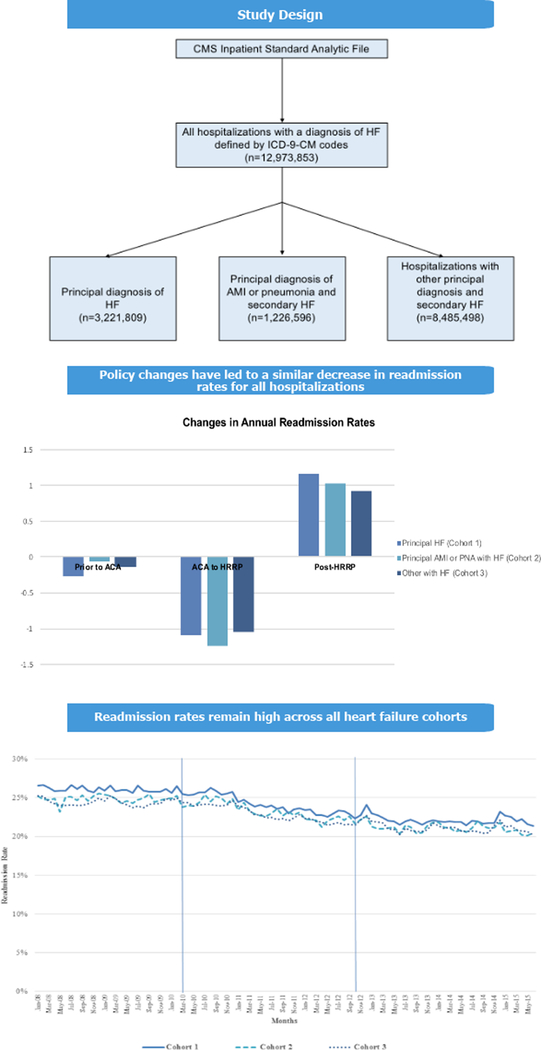
Methods: This was a retrospective study of 12,973,853 Medicare hospitalizations with a principal or secondary diagnosis of HF between January 2008 and June 2015. Hospitalizations were categorized as follows: principal HF hospitalizations; principal acute myocardial infarction or pneumonia hospitalizations with secondary HF; and other hospitalizations with secondary HF. The study examined trends in risk-adjusted, 30-day, all-cause readmission rates for each cohort and trends in differences in readmission rates among cohorts by using linear spline regression models.
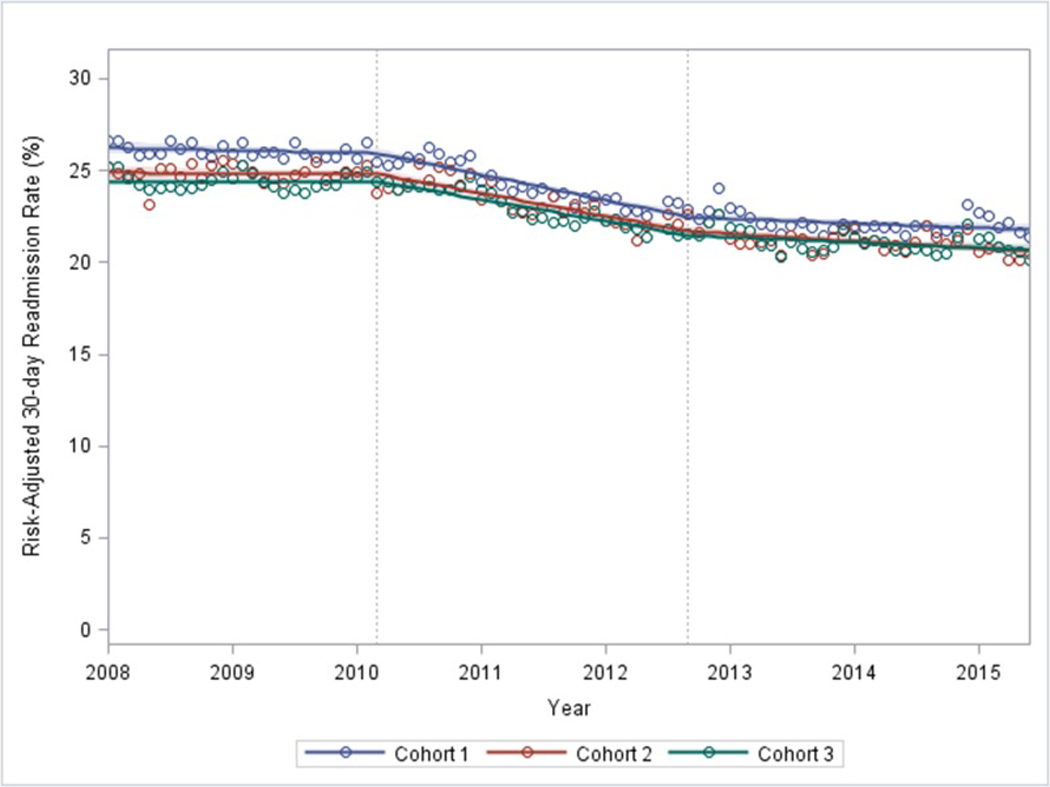
Results: Before passage of the Affordable Care Act in March 2010, risk-adjusted, 30-day readmission rates were stable for all 3 cohorts, with mean monthly rates of 26.1%, 24.9%, and 24.4%, respectively. Risk-adjusted readmission rates started declining after passage of the Affordable Care Act by 1.09% (95% confidence interval [CI]: 0.51% to 1.68%), 1.24% (95% CI: 0.92% to 1.57%), and 1.05% (95% CI: 0.52% to 1.58%) per year, respectively, until implementation of the Hospital Readmissions Reduction Program in October 2012 and then stabilized for all 3 cohorts.
Conclusions: Patients with HF are often hospitalized for other causes, and these hospitalizations have high readmission rates. Policy changes led to decreases in readmission rates for both principal and secondary HF hospitalizations. Readmission rates in both groups remain high, suggesting that initiatives targeting all hospitalized patients with HF continue to be warranted.
Keywords: Medicare; heart failure; hospitalizations; outcomes.
Copyright © 2019 American College of Cardiology Foundation. Published by Elsevier Inc. All rights reserved.
Figures
Comment in
-
Hospital Readmission Reduction Program for Heart Failure: The Spread of Intended and Unintended Consequences.J Am Coll Cardiol. 2019 Mar 12;73(9):1013-1015. doi: 10.1016/j.jacc.2018.12.043. J Am Coll Cardiol. 2019. PMID: 30846094 Free PMC article. No abstract available.
References
-
- Centers for Medicare & Medicaid Services. Readmissions Reduction Program. Available at: https://www.cms.gov/Medicare/Medicare-Fee-for-Service-Payment/AcuteInpat.... Accessed September 21,2018.
-
- Kociol RD, Peterson ED, Hammill BG et al. National survey of hospital strategies to reduce heart failure readmissions: findings from the Get With the Guidelines-Heart Failure registry. Circ Heart Fail 2012;5:680–7. - PubMed
-
- Ahmad FS, Metlay JP, Barg FK, Henderson RR, Werner RM. Identifying hospital organizational strategies to reduce readmissions. Am J Med Qual 2013;28:278–85. - PubMed
Publication types
MeSH terms
Grants and funding
LinkOut - more resources
Full Text Sources
Medical
Research Materials
Miscellaneous
