


Do thermal treatments affect the mechanical behavior of porcelain-veneered zirconia? A systematic review and meta-analysis
- PMID: 30846374
- PMCID: PMC6619427
- DOI: 10.1016/j.dental.2019.02.016
Do thermal treatments affect the mechanical behavior of porcelain-veneered zirconia? A systematic review and meta-analysis
Abstract
Objectives: A systematic review of in vitro studies was conducted to assess the effect of thermal treatments on flexural strength or critical load to failure of porcelain-veneered zirconia (PVZ).
Sources: Literature searches were performed up to June 2018 in PubMed/MEDLINE, Scopus and Web of Science databases, with no publication year or language limits.
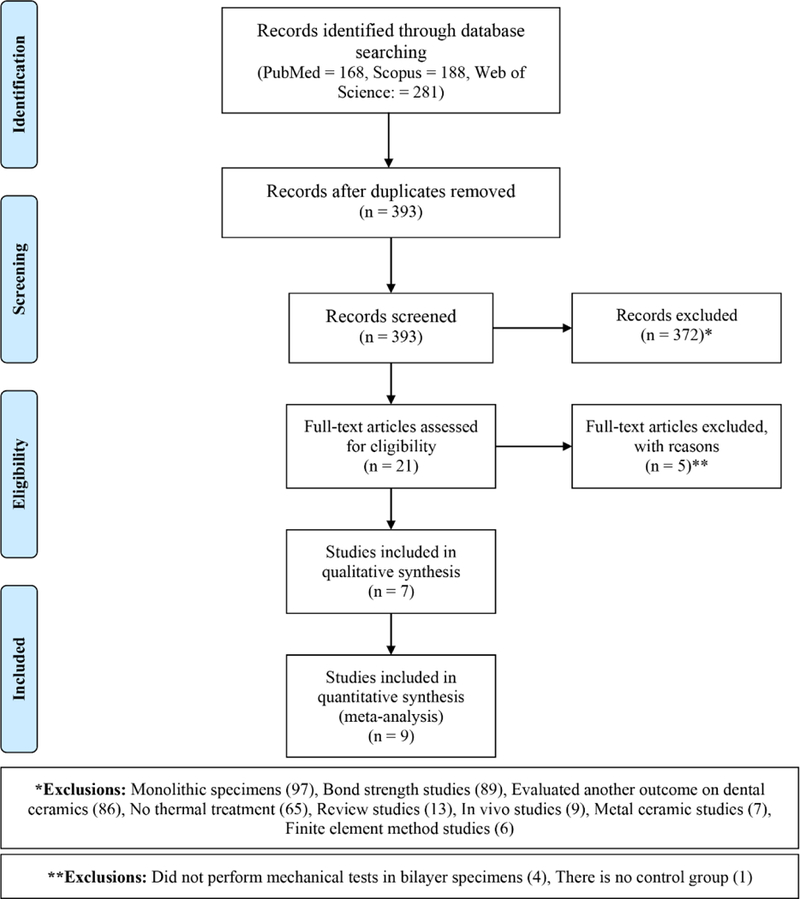
Data: From 393 relevant studies, 21 were selected for full-text analysis, from which 7 failed to meet the inclusion criteria. The 14 remaining papers were included in the systematic review: 8 for meta-analysis and 6 restricted to descriptive analyses. Hand searching of reference lists resulted in no additional papers.
Study selection: In vitro studies using PVZ specimens testing the influence of thermal treatments on the fracture resistance to monotonic or cyclic loading. Papers evaluating cooling rate were divided into those applying fast cooling from above the porcelain glass transition temperature (Tg), or from below it. Meta-analyses were performed separately for flexural strength and critical load to failure, using random effects at a 5% significance level.
Conclusions: Delaying furnace opening at a temperature below the porcelain Tg is advised for PVZ restorations, in order to improve their fracture resistance. Additional information is required to confirm the apparent beneficial effect of self-glaze and repeated veneer firings on the mechanical properties of these restorations. Finally, in order to obtain conclusive and relevant evidence regarding thermal treatments and the fracture resistance of PVZs, future studies should concentrate on anatomically-correct crown specimens.
Keywords: Cooling protocols; Glaze firings; Heat treatment; Mechanical properties; Porcelain-veneered zirconia; Repeated firings.
Copyright © 2019 The Academy of Dental Materials. Published by Elsevier Inc. All rights reserved.
Figures



References
-
- Manicone PF, Rossi Iommetti P, Raffaelli L. An overview of zirconia ceramics: basic properties and clinical applications. J Dent. 2007. November;35(11):819–26. - PubMed
-
- Larsson C, Wennerberg A. The clinical success of zirconia-based crowns: a systematic review. Int J Prosthodont. 2014. Jan-Feb;27(1):33–43. - PubMed
-
- Chaar MS, Kern M. Five-year clinical outcome of posterior zirconia ceramic inlay-retained FDPs with a modified design. J Dent. 2015. December;43(12):1411–5. - PubMed
-
- Raigrodski AJ, Yu A, Chiche GJ, Hochstedler JL, Mancl LA, Mohamed SE. Clinical efficacy of veneered zirconium dioxide-based posterior partial fixed dental prostheses: five-year results. J Prosthet Dent. 2012. October;108(4):214–22. - PubMed
-
- Dhima M, Paulusova V, Carr AB, Rieck KL, Lohse C, Salinas TJ. Practice-based clinical evaluation of ceramic single crowns after at least five years. Prosthet Dent. 2014. February;111(2):124–30. - PubMed
Publication types
MeSH terms
Substances
Grants and funding
LinkOut - more resources
Full Text Sources
Miscellaneous
