Secondhand Smoke and CKD
- PMID: 30846462
- PMCID: PMC6450336
- DOI: 10.2215/CJN.09540818
Secondhand Smoke and CKD
Abstract
Background and objectives: Active smoking is associated with higher risk of various diseases. However, the risk of CKD development in nonsmokers exposed to secondhand smoke is not well elucidated. We aimed to investigate the association between secondhand smoke exposure and the risk of CKD development among never-smokers.
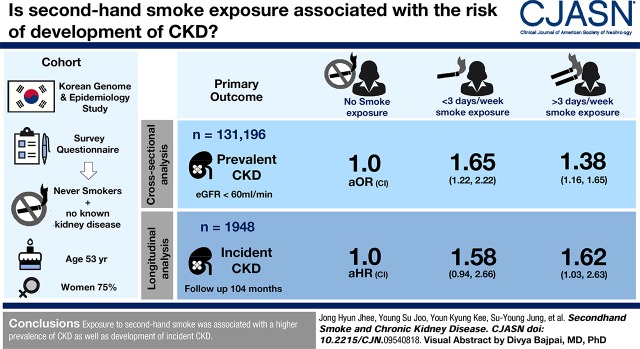
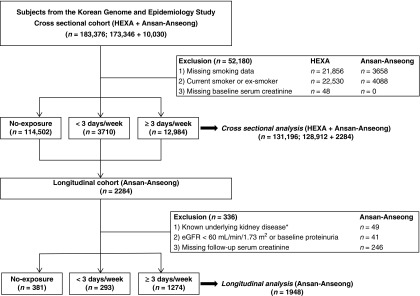
Design, setting, participants, & measurements: A total of 131,196 never-smokers with normal kidney function, who participated in the Korean Genome and Epidemiology Study from 2001 to 2014, were analyzed. The participants were classified into three groups on the basis of frequency of secondhand smoke exposure, assessed with survey questionnaires; no exposure, <3 days per week, and ≥3 days per week. The association between secondhand smoke and CKD, defined as eGFR<60 ml/min per 1.73 m2, was examined in the cross-sectional analysis. In addition, the risk of incident CKD development was analyzed in a longitudinal cohort of 1948 participants without CKD at baseline, which was a subset of the main cohort.
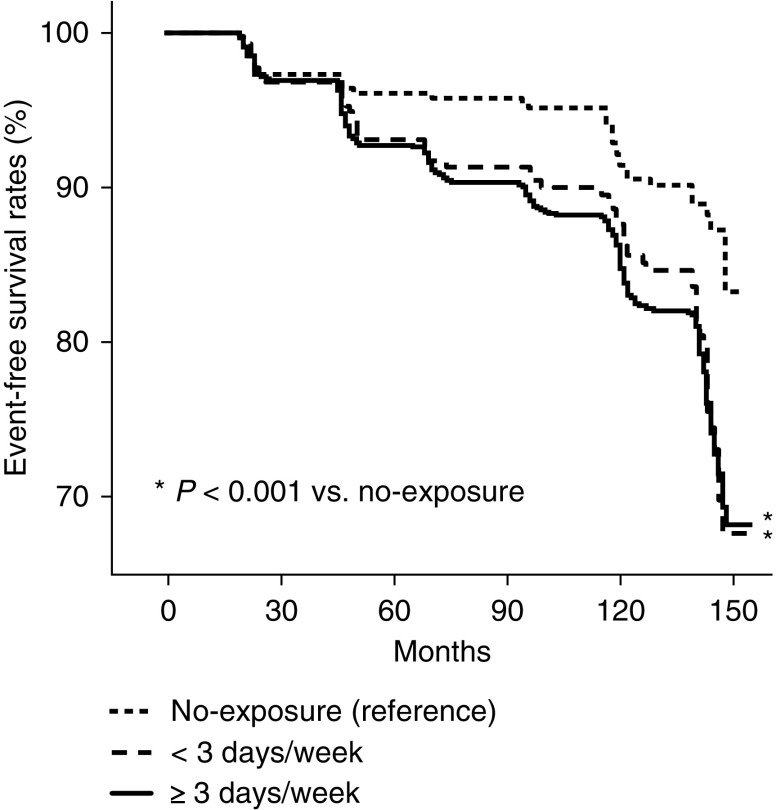
Results: The mean age of participants was 53 years, and 75% were women. Prevalent CKD was observed in 231 (1.8%), 64 (1.7%), and 2280 (2.0%) participants in the ≥3 days per week, <3 days per week, and no exposure groups. The odds ratio (OR) of prevalent CKD was significantly higher in the groups exposed to secondhand smoke than the no exposure group (<3 days per week: OR, 1.72; 95% confidence interval [95% CI], 1.30 to 2.27; and ≥3 days per week: OR, 1.44; 95% CI, 1.22 to 1.70). During a mean follow-up of 104 months, CKD occurred in 319 (16%) participants. Multivariable Cox analysis revealed that the risk for CKD development was higher in participants exposed to secondhand smoke than the no exposure group (<3 days per week: hazard ratio, 1.59; 95% CI, 0.96 to 2.65; and ≥3 days per week: hazard ratio, 1.66; 95% CI, 1.03 to 2.67).
Conclusions: Exposure to secondhand smoke was associated with a higher prevalence of CKD as well as development of incident CKD.
Keywords: Confidence Intervals; Cross-Sectional Studies; Epidemiologic Studies; Follow-Up Studies; Odds Ratio; Prevalence; Renal Insufficiency, Chronic; Risk; Smokers; Smoking; Tobacco Smoke Pollution; chronic kidney disease; clinical epidemiology; glomerular filtration rate; risk factors.
Copyright © 2019 by the American Society of Nephrology.
Figures
References
-
- Coresh J, Byrd-Holt D, Astor BC, Briggs JP, Eggers PW, Lacher DA, Hostetter TH: Chronic kidney disease awareness, prevalence, and trends among U.S. adults, 1999 to 2000. J Am Soc Nephrol 16: 180–188, 2005 - PubMed
-
- Chen J, Wildman RP, Gu D, Kusek JW, Spruill M, Reynolds K, Liu D, Hamm LL, Whelton PK, He J: Prevalence of decreased kidney function in Chinese adults aged 35 to 74 years. Kidney Int 68: 2837–2845, 2005 - PubMed
-
- Chadban SJ, Briganti EM, Kerr PG, Dunstan DW, Welborn TA, Zimmet PZ, Atkins RC: Prevalence of kidney damage in Australian adults: The AusDiab kidney study. J Am Soc Nephrol 14[7 Suppl 2]: S131–S138, 2003 - PubMed
-
- Levey AS, Atkins R, Coresh J, Cohen EP, Collins AJ, Eckardt KU, Nahas ME, Jaber BL, Jadoul M, Levin A, Powe NR, Rossert J, Wheeler DC, Lameire N, Eknoyan G: Chronic kidney disease as a global public health problem: Approaches and initiatives - a position statement from Kidney Disease Improving Global Outcomes. Kidney Int 72: 247–259, 2007 - PubMed
-
- Yoon CY, Lee M, Kim SU, Lim H, Chang TI, Kee YK, Han SG, Han IM, Kwon YE, Park KS, Lee MJ, Park JT, Han SH, Ahn SH, Kang SW, Yoo TH: Fatty liver associated with metabolic derangement in patients with chronic kidney disease: A controlled attenuation parameter study. Kidney Res Clin Pract 36: 48–57, 2017 - PMC - PubMed
Publication types
MeSH terms
Substances
LinkOut - more resources
Full Text Sources
Medical
Research Materials
Miscellaneous