. 2019 Mar 7;10(1):1114.
doi: 10.1038/s41467-019-09034-y.

Bioengineered bacterial vesicles as biological nano-heaters for optoacoustic imaging

Affiliations

Bioengineered bacterial vesicles as biological nano-heaters for optoacoustic imaging

Vipul Gujrati et al. Nat Commun. .

Abstract

Advances in genetic engineering have enabled the use of bacterial outer membrane vesicles (OMVs) to deliver vaccines, drugs and immunotherapy agents, as a strategy to circumvent biocompatibility and large-scale production issues associated with synthetic nanomaterials. We investigate bioengineered OMVs for contrast enhancement in optoacoustic (photoacoustic) imaging. We produce OMVs encapsulating biopolymer-melanin (OMVMel) using a bacterial strain expressing a tyrosinase transgene. Our results show that upon near-infrared light irradiation, OMVMel generates strong optoacoustic signals appropriate for imaging applications. In addition, we show that OMVMel builds up intense heat from the absorbed laser energy and mediates photothermal effects both in vitro and in vivo. Using multispectral optoacoustic tomography, we noninvasively monitor the spatio-temporal, tumour-associated OMVMel distribution in vivo. This work points to the use of bioengineered vesicles as potent alternatives to synthetic particles more commonly employed for optoacoustic imaging, with the potential to enable both image enhancement and photothermal applications.


Conflict of interest statement

V.N. is a shareholder in iThera Medical GmbH, Munich, Germany. The remaining authors declare no competing interests.

Figures
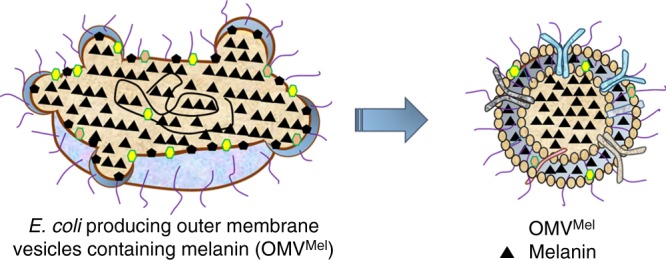
Fig. 1
Fig. 1
Schematic representation of OMVMel generation. A schematic representation of OMVMel purified after vesiculation from the parental bacteria. OMV, outer membrane vesicle
Fig. 2
Fig. 2
Outer membrane vesicle (OMV) purification and characterisation. a Purified form of OMVWT and OMVMel, isolated from parental bacteria by ultrafiltration and ultracentrifugation. b Dynamic light-scattering analysis of OMVs confirmed a particle size distribution in the range of 20 to 100 nm. c Transmission electron micrograph showing the nano-sized (<100 nm), bilayered, circular morphology of OMVWT and OMVMel. Scale bars, 100 nm. d Mean optoacoustic intensity (coloured line) as a function of wavelength for OMVWT and OMVMel
Fig. 3
Fig. 3
In vitro photothermal therapy using OMVMel. a Temperature curves of OMVMel, OMVWT and phosphate-buffered saline (PBS) during exposure to 750 nm light (650 mW cm−2) over a period of 10 min. OMV, outer membrane vesicle. b Plot of temperature change (ΔT) over a period of 10 min as a function of OMVMel concentration. c Absorbance spectra of OMVMel (~150 µg) solution obtained using a spectrometer. d Plot of time as a function of −ln(θ) for the raw data and a linear fit during cooling after 10 min of irradiation as described for a. e Fluorescence images of 4T1 cells treated with PBS, OMVWT or OMVMel, then irradiated with a laser as described in the Methods. Viable cells were stained green with calcein-acetoxymethyl (AM), while dead cells were stained red with ethidium homodimer-1 (EthD-1). Scale bars, 20 µm
Fig. 4
Fig. 4
In vivo multi-spectral optoacoustic tomography (MSOT) imaging. a 4T1 tumour-bearing mice were given a single injection of phosphate-buffered saline (PBS) (n = 3) or 150 µg of OMVWT (n = 4) or OMVMel (n = 4) via the tail vein. Tumour-specific accumulation over time was monitored using a commercially available preclinical MSOT system. Scale bar, 4 mm. OMV, outer membrane vesicle. b Melanin concentration in the tumour was measured over time. A single mean value was calculated over the tumour region. Mean values and error bars were expressed as mean ± SD, inter-group differences were assessed for significance using the paired t-test compared to control and differences were considered significant if ***p < 0.001. c, d Optoacoustic spectra from the tumour region of animals treated with c PBS or d OMVMel
Fig. 5
Fig. 5
In vivo photothermal therapy. a Infrared (IR) thermal images of 4T1 tumour-bearing mice before and after laser irradiation (1.5 W cm−2, 800 nm, 6 min). Before irradiation, animals were injected with phosphate-buffered saline (PBS) intravenously or with OMVMel or OMVWT intravenously (i.v.) or intratumourally (i.t.). b Tumour growth curves. Representative images of dissected tumours are also shown, except for OMVMel (i.t.) + L, which had nearly disappeared. Mean values and error bars are presented as mean ± SD, inter-group differences were assessed for significance using the paired t-test compared to control (***p < 0.001 vs. PBS with laser treatment; n= 4). c Body weight of all animals was recorded during each treatment, with all animals appearing healthy throughout the study based on eating and behaviour. OMV, outer membrane vesicle; L, laser irradiation

References

    1. Shanmugam V, Selvakumar S, Yeh CS. Near-infrared light-responsive nanomaterials in cancer therapeutics. Chem. Soc. Rev. 2014;43:6254–6287. doi: 10.1039/C4CS00011K. - DOI - PubMed
    1. Xie J, Lee S, Chen X. Nanoparticle-based theranostic agents. Adv. Drug Deliv. Rev. 2010;62:1064–1079. doi: 10.1016/j.addr.2010.07.009. - DOI - PMC - PubMed
    1. Michalet X, et al. Quantum dots for live cells, in vivo imaging, and diagnostics. Science. 2005;307:538–544. doi: 10.1126/science.1104274. - DOI - PMC - PubMed
    1. Nam J, et al. Chemo-photothermal therapy combination elicits anti-tumor immunity against advanced metastatic cancer. Nat. Commun. 2018;9:1074. doi: 10.1038/s41467-018-03473-9. - DOI - PMC - PubMed
    1. Mukherjee S, et al. Potential theranostics application of bio-synthesized silver nanoparticles (4-in-1 system) Theranostics. 2014;4:316–335. doi: 10.7150/thno.7819. - DOI - PMC - PubMed

Publication types
