. 2019 Mar 7;9(1):3788.
doi: 10.1038/s41598-019-39789-9.

2-Deoxy-D-Glucose inhibits aggressive triple-negative breast cancer cells by targeting glycolysis and the cancer stem cell phenotype

Affiliations

2-Deoxy-D-Glucose inhibits aggressive triple-negative breast cancer cells by targeting glycolysis and the cancer stem cell phenotype

Sadhbh O'Neill et al. Sci Rep. .

Abstract

Due to limited availability of pharmacological therapies, triple-negative breast cancer (TNBC) is the subtype with worst outcome. We hypothesised that 2-Deoxy-D-Glucose (2-DG), a glucose analogue, may hold potential as a therapy for particularly aggressive TNBC. We investigated 2-DG's effects on TNBC cell line variants, Hs578T parental cells and their isogenic more aggressive Hs578Ts(i)8 variant, using migration, invasion and anoikis assays. We assessed their bioenergetics by Seahorse. We evaluated metabolic alterations using a Seahorse XF Analyzer, citrate synthase assay, immunoblotting and flow cytometry. We assessed the cancer stem cell (CSC) phenotype of the variants and 2-DG's effects on CSCs. 2-DG significantly inhibited migration and invasion of Hs578Ts(i)8 versus Hs578T and significantly decreased their ability to resist anoikis. Investigating 2-DG's preferential inhibitory effect on the more aggressive cells, we found Hs578Ts(i)8 also had significantly decreased oxidative phosphorylation and increased glycolysis compared to Hs578T. This is likely due to mitochondrial dysfunction in Hs578Ts(i)8, shown by their significantly decreased mitochondrial membrane potential. Furthermore, Hs578Ts(i)8 had a significantly increased proportion of cells with CSC phenotype, which was significantly decreased by 2-DG. 2-DG may have benefit as a therapy for TNBC with a particularly aggressive phenotype, by targeting increased glycolysis. Studies of more cell lines and patients' specimens are warranted.


Conflict of interest statement

The authors declare no competing interests.

Figures
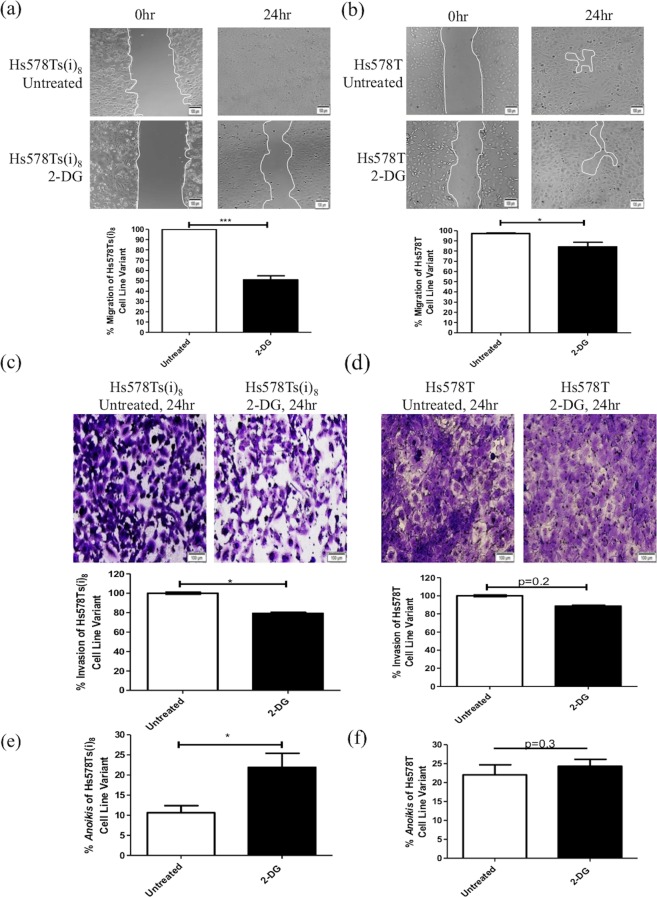
Figure 1
Figure 1
2-Deoxy-D-glucose significantly decreases the migration, invasion and resistance to anoikis of Hs578Ts(i)8 compared to Hs578T cells. (a,b) Wound-healing assays indicate that 2-DG significantly decreases the rate of migration of the Hs578T(i)8 and Hs578T cell variants, with effects on the Hs578T(i)8 population being most substantial. (c,d) Invasion assays indicate 2-DG significantly decreases the rate of invasion of Hs578T(i)8, but not Hs578T, cells; (e,f) anoikis assays showed 2-DG to significantly decreases the apoptosis resistance of the Hs578T(i)8 variant, but not the Hs578T cells. Data is expressed as the mean ± SEM of n = 3 experiments, where *p < 0.05, **p < 0.01, ***p < 0.001.
Figure 2
Figure 2
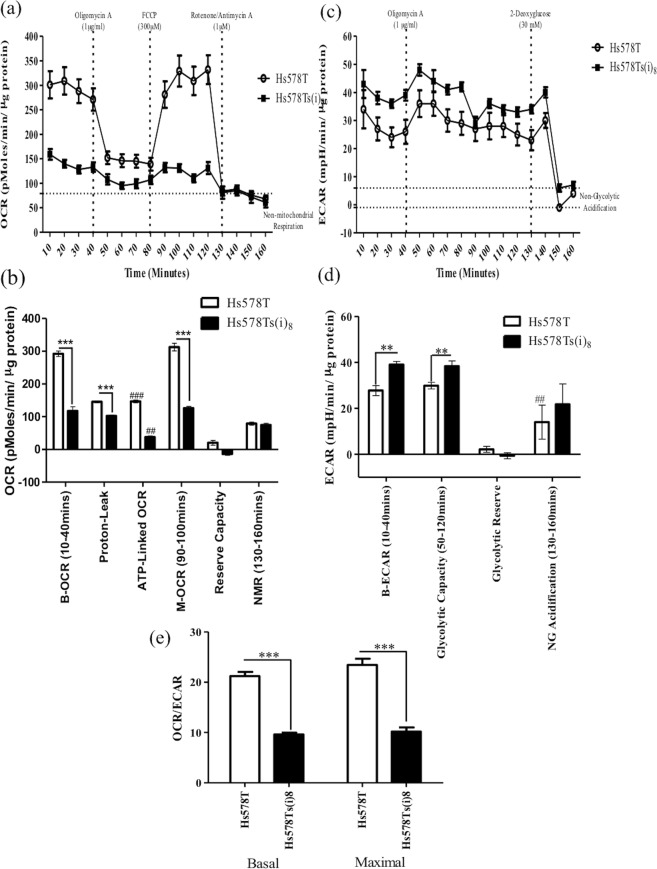
Bioenergetics of the Hs578T and Hs578Ts(i)8 cell variants. (a,b) There is a significant decrease in the rate of basal oxygen consumption (OCR) in the Hs578Ts(i)8 cells compared to the Hs578T cells. Addition of oligomycin A resulted in a significant decrease in the OCR of the Hs578Ts(i)8 cells and thus a significant difference in the OCR between the Hs578Ts(i)8 and Hs578T variants. Following addition of FCCP, OCR significantly increased in the Hs578Ts(i)8 cells. Finally, upon addition of rotenone, oxygen consumption was decreased substantially, a significant decrease from Hs578Ts(i)8 cells’ maximal OCR. (c,d) A significant increase in the basal rate of glycolysis was observed in the Hs578Ts(i)8 cells compared to the Hs578T cells. Following oligomycin A addition, the ECAR increased significantly in the Hs578Ts(i)8 cells compared to the Hs578T cells. Finally, following addition of 2-DG the ECAR decreased substantially in the Hs578Ts(i)8 and Hs578T cells. (e) The ratio of the basal and maximal OCR and ECAR is shown, this indicates that the OCR/ECAR ratios were significantly decreased in the Hs578Ts(i)8 cells compared to the parental Hs578T cells. Data is expressed as the mean ± SEM of n = 3 experiments, where **/##p < 0.01, ***/###p < 0.001, *Hs578Ts(i)8 vs Hs578T vs, #Hs578T vs Hs578T.
Figure 3
Figure 3
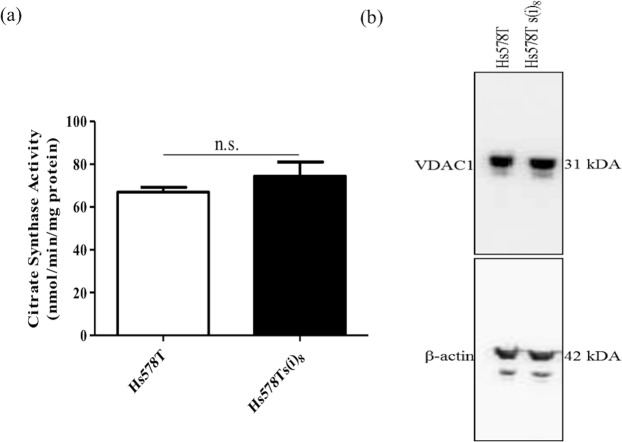
Evaluation of potential alterations in the mitochondrial biomass. Analysis of mitochondrial biomass by (a). The citrate synthase assay and (b). Immunoblot for VDAC1 showed no significant differences between Hs578T and Hs578Ts(i)8 cell variants. Data is expressed as the mean ± SEM of n = 3 experiments, differences were not statistically significant (n.s.). Note: the immunoblot was cropped to approximately 6 gel bandwidths of the relevant band. VDAC1 was probed for, the transmembrane was stripped and re-probed with the anti-β-actin antibody. Due to the large qualities of VDAC1 in the cell lysates, complete stripping did not occur and faint VDAC1 bands are still visible when presenting β-actin, due to the large quantities of VDAC1. However, their size differences make them clearly distinguishable.
Figure 4
Figure 4
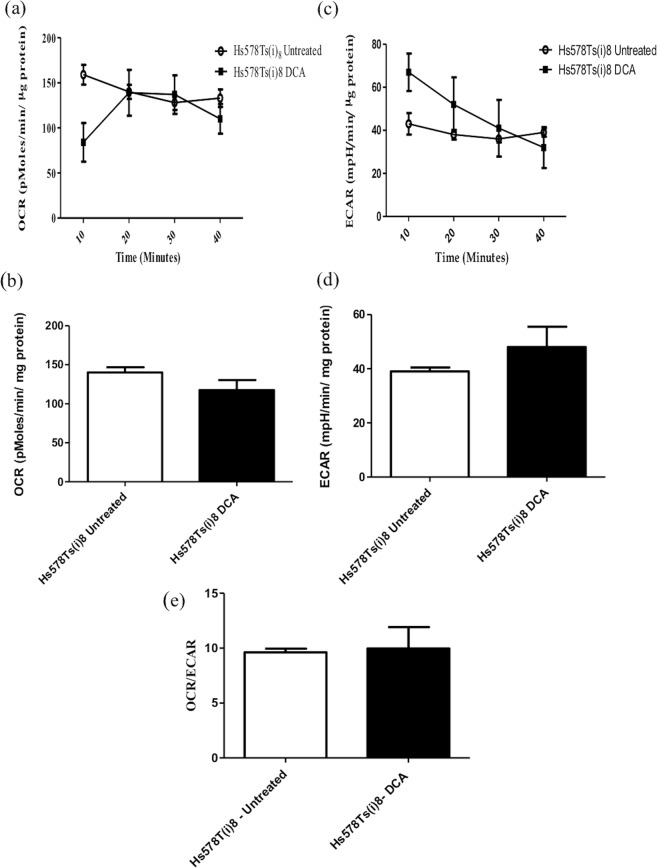
Bioenergetics of the Hs578T and Hs578Ts(i)8 variants following DCA treatment. (a,b) Following DCA treatment the basal OCR of the Hs578Ts(i)8 cells did not change significantly from the OCR observed without treatment. (c,d) Similarly the ECAR does not significantly change following treatment with DCA. (e) The ratio of the OCR and ECAR for the untreated and DCA treated Hs578Ts(i)8 cells is similar, showing that PDK is not implicated in the switch of the Hs578Ts(i)8 cells from oxidative phosphorylation to glycolysis. Data is expressed as the mean ± SEM of n = 3 experiments.
Figure 5
Figure 5
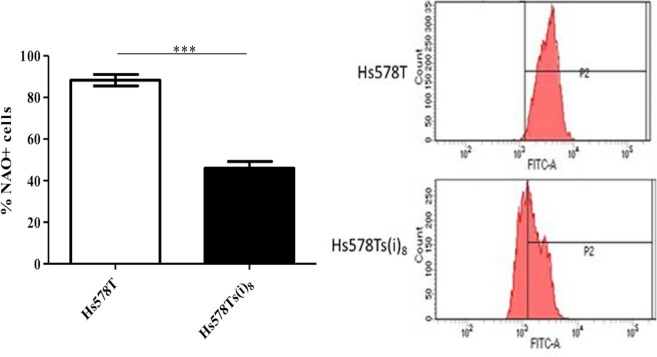
Mitochondria in Hs578Ts(i)8 cells show decreased mitochondrial potential compared to that of Hs578T cells. Hs578T and Hs578Ts(i)8 cell line variants were stained with 10 µM NAO. The intensity of the NAO staining showed that there is decreased mitochondrial membrane potential in the Hs578Ts(i)8 cells compared to the Hs578T cells. Data is expressed as the mean ± SEM of n = 3 experiments, where ***p < 0.001.
Figure 6
Figure 6
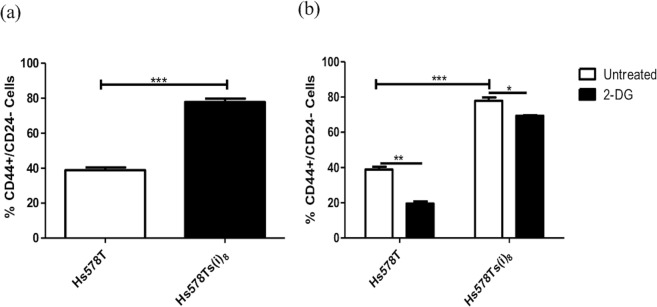
Hs578Ts(i)8 cells have an increased CSC population. Analysis of the CSC population showed that (a). Hs578Ts(i)8 variant, compared to Hs578T, has a significantly increased proportion of CD44+/CD24 cells, and (b). 2-DG significantly decreased the CSC population in both cell variants. Data is expressed as the mean ± SEM of n = 3 experiments, where *p < 0.05, **p < 0.01, ***p < 0.001.

References

    1. Crown J, O’Shaughnessy J, Gullo G. Emerging targeted therapies in triple-negative breast cancer. Ann. Oncol. 2012;23(Suppl 6):vi56–65. doi: 10.1093/annonc/mds196. - DOI - PubMed
    1. Zhao Y, Butler EB, Tan M. Targeting cellular metabolism to improve cancer therapeutics. Cell Death & Disease. 2013;4:e532. doi: 10.1038/cddis.2013.60. - DOI - PMC - PubMed
    1. Han T, et al. How does cancer cell metabolism affect tumor migration and invasion? Cell Adhesion & Migration. 2013;7:395–403. doi: 10.4161/cam.26345. - DOI - PMC - PubMed
    1. Christiansen JJ, Rajasekaran AK. Reassessing epithelial to mesenchymal transition as a prerequisite for carcinoma invasion and metastasis. Cancer Research. 2006;66:8319–8326. doi: 10.1158/0008-5472.CAN-06-0410. - DOI - PubMed
    1. Gumbiner BM. Regulation of cadherin-mediated adhesion in morphogenesis. Nature Reviews. Mol. Cell Biol. 2005;6:622–634. doi: 10.1038/nrm1699. - DOI - PubMed

Publication types

MeSH terms

Substances