


Identification of Key Metabolites for Acute Lung Injury in Patients with Sepsis
- PMID: 30847314
- PMCID: PMC6401565
Identification of Key Metabolites for Acute Lung Injury in Patients with Sepsis
Abstract
Background: The study aimed to detect critical metabolites in acute lung injury (ALI).
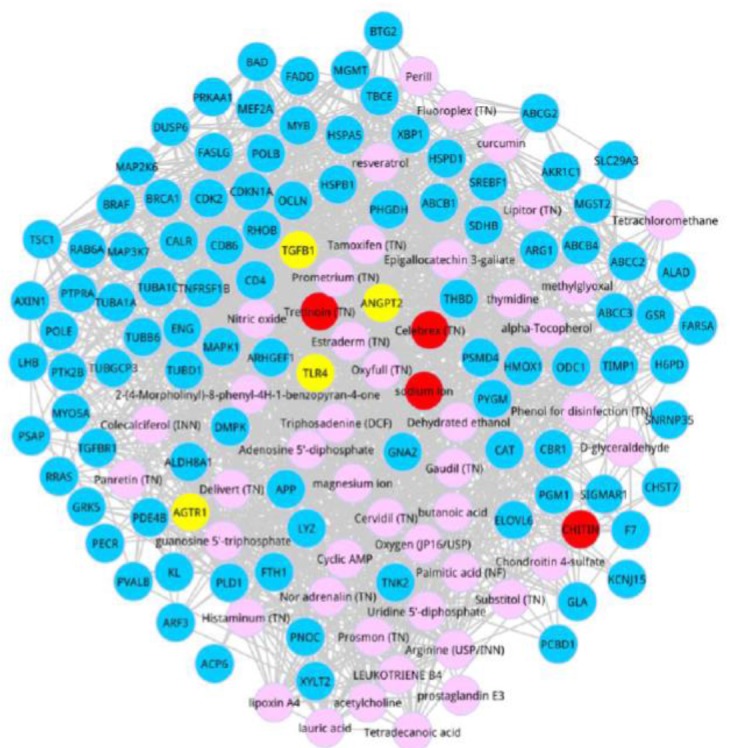
Methods: A comparative analysis of microarray profile of patients with sepsis-induced ALI compared with sepsis patients with was conducted using bioinformatic tools through constructing multi-omics network. Multi-omics composite networks (gene network, metabolite network, phenotype network, gene-metabolite association network, phenotype-gene association network, and phenotype-metabolite association network) were constructed, following by integration of these composite networks to establish a heterogeneous network. Next, seed genes, and ALI phenotype were mapped into the heterogeneous network to further obtain a weighted composite network. Random walk with restart (RWR) was used for the weighted composite network to extract and prioritize the metabolites. On the basis of the distance proximity among metabolites, the top 50 metabolites with the highest proximity were identified, and the top 100 co-expressed genes interacted with the top 50 metabolites were also screened out.
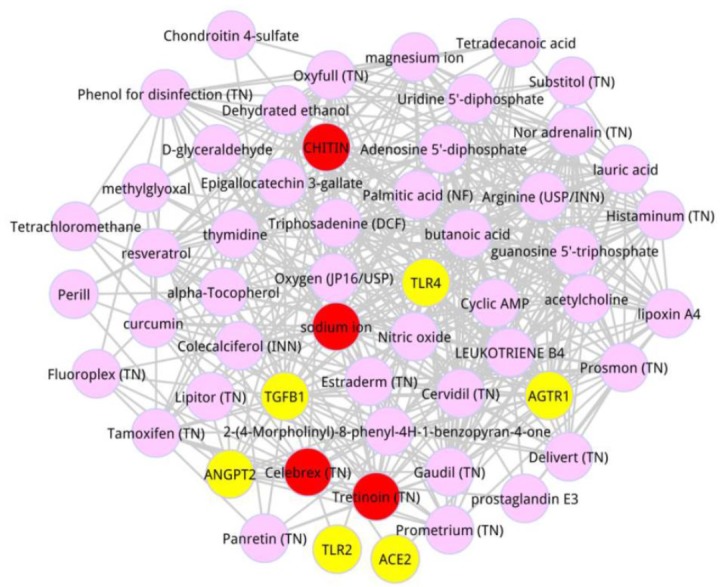
Results: Totally, there were 9363 nodes and 10,226,148 edges in the integrated composite network. There were 4 metabolites with the scores > 0.009, including CHITIN, Tretinoin, sodium ion, and Celebrex. Adenosine 5'-diphosphate, triphosadenine, and tretinoin had higher degrees in the composite network and the co-expressed network.
Conclusion: Adenosine 5'-diphosphate, triphosadenine, and tretinoin may be potential biomarkers for diagnosis and treatment of ALI.
Keywords: Acute lung injury; Differentially expressed genes; Metabolites; Multi-omics network.
Conflict of interest statement
Conflict of Interest The authors declare that there is no conflict of interest.
Figures
References
-
- Barbas CS. (2007). Acute lung injury and acute respiratory distress syndrome: diagnostic hurdles. J Bras Pneumol, 33: xxv– xxvi. - PubMed
-
- Rubenfeld GD, Caldwell E, Peabody E, et al. (2005). Incidence and outcomes of acute lung injury. N Engl J Med, 353: 1685– 93. - PubMed
-
- Esteban A, Fernández-Segoviano P, Frutos-Vivar F, et al. (2004). Comparison of clinical criteria for the acute respiratory distress syndrome with autopsy findings. Ann Intern Med, 141: 440– 5. - PubMed
LinkOut - more resources
Full Text Sources