Comparative Study
. 2019 Apr 1;11(4):1178-1191.
doi: 10.1093/gbe/evz047.

Genetic Variation in Pan Species Is Shaped by Demographic History and Harbors Lineage-Specific Functions

Affiliations
Comparative Study

Genetic Variation in Pan Species Is Shaped by Demographic History and Harbors Lineage-Specific Functions

Sojung Han et al. Genome Biol Evol. .

Abstract

Chimpanzees (Pan troglodytes) and bonobos (Pan paniscus) are the closest living relatives of humans, but the two species show distinct behavioral and physiological differences, particularly regarding female reproduction. Despite their recent rapid decline, the demographic histories of the two species have been different during the past 1-2 Myr, likely having an impact on their genomic diversity. Here, we analyze the inferred functional consequences of genetic variation across 69 individuals, making use of the most complete data set of genomes in the Pan clade to date. We test to which extent the demographic history influences the efficacy of purifying selection in these species. We find that small historical effective population sizes (Ne) correlate not only with low levels of genetic diversity but also with a larger number of deleterious alleles in homozygosity and an increased proportion of deleterious changes at low frequencies. To investigate the putative genetic basis for phenotypic differences between chimpanzees and bonobos, we exploit the catalog of putatively deleterious protein-coding changes in each lineage. We show that bonobo-specific nonsynonymous changes are enriched in genes related to age at menarche in humans, suggesting that the prominent physiological differences in the female reproductive system between chimpanzees and bonobos might be explained, in part, by putatively adaptive changes on the bonobo lineage.

Keywords: bonobo genome; bonobo reproduction; comparative genomics; deleteriousness.


Figures

<sc>Fig</sc>. 1.
Fig. 1.
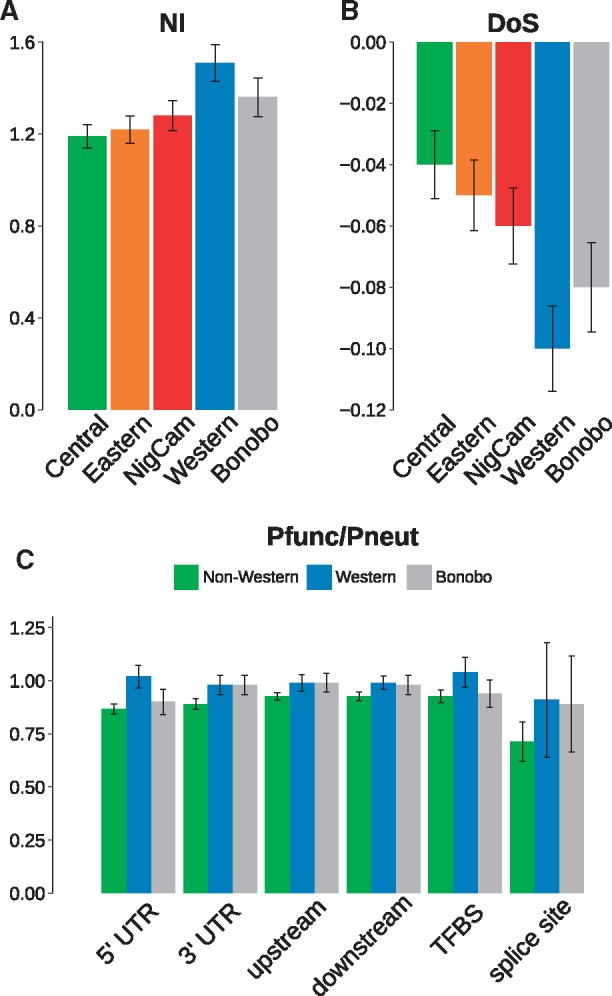
—Patterns of functional and neutral alleles. (A) Neutrality index in the five populations, with 95% confidence intervals across 22 chromosomes. (B) Direction of selection-test in the five populations, with 95% confidence intervals across 22 chromosomes. (C) Genome-wide ratio of functional to neutral polymorphism (Pfunc/Pneut) in different functional categories, for western chimpanzees, bonobos, and the average of three nonwestern chimpanzee populations; with 95% confidence intervals across 22 chromosomes.
<sc>Fig</sc>. 2.
Fig. 2.
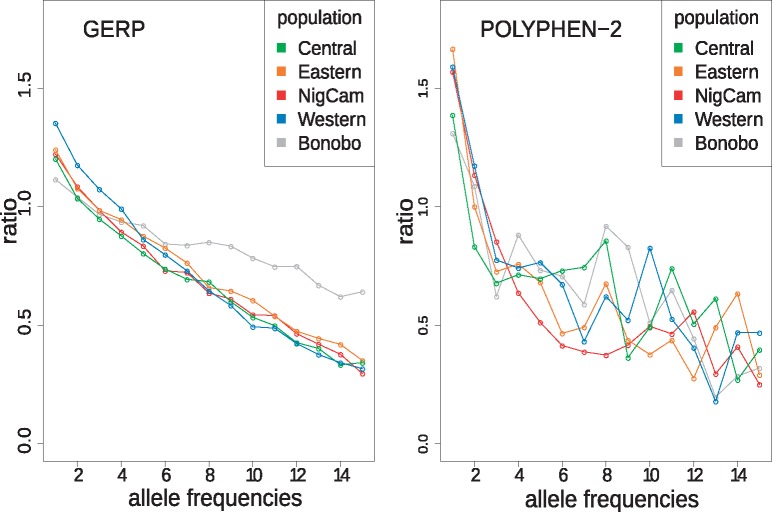
—Ratio of site frequency spectra (SFS) of deleterious-to-neutral derived alleles. Relative proportion of deleterious derived allele frequencies in each population, defined by GERP (Davydov et al., 2010) and POLYPHEN-2 (Adzhubei et al. 2010), respectively, compared with derived allele frequencies in neutral genomic regions, defined by Gronau et al. (2011). For comparison, eight individuals from each population were selected.
<sc>Fig</sc>. 3.
Fig. 3.
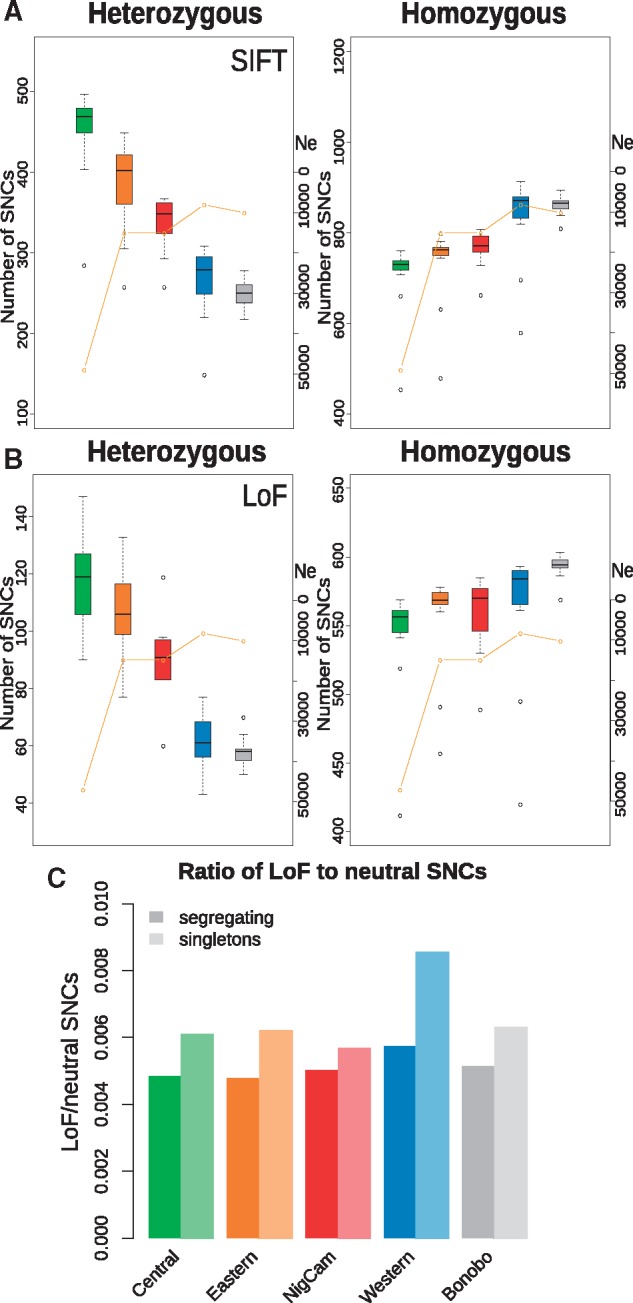
—Mutational load and LoF variants. (A) Individual mutational load in each population, considering only heterozygous sites (left) and only homozygous sites (right). These are the counts of deleterious derived alleles in each individual in each population, as defined by SIFT. Orange lines indicate the trend of Ne. Boxes and whisker diagrams represent lower quartile, median, and upper quartile. (B) Individual numbers of LoF variants, considering only heterozygous sites (left), and only homozygous sites (right). (C) Ratio of LoF variants to neutral variants in each population.
<sc>Fig</sc>. 4.
Fig. 4.
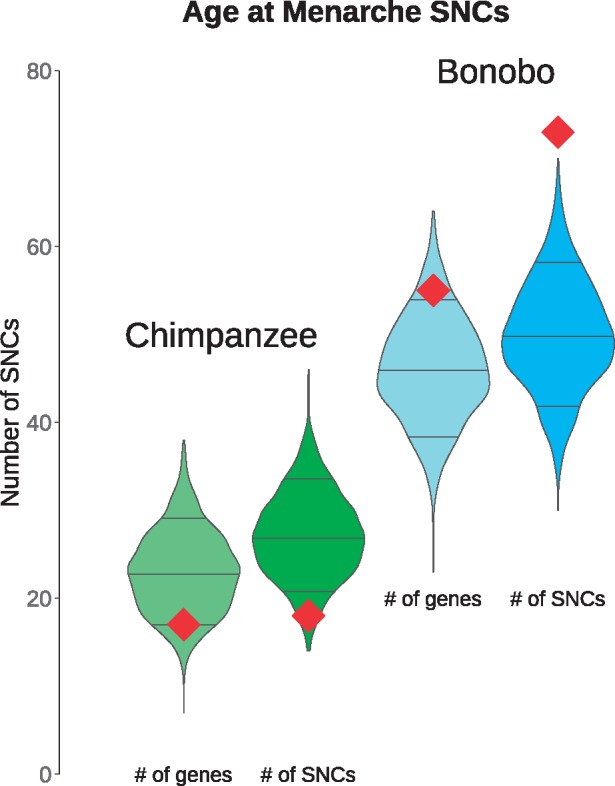
—Enrichment of nonsynonymous SNCs in genes associated with age at menarche in humans. The distributions of the overlap of genes with nonsynonymous SNCs with 1,000 random sets of 307 genes of similar coding length (±10%) as the menarche-associated genes are shown, with the observed values marked as red squares. From the left, the number of genes and SNCs with chimpanzee-specific changes, the number genes and SNCs with bonobo-specific changes. Lines represent median values, upper and lower deciles.

References

    1. Adzhubei IA, et al. 2010. A method and server for predicting damaging missense mutations. Nat Methods. 7(4):248–249. - PMC - PubMed
    1. Anders S, Pyl PT, Huber W.. 2015. HTSeq—a Python framework to work with high-throughput sequencing data. Bioinformatics 31(2):166.. - PMC - PubMed
    1. Bataillon T, et al. 2015. Inference of purifying and positive selection in three subspecies of chimpanzees (Pan troglodytes) from exome sequencing. Genome Biol Evol. 7(4):1122–1132. - PMC - PubMed
    1. Behringer V, Deschner T, Deimel C, Stevens JMG, Hohmann G.. 2014. Age-related changes in urinary testosterone levels suggest differences in puberty onset and divergent life history strategies in bonobos and chimpanzees. Horm Behav. 66(3):525–533. - PubMed
    1. Brawand D, et al. 2011. The evolution of gene expression levels in mammalian organs [SupMat]. Nature 478(7369):343–348. - PubMed

Publication types