


Adjusting for social risk factors impacts performance and penalties in the hospital readmissions reduction program
- PMID: 30848491
- PMCID: PMC6407348
- DOI: 10.1111/1475-6773.13133
Adjusting for social risk factors impacts performance and penalties in the hospital readmissions reduction program
Abstract
Objective: Medicare's Hospital Readmissions Reduction Program (HRRP) does not account for social risk factors in risk adjustment, and this may lead the program to unfairly penalize safety-net hospitals. Our objective was to determine the impact of adjusting for social risk factors on HRRP penalties.
Study design: Retrospective cohort study.
Data sources/study setting: Claims data for 2 952 605 fee-for-service Medicare beneficiaries with acute myocardial infarction (AMI), congestive heart failure (CHF) or pneumonia from December 2012 to November 2015.
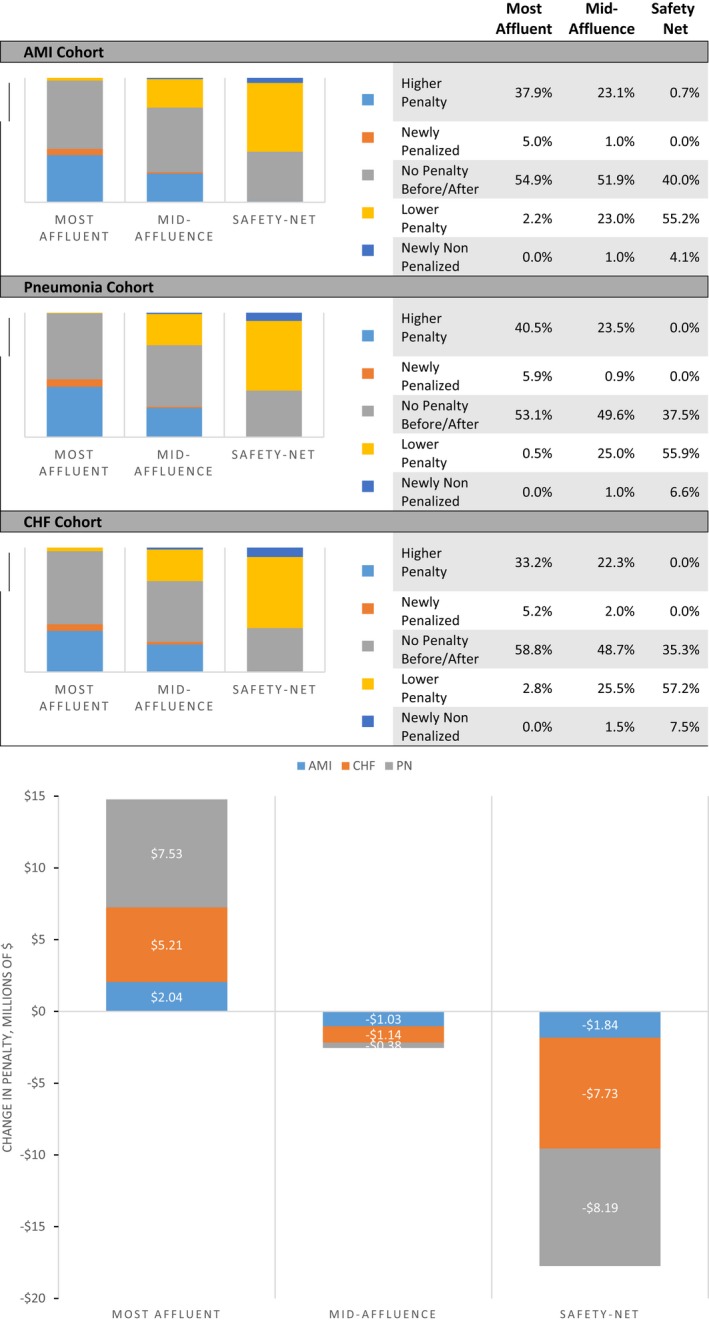
Principal findings: Poverty, disability, housing instability, residence in a disadvantaged neighborhood, and hospital population from a disadvantaged neighborhood were associated with higher readmission rates. Under current program specifications, safety-net hospitals had higher readmission ratios (AMI, 1.020 vs 0.986 for the most affluent hospitals; pneumonia, 1.031 vs 0.984; and CHF, 1.037 vs 0.977). Adding social factors to risk adjustment cut these differences in half. Over half the safety-net hospitals saw their penalty decline; 4-7.5 percent went from having a penalty to having no penalty. These changes translated into a $17 million reduction in penalties to safety-net hospitals.
Conclusions: Accounting for social risk can have a major financial impact on safety-net hospitals. Adjustment for these factors could reduce negative unintended consequences of the HRRP.
Keywords: Medicare; readmission.
© Health Research and Educational Trust.
Conflict of interest statement
Dr. Joynt Maddox does intermittent contract work for the United States Department of Health and Human Services, Office of the Assistant Secretary for Planning and Evaluation. Dr. Kind receives grant funding from the NIH/National Institute on Minority Health and Health Disparities, the NIH/National Institute on Aging, the Commonwealth Fund, the US Department of Veterans Affairs, and the US Centers for Medicare and Medicaid Services, and has performed work as a consultant for the US state of Maryland. Dr. Zaslavsky receives support under grants and contracts from the National Institutes on Aging and on Mental Health, and from the Centers for Medicare and Medicaid Services. Mr. Reidhead, Dr. Nerenz, Dr. Nagasako, and Dr. Hu report no conflicts.
Figures
References
-
- Joynt KE, Jha AK. Thirty‐day readmissions–truth and consequences. N Engl J Med. 2012;366(15):1366‐1369. - PubMed
-
- Joynt Maddox KE, Chen LM, Zuckerman R, Epstein AM. Association between race, neighborhood, and medicaid enrollment and outcomes in medicare home health care. J Am Geriatr Soc. 2018;66(2):239‐246. - PubMed
-
- Hu J, Gonsahn MD, Nerenz DR. Socioeconomic status and readmissions: evidence from an urban teaching hospital. Health Aff (Millwood). 2014;33(5):778‐785. - PubMed
Publication types
MeSH terms
Grants and funding
LinkOut - more resources
Full Text Sources
Medical
