


Family structure and past-30 day opioid misuse among justice-involved children
- PMID: 30849263
- PMCID: PMC6483835
- DOI: 10.1080/10826084.2019.1573839
Family structure and past-30 day opioid misuse among justice-involved children
Abstract
Background: To prevent opioid-related overdose among high risk youth, research on the predictors of opioid misuse (OM) initiation among justice-involved children (JIC) is needed. Living in a single-parent household, an important adverse childhood experience, is prevalent among JIC and linked to substance abuse. It is hypothesized that JIC who live in single-parent households will have a higher likelihood of meeting criteria for past-30 day OM than those who live in two-parent households.
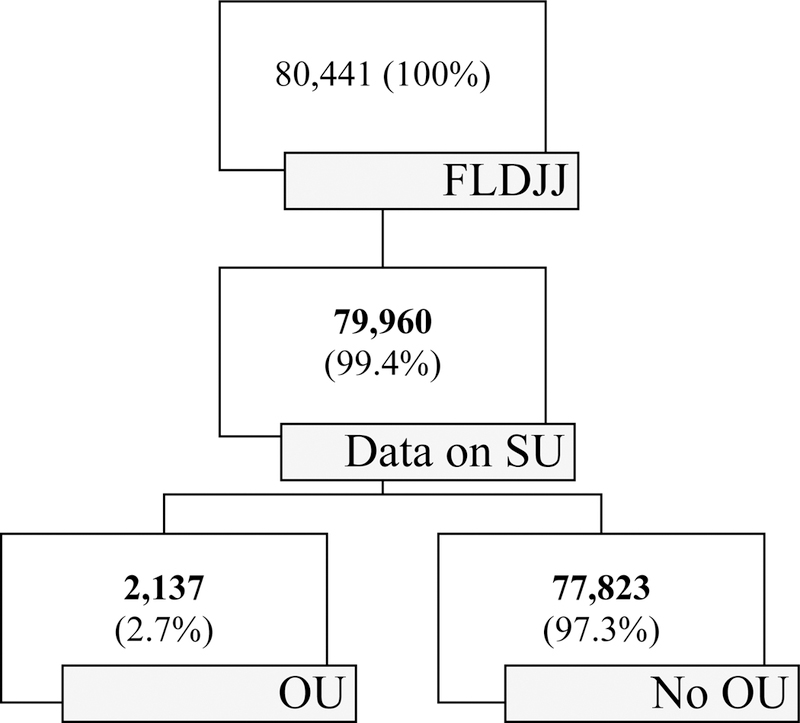
Methods: The data in this paper were obtained from the Florida Department of Juvenile Justice (FLDJJ). Cross-sectional data on 79,960 JIC from FLDJJ were examined. To test the hypothesis, multivariate logistic regression analyses were employed.
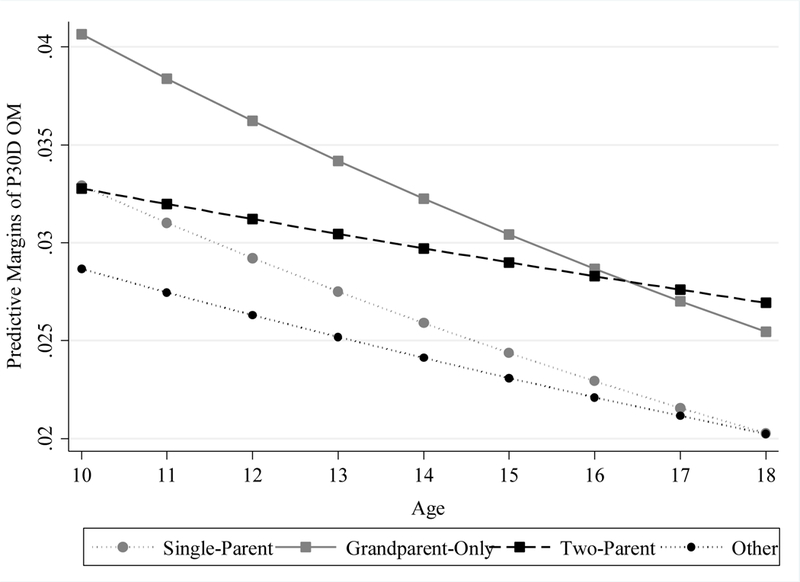
Results: Over 2,000 JIC in the sample met criteria for past-30 day (P30D) OM. Over 27.1% of those who met criteria for past-30 day OM lived in a two-parent household while 21.3% of those who were non-past-30 day users lived in two-parent households. Contrary to our hypothesis, JIC who lived in grandparent-only households were 28% as likely to report P30D OM as those who lived in single-parent households. Those who lived in two-parent households were 16% as likely to meet criteria for P30D OM as those in single-parent households. These relationships varied by age.
Conclusion: Two-parent and grandparent-only households maybe associated with increased access to opioids compared to other family structures with fewer adults. The risk of increased access may be more harmful than the strain of a single-parent household. Disposal of prescription medication initiatives should target households with multiple adults and grandparents.
Keywords: Opioid misuse; drug abuse; family structure; justice-involved children; juvenile justice.
Figures
References
-
- Baglivio MT, Epps N, Swartz K, Huq MS, Sheer A, & Hardt NS (2014). The prevalence of adverse childhood experiences (ACE) in the lives of juvenile offenders. Journal of Juvenile Justice, 3(2), 1.
-
- Baglivio MT, & Jackowski K (2013). Examining the validity of a juvenile offending risk assessment instrument across gender and race/ethnicity. Youth Violence and Juvenile Justice, 11(1), 26–43. doi: 10.1177/1541204012440107 - DOI
Publication types
MeSH terms
Grants and funding
LinkOut - more resources
Full Text Sources
Medical
Miscellaneous
