


Review
doi: 10.1016/j.sbi.2019.01.012.
Epub 2019 Mar 5.
Controlling protein conformation with light
Affiliations
- PMID: 30849716
- PMCID: PMC6697613
- DOI: 10.1016/j.sbi.2019.01.012
Item in Clipboard
Review
Controlling protein conformation with light
Curr Opin Struct Biol.
2019 Aug.
Abstract
Optogenetics, genetically encoded engineering of proteins to respond to light, has enabled precise control of the timing and localization of protein activity in live cells and for specific cell types in animals. Light-sensitive ion channels have become well established tools in neurobiology, and a host of new methods have recently enabled the control of other diverse protein structures as well. This review focuses on approaches to switch proteins between physiologically relevant, naturally occurring conformations using light, accomplished by incorporating light-responsive engineered domains that sterically and allosterically control the active site.
Copyright © 2019 Elsevier Ltd. All rights reserved.
Figures
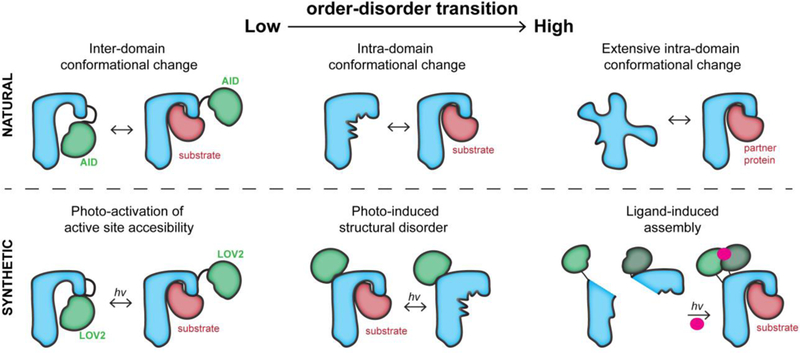
Top, left: An auto-inhibitory domain (AID) blocks the active site in the inactive state. Upon post-translational modification or protein binding, the AID undocks from the active site. Top, center: The active site undergoes a disorder-order transition during activation, enabling binding. Top, right: An intrinsically disordered protein becomes ordered upon binding to a partner protein. Bottom, left: The light-sensitive domain LOV2 blocks the active site. Upon irradiation, it undocks from the active site. Bottom, center: The LOV2 domain inserted into a loop of the host protein undergoes a light-induced conformational change. This distorts the active site allosterically. Bottom, right; The split halves of a protein reassemble upon binding a small molecule that enables dimerization. The small molecule is activated through cleavage of a light-sensitive protecting group.
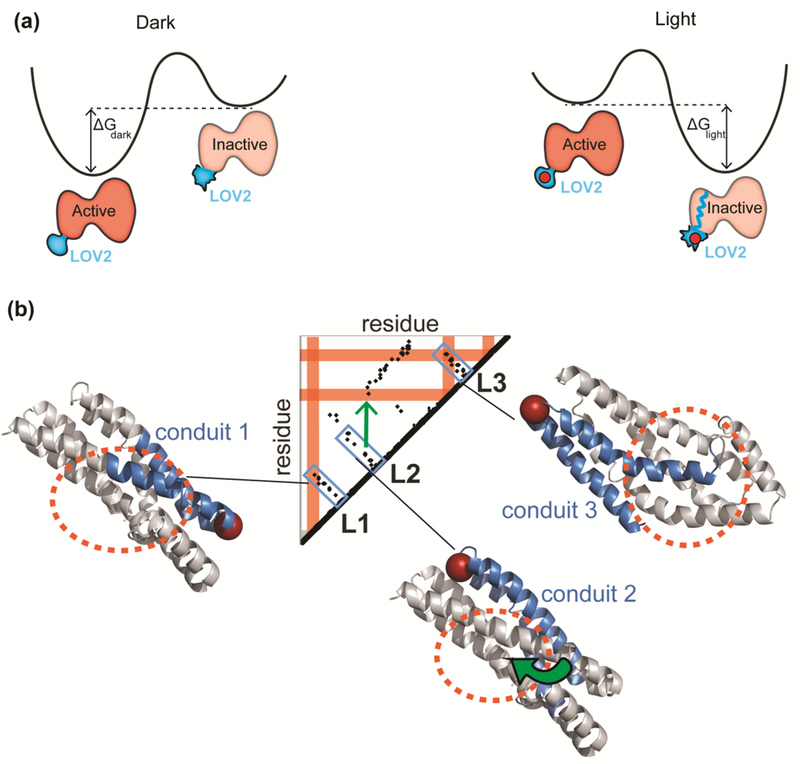
(a) Left: The lit/dark state equilibrium of the LOV2 domain is affected by irradiation [2,26]. In the dark, the active state (Jα helix wound) is favored. When LOV2 is irradiated, a covalent bond formed to the flavin shifts the equilibrium, favoring the inactive state (Jα unwound). The maximum energy that could be derived from this conformational shift in the LOV2 domain alone is 3.8 kcal/mol [26], and protein stabilities range between roughly 5 and 15 kcal/mol [36]. (b) A contact map showing pairwise contacts in the DH domain. The orange circles show the active site of the protein. The blue portions are “conduits” connecting the allosteric insertion sites (shown with red spheres) to the active site. The conduits can be seen as close proximity residues on the contact map. Allosteric effects can propagate through a secondary structure element that connects the loop to the active site (L1, L3) or the loop can communicate with the active site by passing through two secondary structure elements that affect one another at a point of close contact (green arrow).
References
-
- Trudeau T, Nassar R, Cumberworth A, Wong ET, Woollard G, Gsponer J: Structure and intrinsic disorder in protein autoinhibition. Structure 2013, 21:332–341. - PubMed
-
- Pufall MA, Graves BJ: Autoinhibitory domains: modular effectors of cellular regulation. Annu Rev Cell Dev Biol 2002, 18:421–462. - PubMed
Publication types
MeSH terms
Grants and funding
LinkOut - more resources
Full Text Sources
