


Chromosome screening using culture medium of embryos fertilised in vitro: a pilot clinical study
- PMID: 30849973
- PMCID: PMC6408780
- DOI: 10.1186/s12967-019-1827-1
Chromosome screening using culture medium of embryos fertilised in vitro: a pilot clinical study
Abstract
Background: Previous studies from this as well as other research groups suggested that non-invasive chromosome screening (NICS) with embryo culture medium can be used to identify chromosomal ploidy and chromosomal abnormalities. We here report a series of clinical cases utilizing the technology.
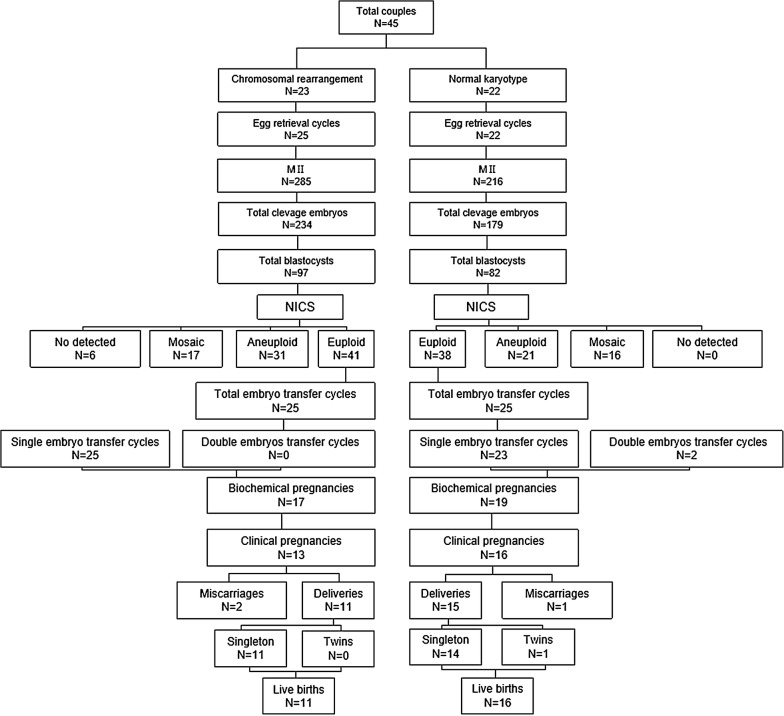
Methods: A total of 45 couples underwent in vitro fertilisation during a period between February 2016 and February 2017. Karyotyping revealed normal chromosomes in both partners in 23 couples, and chromosomal rearrangements in at least one partner in 22 couples. Intracytoplasmic sperm injection (ICSI) was used for fertilization. NICS was carried out using embryo culture medium at the blastocyst stage via multiple annealing and looping-based amplification cycles, whole-genome amplification and next-generation sequencing.
Results: A total of 413 embryos were obtained; 170 blastocysts were subjected to NICS. The screening showed euploidy in 79 embryos, aneuploidy in 52 embryos, and mosaic ploidy for 33 embryos. The rate of euploidy was comparable in couples with normal karyotype (50.7%; 38/75) vs. chromosomal rearrangement (43.2%; 41/95). A total of 52 euploid embryos (50 oocyte retrieval cycles) were transferred in 43 women. Biochemical pregnancy rate was 72.0% (36/50). Clinical pregnancy rate was 58.0% (29/50). The rate of spontaneous miscarriage was 3/29 (none with chromosomal aneuploidy). A total of 27 healthy babies were delivered.
Conclusions: NICS could identify embryo chromosomal abnormalities in couples either with or without chromosomal rearrangement, with satisfying clinical outcomes.
Keywords: Assisted reproductive technology; Chromosomal ploidy; Clinical outcome; Next-generation sequencing; Non-invasive chromosome screening.
Figures
References
-
- Minasi MG, Colasante A, Riccio T, Ruberti A, Casciani V, Scarselli F, et al. Correlation between aneuploidy, standard morphology evaluation and morphokinetic development in 1730 biopsied blastocysts: a consecutive case series study. Hum Reprod. 2016;31:2245–2254. doi: 10.1093/humrep/dew183. - DOI - PubMed
Publication types
MeSH terms
Substances
LinkOut - more resources
Full Text Sources
Other Literature Sources
Medical
