. 2019 Mar 8;10(1):1133.
doi: 10.1038/s41467-019-08867-x.

Diversifying the structure of zinc finger nucleases for high-precision genome editing

Affiliations

Diversifying the structure of zinc finger nucleases for high-precision genome editing

David E Paschon et al. Nat Commun. .

Abstract

Genome editing for therapeutic applications often requires cleavage within a narrow sequence window. Here, to enable such high-precision targeting with zinc-finger nucleases (ZFNs), we have developed an expanded set of architectures that collectively increase the configurational options available for design by a factor of 64. These new architectures feature the functional attachment of the FokI cleavage domain to the amino terminus of one or both zinc-finger proteins (ZFPs) in the ZFN dimer, as well as the option to skip bases between the target triplets of otherwise adjacent fingers in each zinc-finger array. Using our new architectures, we demonstrate targeting of an arbitrarily chosen 28 bp genomic locus at a density that approaches 1.0 (i.e., efficient ZFNs available for targeting almost every base step). We show that these new architectures may be used for targeting three loci of therapeutic significance with a high degree of precision, efficiency, and specificity.


Conflict of interest statement

All authors are current or former full-time employees of Sangamo Therapeutics, Inc.

Figures
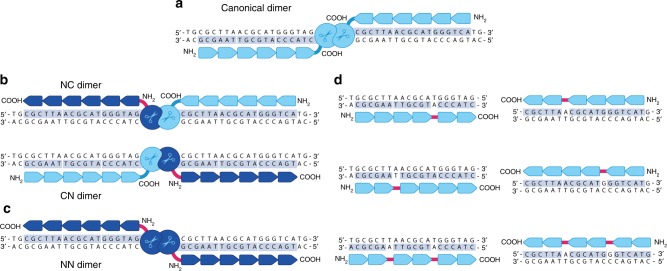
Fig. 1
Fig. 1
Linkers and architectures developed in this study. a Sketch of the canonical ZFN dimer architecture. Circles marked with a scissors symbol denote the FokI cleavage domain. A tandem array of six arrows indicates each designed six-finger ZFP. Key features of this architecture include attachment of the FokI nuclease domain to the carboxy terminus of each zinc finger array and a lack of base-skipping between adjacent zinc fingers. ZFNs are shown interacting with duplex DNA, with black text on a gray background denoting ZFN target sites. b Alternative architectures enabled via pairing of ZFNs bearing an amino-terminal FokI cleavage domain (dark blue) and a carboxy-terminal FokI cleavage domain (light blue). The linker joining the FokI nuclease domain to the amino terminus of the ZFP is shown in red. ZFNs bearing an amino-terminal FokI attachment are able to recognize a target on the opposite DNA strand, relative to their canonical counterparts (compare with a). Thus, these architectures allow both ZFNs to recognize the same DNA strand. These two architectures are structurally identical, although for this study they will be referred to as NC and CN dimers denoting the FokI attachment point for the upstream and downstream ZFN, respectively. c ZFN architecture enabled via pairing two ZFNs with amino-terminal FokI nuclease domain fusions. This architecture is the inverse of the canonical pair shown in a and is referred to as an NN dimer. d Recognition of alternative DNA frames and sequences enabled by insertion of base-skipping linkers between fingers 2 and 3 or 4 and 5 of a six-finger ZFP. Skipped bases are shown without a gray background. The skipping linker is shown as a red bar between fingers
Fig. 2
Fig. 2
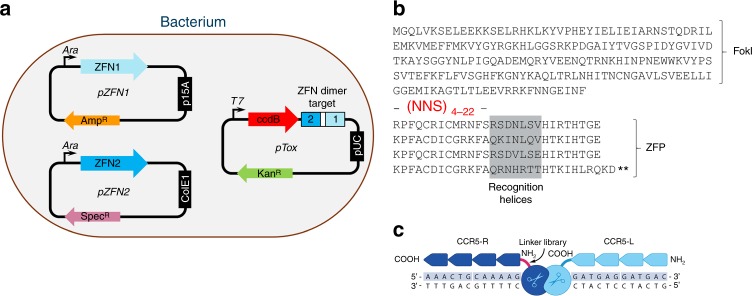
Overview of bacterial selection system and library design. a Sketch of a bacterium containing plasmids used for selection. Within the pZFN1 and pZFN2 plasmids (left), each ZFN monomer is placed under control of the inducible arabinose promoter, which allows fine-tuning of the expression level based on the concentration of arabinose in the culture medium. Each expression plasmid contains a different antibiotic resistance marker and also compatible low-copy replication origins. Within the pTox plasmid (at right) the highly lethal topoisomerase inhibitor ccdB is expressed under control of the T7 promoter and a compatible origin of replication. pTox also contains the ZFN dimer target, cleavage of which leads to plasmid clearance. The bacterial cells used in this study express T7 RNA polymerase under control of the lac promoter. The cells also express the lac inhibitor and T7 lysozyme. b Linker library design. The amino acid sequence of the host ZFN used for selection is shown in single letter code, with the FokI cleavage domain and ZFP regions indicated. The ZFP region is shown as an alignment of the four fingers with recognition helices highlighted in gray. The location and composition of the randomized linker is shown in red (N = mixture of all bases, S = mixture of G and C). The randomized linker library is inserted between the carboxy-terminal residue of the FokI nuclease domain and the first conserved residue in the zinc-finger domain. The library length varies from four to twenty-two residues. c Sketch of cleavage target used for selections. The bound ZFN dimer is shown consisting of the fixed right-hand ZFN (CCR5-L) and the left-hand ZFN bearing the linker library (CCR5-R) with randomized linker highlighted in red
Fig. 3
Fig. 3
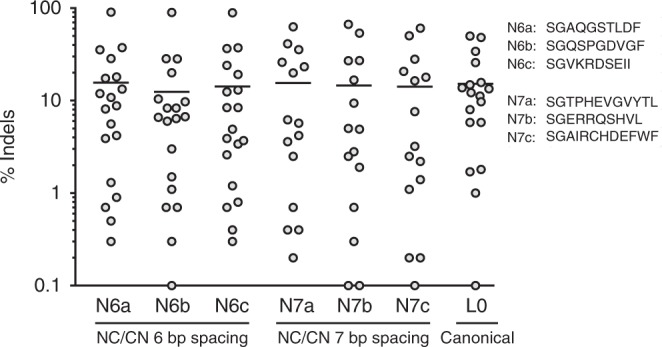
Activity comparison of NC/CN architectures with canonical ZFNs. The NC/CN ZFN architectures were tested in a portability study for their editing efficiency in the context of diverse new ZFN designs. Two sets of 19 NC/CN ZFNs were designed against an endogenous locus (intron 1 of the gene bearing the AAVS1 safe harbor ), one set with a 6 bp spacing, and one with a 7 bp spacing. DNA encoding the top three linkers for their respective spacings (identified in the stage 3 screen, Supplementary Fig. 7) was cloned into an expression vector between the ZFP and FokI domains for each of the designs bearing an amino-terminal FokI cleavage domain. Plasmid DNA for each pair was nucleofected into K562 cells at a dose of 400 ng of DNA per ZFN. Genomic DNA was isolated after three days of incubation and modification was assessed by PCR of the target loci followed by deep sequencing (MiSeq). The results of this study are grouped by architecture type and by linker: NC/CN ZFNs spanning a 6 bp gap with the indicated linker (N6a-N6c), NC/CN ZFNs spanning a 7 bp gap with the indicated linker (N7a-N7c), and canonical ZFNs (L062, included for comparison). Linker sequences are shown at the right. Average values for each group are shown as a solid black bar. Each data point represents a single measurement. For plotted data values see Supplementary Fig. 8. The source data for this figure is available in the Source Data file
Fig. 4
Fig. 4
Using new ZFN architectures for high-precision targeting. a Indel levels generated in a saturation scanning study of a 28 bp segment of the HBG1 promoter. ZFNs were designed to center cleavage on as many distinct base steps as possible for positions 172–199 upstream of the transcription start site (corresponding to the sequence 5′-TTCCCCACACTATCTCAATGCAAATATC-3′). ZFN-encoding mRNA was delivered to K562 cells via nucleofection at a dose of 800 ng of mRNA per ZFN, followed by indel quantification via PCR of the target locus and deep sequencing (MiSeq). The x-axis indicates base position upstream of the transcription start, defined as the center of cleavage between the two ZFN-binding sites. Details of each dimer are shown below the base position, indicating dimer architecture and the number of skipped bases in each ZFN. Results from the initial screen are shown as orange bars with individual data points provided as triangles, whereas blue extensions indicate the increase in modification observed with ZFNs developed via one additional cycle of design with individual data points provided as circles (e.g., for position 199, the initial designs yielded a dimer inducing 51% indels and the redesigned pair increased the modification by 41% to yield 92% indels). Each transfection was performed in triplicate. b Indel types and frequencies induced by a ZFN pair that straddles the site of the LCA10 mutation within the CEP290 gene. ZFNs were delivered as mRNA to K562 cells via nucleofection of 800 ng of mRNA per ZFN, followed by indel quantification via PCR of the target locus and deep sequencing (MiSeq). At the top of the alignment is the wild-type sequence of the target region in the CEP290 gene with the location of the LCA10 mutation highlighted in blue and indicated by the arrow. Below this are the deletion and integration events induced by ZFN treatment with frequencies > 0.5% (frequencies noted at the left). The total indel rate induced by this pair was 85% and in the aggregate the indels shown account for 51% of the total indels observed. Target sites for this ZFN are shown in Supplementary Fig. 18. The source data for this figure is available in the Source Data file
Fig. 5
Fig. 5
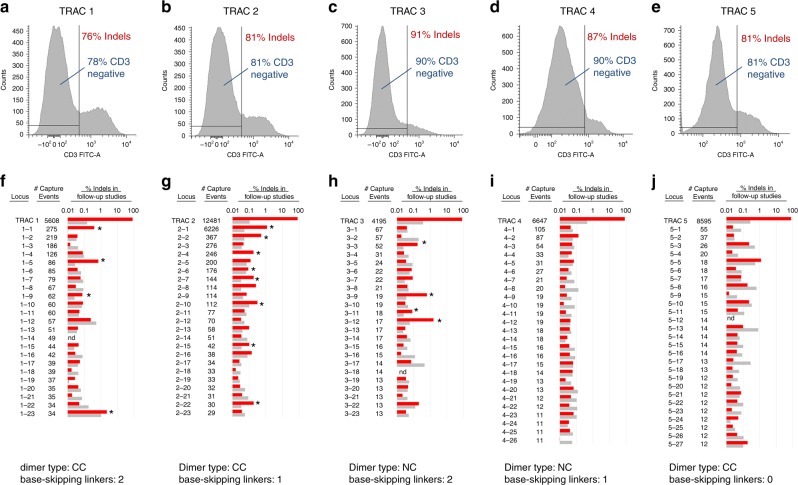
Phenotypic analysis and specificity assessment of ZFNs targeting TRAC. Across the top are shown names of the distinct sites targeted by each pair of ZFNs (Supplementary Fig. 21). Underneath each label are two panels containing the data for the indicated pair (e.g., a and f for TRAC 1, b and g for TRAC 2, etc.). Architecture information is indicated at the bottom. ae Phenotypic characterization of ZFN-treated T-cells. Histograms for each pair were generated via analysis of 10,000 cells and plots are shown for each of the indicated pairs with the percentage of cells that are negative for CD3 annotated on each graph. CD3 is a component of the T-cell receptor complex queried as a proxy for TRAC surface disruption. Also shown on each plot are the corresponding % indels induced by each ZFN pair in this transfection. Plots for mock transfected T-cells are shown in Supplementary Fig. 22. fj Specificity assessment of TRAC ZFNs. Candidate off-target loci were first identified for each pair using an unbiased oligonucleotide duplex-capture assay in K562 cells. In a follow-up study, ZFN-encoding mRNA for each pair was transfected into activated T-cells via BTX transfection. Modification was monitored at each on- and off-target locus by PCR followed by deep sequencing (MiSeq). The off-target characterization for each pair is shown under the corresponding flow cytometry data. On the left of each bottom panel is a table with the locus being monitored (on-target locus at top) and the number of sequences recovered in the capture assay. To the right, log-scale bar graphs are shown that summarize off-target modification in the follow-up indel study. The red bars indicate the % indels for the ZFN-treated T-cells and the gray bars indicate the % indels observed in T-cells treated with mRNA expressing GFP. Candidate loci that were significantly modified in ZFN-treated cells as compared with GFP-treated controls are marked with an asterisk. Statistical significance was determined as previously described combined with a Bonferroni correction. Each bar represents a single measurement. An expanded dataset for this study is provided in Supplementary Fig. 23. The source data for this figure is available in the Source Data file

References

    1. Kim YG, Cha J, Chandrasegaran S. Hybrid restriction enzymes: zinc finger fusions to Fok I cleavage domain. Proc. Natl Acad. Sci. USA. 1996;93:1156–1160. doi: 10.1073/pnas.93.3.1156. - DOI - PMC - PubMed
    1. Bibikova M, Golic M, Golic KG, Carroll D. Targeted chromosomal cleavage and mutagenesis in Drosophila using zinc-finger nucleases. Genetics. 2002;161:1169–1175. - PMC - PubMed
    1. Bibikova M, Beumer K, Trautman JK, Carroll D. Enhancing gene targeting with designed zinc finger nucleases. Science. 2003;300:764. doi: 10.1126/science.1079512. - DOI - PubMed
    1. Porteus MH, Baltimore D. Chimeric nucleases stimulate gene targeting in human cells. Science. 2003;300:763. doi: 10.1126/science.1078395. - DOI - PubMed
    1. Diez B, et al. Therapeutic gene editing in CD34(+) hematopoietic progenitors from Fanconi anemia patients. EMBO Mol. Med. 2017;9:1574–1588. doi: 10.15252/emmm.201707540. - DOI - PMC - PubMed

MeSH terms

Substances