


Outcomes of young people who reach the transition boundary of child and adolescent mental health services: a systematic review
- PMID: 30850925
- PMCID: PMC6800846
- DOI: 10.1007/s00787-019-01307-7
Outcomes of young people who reach the transition boundary of child and adolescent mental health services: a systematic review
Abstract
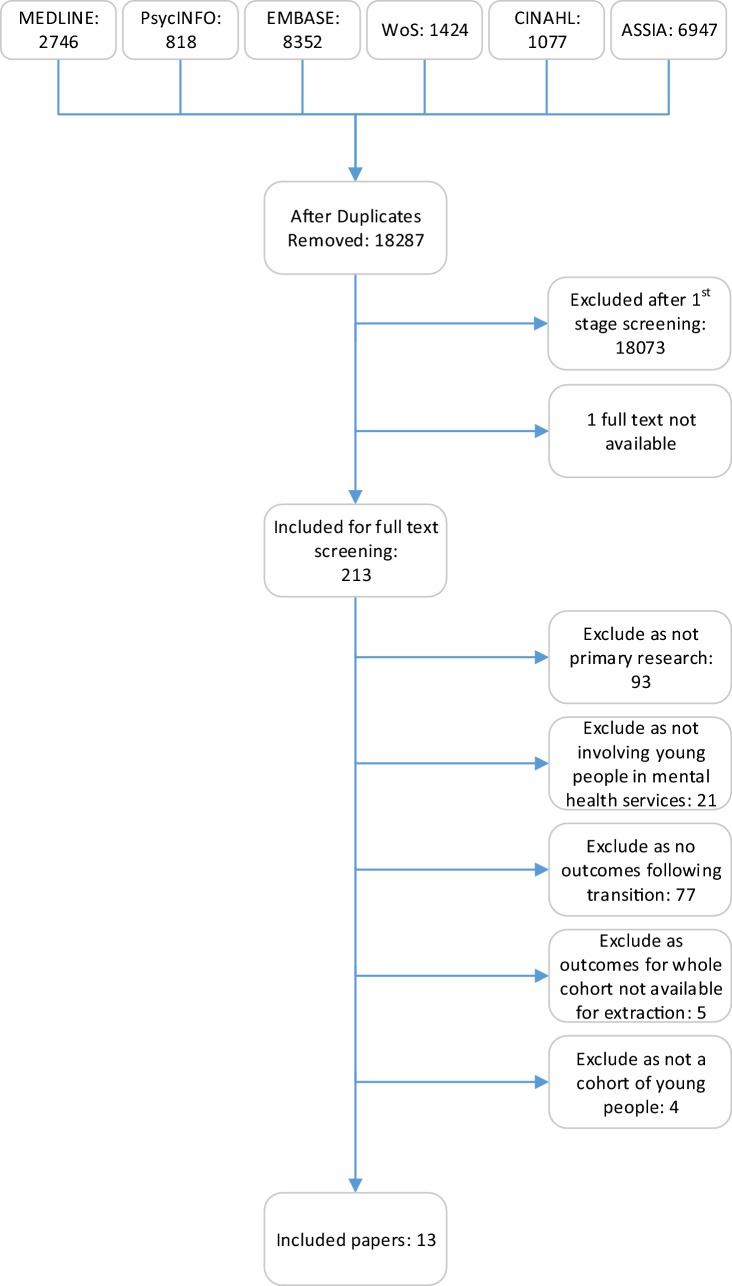
When young people reach the upper age limit of child and adolescent mental health services (CAMHS), care should be transferred to an adult mental health service (AMHS) if they require ongoing support. However, many young people experience a significant disruption of their care during this transition, whilst others may fail to transition at all. Currently, there is no systematic appraisal of the international evidence regarding the outcomes of young people after transition. A systematic review was conducted which aimed to synthesise and review the existing research regarding outcomes after transition. We searched six databases from their inception until December 2017 for research relating to either the mental health or service use outcomes of young people after reaching their CAMHS age boundary. Results were synthesised narratively. The initial searches identified 18,287 papers, of which 213 were screened on full text. 13 papers were included in the review, representing 10 cohorts of young people who crossed the transition age boundary. No studies contained extractable data on mental health outcomes following transition, and therefore, this review focused only on service use outcomes. Results showed a quarter of young people transitioned to AMHS, with the other young people experiencing varied outcomes after leaving CAMHS and multiple transitions during this time. This review provides evidence for the varying service use outcomes of young people after reaching the upper age limit of CAMHS. However, longitudinal research into long-term outcomes is lacking, in addition to research regarding the mental health and functioning outcomes of young people following transition.Protocol registration The protocol for this systematic review has been registered with PROSPERO, ID number CRD42018085916.
Keywords: AMHS; CAMHS; Mental health service; Systematic review; Transition.
Conflict of interest statement
On behalf of all authors, the corresponding author states that there is no conflict of interest.
Figures
References
-
- Signorini G, Singh SP, Marsanic VB, Dieleman G, Dodig-Ćurković K, Franic T, et al. The interface between child/adolescent and adult mental health services: results from a European 28-country survey. Eur Child Adolesc Psychiatry. 2018;27:501–511. - PubMed
-
- Ogundele MO. Transitional care to adult ADHD services in a North West England district. Clin Gov Int J. 2013;18:210–219.
-
- Paul M, Ford T, Kramer T, Islam Z, Harley K, Singh SP. Transfers and transitions between child and adult mental health services. Br J Psychiatry. 2013;202:s36–s40. - PubMed
-
- Singh SP, Paul M, Ford T, Kramer T, Weaver T, McLaren S, et al. Process, outcome and experience of transition from child to adult mental healthcare: multiperspective study. Br J Psychiatry. 2010;197:305–312. - PubMed
-
- McNicholas F, Adamson M, McNamara N, Gavin B, Paul M, Ford T, et al. Who is in the transition gap? Transition from CAMHS to AMHS in the Republic of Ireland. Ir J Psychol Med. 2015;32:61–69. - PubMed
Publication types
MeSH terms
LinkOut - more resources
Full Text Sources
Medical
