


Prenatal exposure to the herbicide 2,4-D is associated with deficits in auditory processing during infancy
- PMID: 30851698
- PMCID: PMC6511332
- DOI: 10.1016/j.envres.2019.02.046
Prenatal exposure to the herbicide 2,4-D is associated with deficits in auditory processing during infancy
Abstract
Introduction: Despite widespread use, many herbicides and fungicides are not well studied for neurological effects. Fetal and infant brains are rapidly developing, yet the effects of early-life exposure to these classes of pesticides on visual and auditory function are unknown. Here we examined the effects of prenatal herbicide and fungicide exposure on infant grating visual acuity (VA) and auditory brainstem response (ABR).
Methods: 9 herbicides and 13 fungicides were measured in umbilical cord blood plasma from a cohort of infants in Fuyang County, China (n = 232). Grating VA and ABR latencies for waves I, III, V were measured at 3 time points: 6 weeks, 9 months, and 18 months. Outcomes included VA score, ABR wave V latency and ABR central conduction time (CCT [wave V- wave I]). Pesticides were analyzed as 3-level ordinal (non-detect [ND]/medium/high), or dichotomous (ND/detect), depending on detection rates. Linear mixed models were used to evaluate relations between pesticides and VA and ABR outcomes.
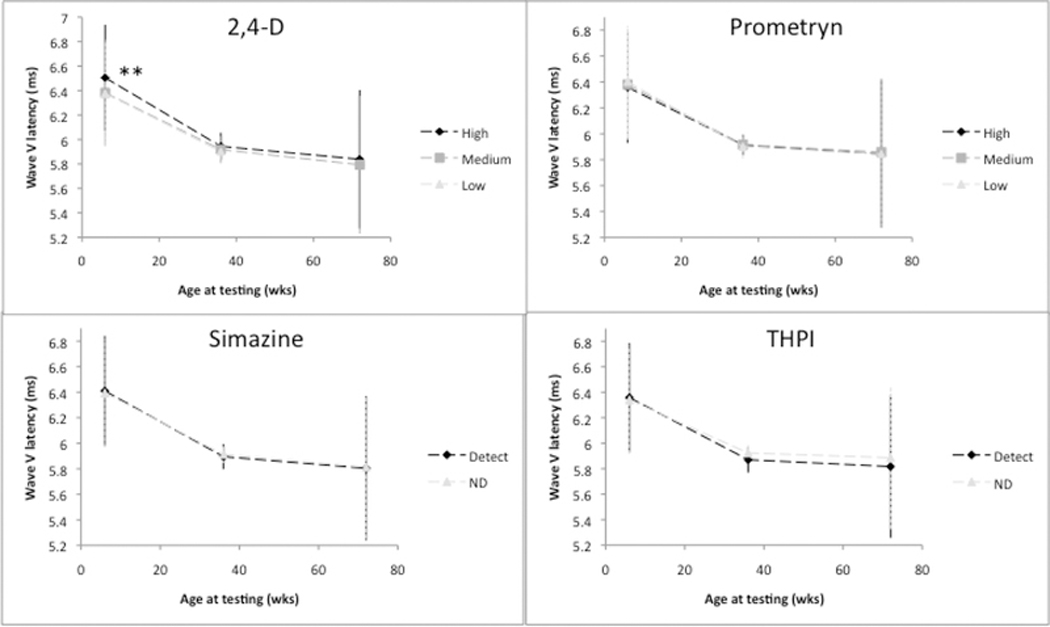
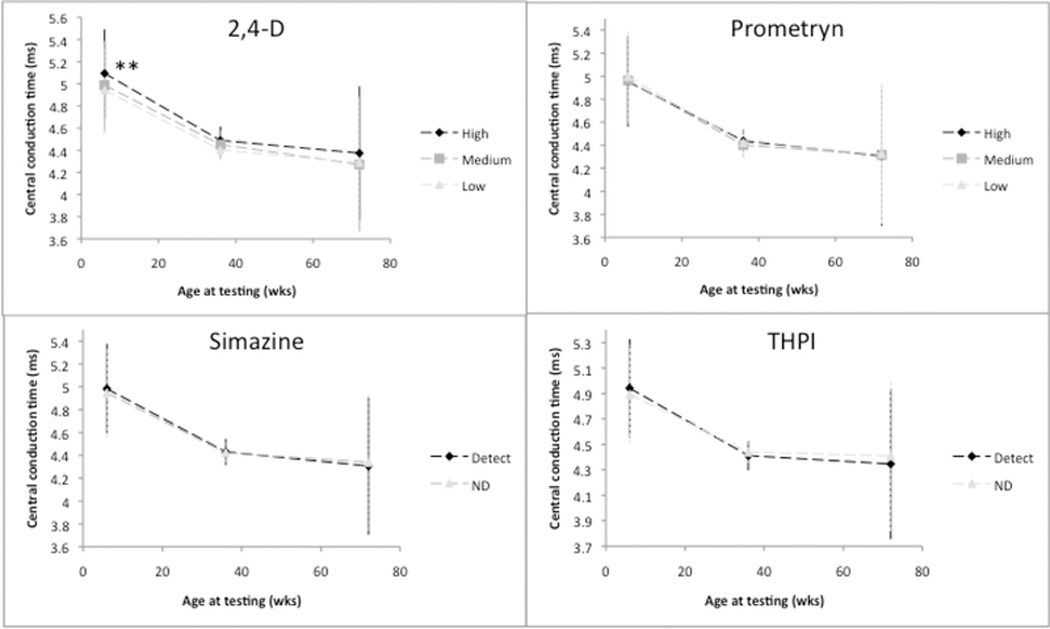
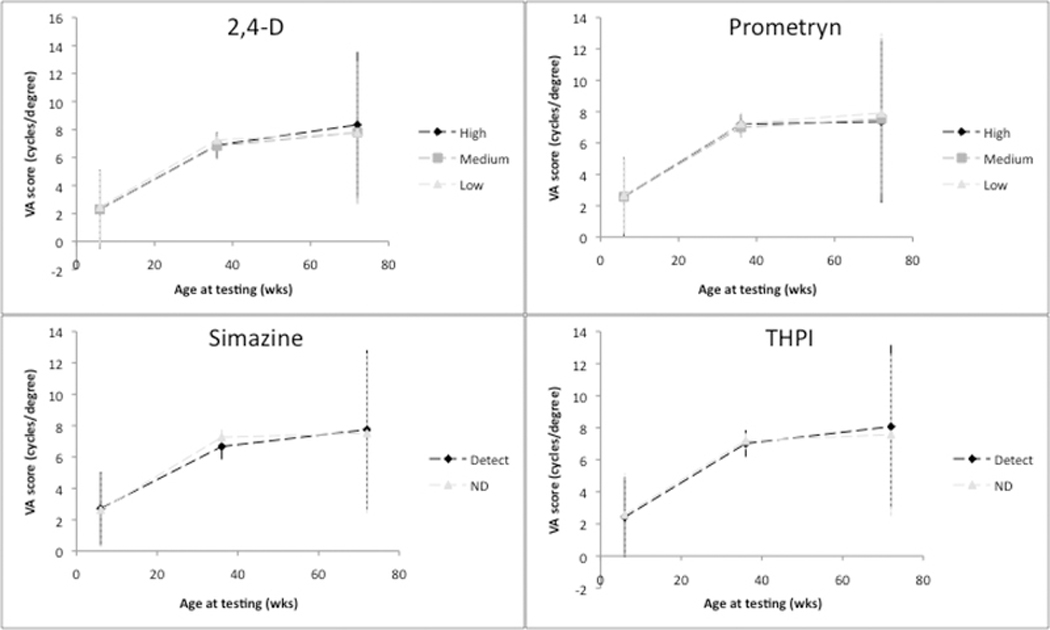
Results: 2,4-dichloroacetic acid (2,4-D), prometryn, simazine, and tetrahydrophthalamide (THPI, a metabolite of captan) were detected in 27%, 81%, 17%, and 16% of samples, respectively. Infants prenatally exposed to 2,4-D had slower auditory response times at 6 weeks. Infants with cord levels of 2,4-D > 1.17 ng/mL had wave V latencies that were 0.12 (95% CI: 0.03, 0.22) ms slower (p = 0.01) and overall CCTs that were 0.15 (95% CI:0.05, 0.25) ms slower (p = 0.003) than infants with non-detectable 2,4-D in their cord blood. No other statistically significant findings were observed for the other herbicides and fungicides or for the grating VA outcome.
Conclusions: Prenatal exposure to the herbicide 2,4-D was associated with slower auditory signal transmission in early infancy. ABR latencies reflect auditory pathway maturation and longer latencies may indicate delayed auditory development.
Keywords: Auditory processing; Fungicides; Herbicides; Neonates; Visual acuity.
Copyright © 2019 Elsevier Inc. All rights reserved.
Figures
References
-
- Algarin C, Peirano P, Garrido M, Pizarro F, Lozoff B, 2003. Iron deficiency anemia in infancy: long-lasting effects on auditory and visual system functioning. Pediatr Res 53, 217–223. - PubMed
-
- Barr DB, Barr JR, Driskell WJ, Hill RH Jr., Ashley DL, Needham LL, Head SL, Sampson EJ, 1999. Strategies for biological monitoring of exposure for contemporary-use pesticides. Toxicol Ind Health 15, 168–179. - PubMed
-
- Batton AD, Blaha CD, Bieber A, Lee KH, Boschen SL, 2018. Stimulation of the subparafascicular thalamic nucleus modulates dopamine release in the inferior colliculus of rats. Synapse. - PubMed
-
- Berglund SK, Westrup B, Haraldsson E, Engstrom B, Domellof M, 2011. Effects of iron supplementation on auditory brainstem response in marginally LBW infants. Pediatr Res 70, 601–606. - PubMed
Publication types
MeSH terms
Substances
Grants and funding
LinkOut - more resources
Full Text Sources
