


Effects of water, sanitation and hygiene (WASH) education on childhood intestinal parasitic infections in rural Dembiya, northwest Ethiopia: an uncontrolled before-and-after intervention study
- PMID: 30851729
- PMCID: PMC6408793
- DOI: 10.1186/s12199-019-0774-z
Effects of water, sanitation and hygiene (WASH) education on childhood intestinal parasitic infections in rural Dembiya, northwest Ethiopia: an uncontrolled before-and-after intervention study
Abstract
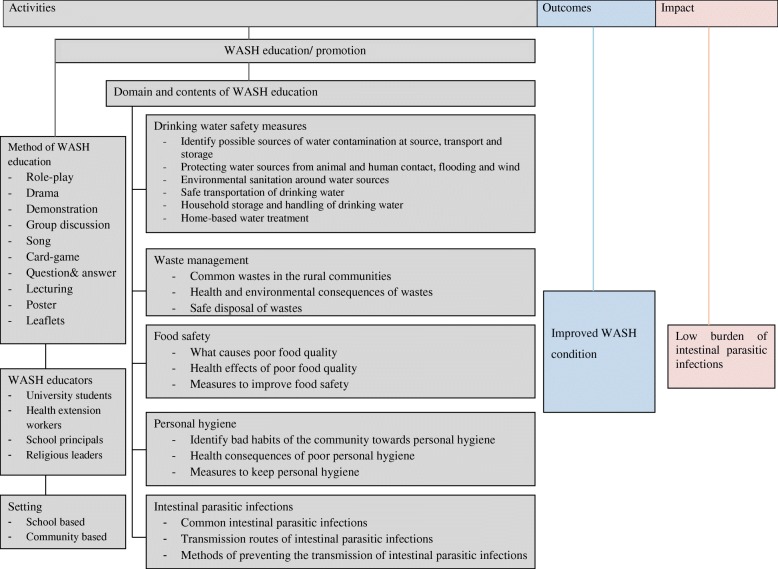
Background: Soil-transmitted helminthes (STH) infections are among the most common infections worldwide and affect the most deprived communities. Adequate water, sanitation, and hygiene (WASH) prevents environmental contamination, thereby preventing transmission of STH. Cognizant of this, WASH education was implemented in rural Dembiya to reduce intestinal parasitic infections. This study was, therefore, conducted to assess the impacts of the intervention on households' WASH conditions and prevalence of intestinal parasitic infections.
Method: An uncontrolled before-and-after intervention study was used. Cross-sectional studies were done before and after the intervention. Two hundred twenty-five and 302 under five children were recruited randomly at the baseline and endline, respectively. Data were collected using a structured questionnaire and observational checklists. Direct stool examination and Kato-Katz methods were used to identify parasites in the stool. We used percent point change and prevalence ratio (PR) to see the effects of the intervention on WASH conditions and prevalence of intestinal parasitic infections respectively. Pearson chi-squared and Fisher's exact tests were used to test for statistically significant percentage point changes of WASH conditions. The effect of the intervention on intestinal parasitic infections was statistically tested on the basis of PR with 95% confidence interval (CI).
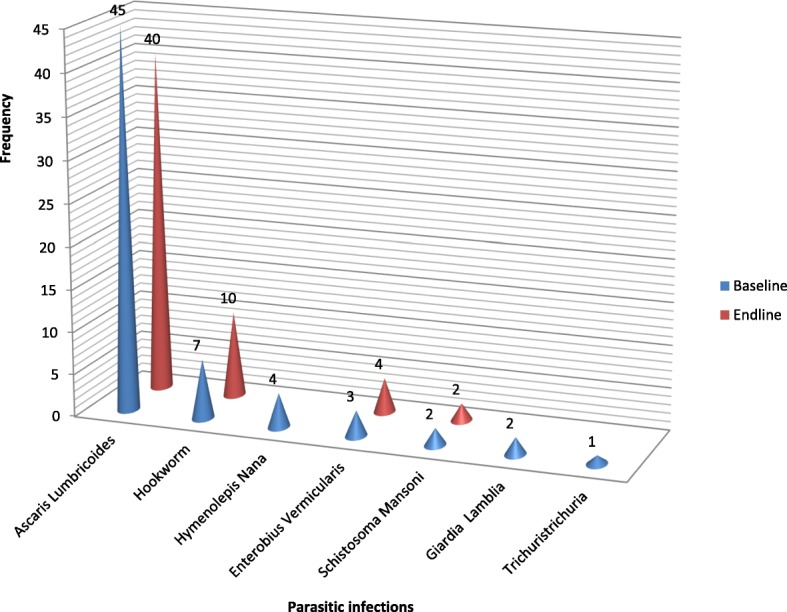
Results: The baseline prevalence of intestinal parasitic infections was 25.8%, and the endline prevalence was 23.8%. The prevalence of intestinal parasitic infections was not significantly decreased at the endline compared with the baseline [PR = 0.92, 95% CI = (0.62, 1.38)]. Ascaris Lumbricoides was the most prevalent parasitic infection both at the baseline and endline. The proportion of children who had good hygienic condition increased from 1.3% at the baseline to 34.4% at the end line (p < 0.05). The percentage of mothers/care givers who washed hands at different pick times was significantly increased from 24.4% at the baseline to 68.2% at the endline (p < 0.001). The proportion of households who practiced home-based water treatment was significantly increased from 7.6% at the baseline to 47% at the endline (p < 0.001). The proportion of households who used sanitary latrine was increased from 32% at the baseline to 49% at the endline (p < 0.05).
Conclusion: This before-and-after intervention study found that households' WASH performance was significantly improved at the endline compared with the baseline. The endline prevalence of intestinal parasitic infections was slightly lower than the baseline prevalence; however, the reduction was not statistically significant. The local health office needs to strengthen the WASH education program, mobilize the community to construct WASH facilities, and support the community to sustain households' WASH performance.
Keywords: Children aged 6–59 months; Intestinal parasitic infections; Rural Dembiya; Uncontrolled before and after intervention study; WASH education.
Conflict of interest statement
Ethics approval and consent to participate
Ethical clearance was obtained from the Institutional Review Board of the University of Gondar (ethics approval number is O/V/P/RCS/05/541/2017) and an official letter was submitted to the district administrators. There were no risks due to participation in this research project, and the collected data were used only for this research purpose. Verbal informed consent was obtained from the mothers/care givers. Information was kept with complete confidentiality. Appropriate anthelmintic drugs were given for children infected by intestinal parasitic infections together with brief health messages for the mothers or caregivers.
Consent for publication
This manuscript does not contain any individual person’s data.
Competing interests
The authors declare that they have no competing interests.
Publisher’s Note
Springer Nature remains neutral with regard to jurisdictional claims in published maps and institutional affiliations.
Figures
References
-
- Hotez PJ, Fenwick A, Savioli L, Molyneux DH. Rescuing the bottom billion through control of neglected tropical diseases. Lancet. 2009;373(9674):1570–1575. - PubMed
-
- De Silva NR, Brooker S, Hotez PJ, Montresor A, Engels D, Savioli L. Soil-transmitted helminth infections: updating the global picture. Trends Parasitol. 2003;19(12):547–551. - PubMed
-
- Bethony J, Brooker S, Albonico M, Geiger SM, Loukas A, Diemert D, et al. Soil-transmitted helminth infections: ascariasis, trichuriasis, and hookworm. Lancet. 2006;367(9521):1521–1532. - PubMed
Publication types
MeSH terms
Substances
Supplementary concepts
LinkOut - more resources
Full Text Sources
Medical
Research Materials