


Applying surface-based hippocampal morphometry to study APOE-E4 allele dose effects in cognitively unimpaired subjects
- PMID: 30852398
- PMCID: PMC6411498
- DOI: 10.1016/j.nicl.2019.101744
Applying surface-based hippocampal morphometry to study APOE-E4 allele dose effects in cognitively unimpaired subjects
Abstract
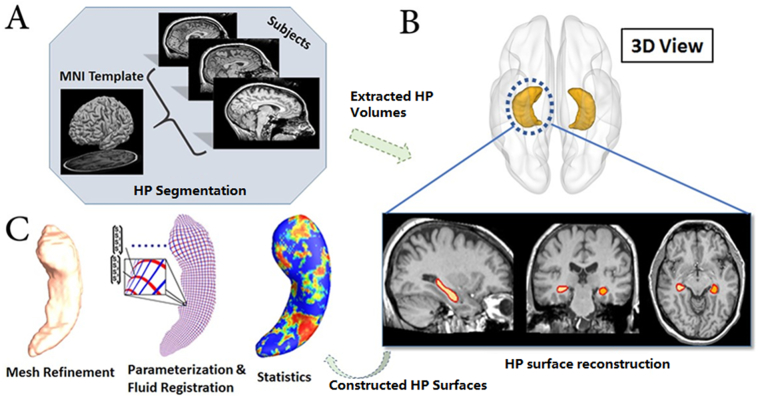
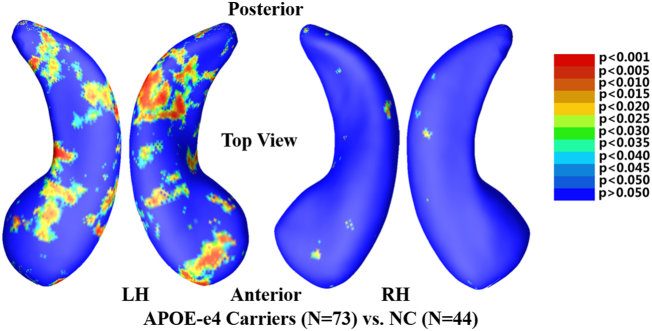
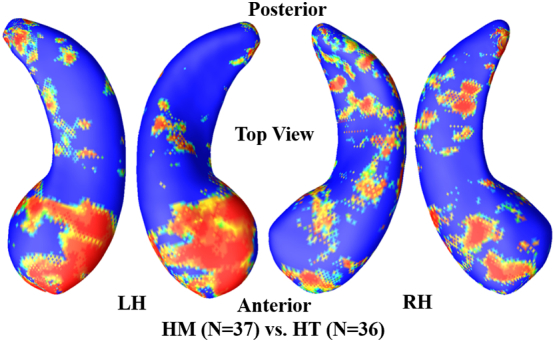
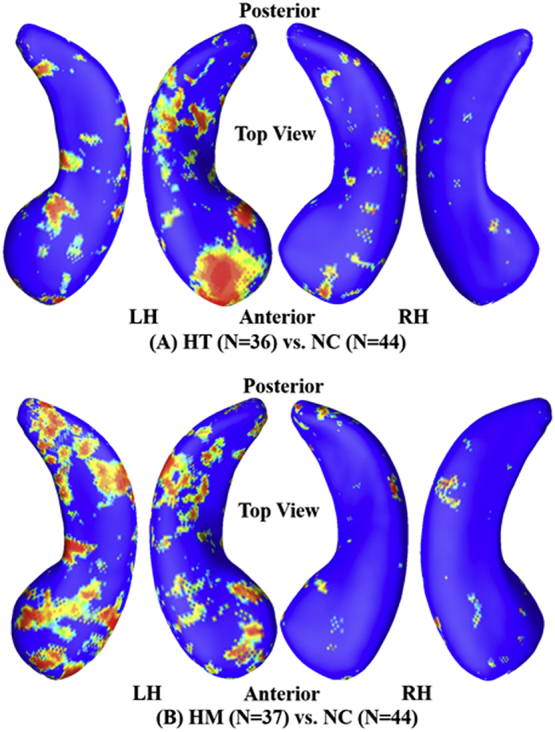
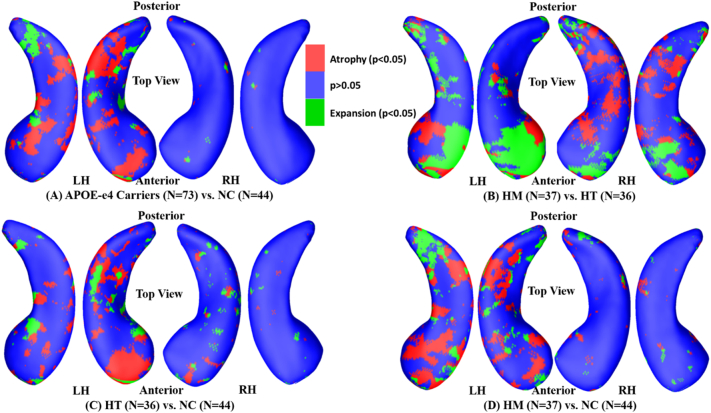
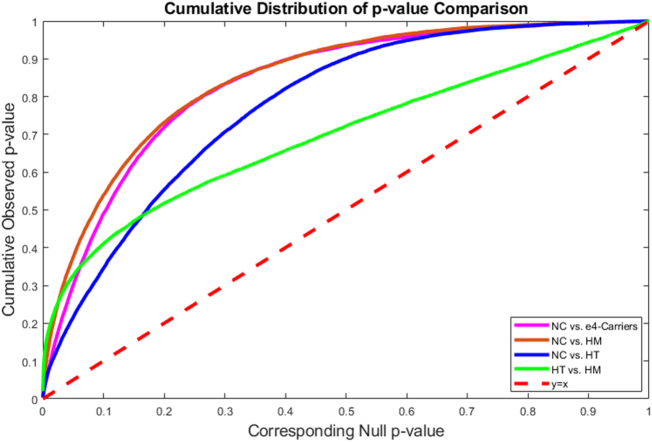
Apolipoprotein E (APOE) e4 is the major genetic risk factor for late-onset Alzheimer's disease (AD). The dose-dependent impact of this allele on hippocampal volumes has been documented, but its influence on general hippocampal morphology in cognitively unimpaired individuals is still elusive. Capitalizing on the study of a large number of cognitively unimpaired late middle aged and older adults with two, one and no APOE-e4 alleles, the current study aims to characterize the ability of our automated surface-based hippocampal morphometry algorithm to distinguish between these three levels of genetic risk for AD and demonstrate its superiority to a commonly used hippocampal volume measurement. We examined the APOE-e4 dose effect on cross-sectional hippocampal morphology analysis in a magnetic resonance imaging (MRI) database of 117 cognitively unimpaired subjects aged between 50 and 85 years (mean = 57.4, SD = 6.3), including 36 heterozygotes (e3/e4), 37 homozygotes (e4/e4) and 44 non-carriers (e3/e3). The proposed automated framework includes hippocampal surface segmentation and reconstruction, higher-order hippocampal surface correspondence computation, and hippocampal surface deformation analysis with multivariate statistics. In our experiments, the surface-based method identified APOE-e4 dose effects on the left hippocampal morphology. Compared to the widely-used hippocampal volume measure, our hippocampal morphometry statistics showed greater statistical power by distinguishing cognitively unimpaired subjects with two, one, and no APOE-e4 alleles. Our findings mirrored previous studies showing that APOE-e4 has a dose effect on the acceleration of brain structure deformities. The results indicated that the proposed surface-based hippocampal morphometry measure is a potential preclinical AD imaging biomarker for cognitively unimpaired individuals.
Keywords: APOE-e4; Alzheimer's disease; Cognitively unimpaired; Hippocampal morphometry; Magnetic resonance imaging (MRI).
Copyright © 2019 The Authors. Published by Elsevier Inc. All rights reserved.
Figures
References
-
- Apostolova L.G., Morra J.H., Green A.E., Hwang K.S., Avedissian C., Woo E., Cummings J.L., Toga A.W., Jack C.R., Jr., Weiner M.W., Thompson P.M. Automated 3D mapping of baseline and 12-month associations between three verbal memory measures and hippocampal atrophy in 490 ADNI subjects. Neuroimage. 2010;51(1):488–499. - PMC - PubMed
-
- Arsigny V., Fillard P., Pennec X., Ayache N. Log-Euclidean Metrics for Fast and Simple Calculus on Diffusion Tensors. Magn. Reson. Med. 2006;56(2):411–421. - PubMed
-
- Braun C.M., Daigneault R., Gaudelet S., Guimond A. Diagnostic and statistical manual of mental disorders, fourth edition symptoms of mania: which one(s) result(s) more often from right than left hemisphere lesions? Compr. Psychiatry. 2008;49(5):441–459. - PubMed
-
- Bro-Nielsen M., Gramkow C. Springer; 1996. Fast Fluid Registration of Medical Images. Visualization in Biomedical Computing (VBC'96) pp. 267–276.
Publication types
MeSH terms
Substances
Grants and funding
LinkOut - more resources
Full Text Sources
Miscellaneous
