


Excessive discounting of delayed reinforcers as a trans-disease process: Update on the state of the science
- PMID: 30852411
- PMCID: PMC6684865
- DOI: 10.1016/j.copsyc.2019.01.005
Excessive discounting of delayed reinforcers as a trans-disease process: Update on the state of the science
Abstract
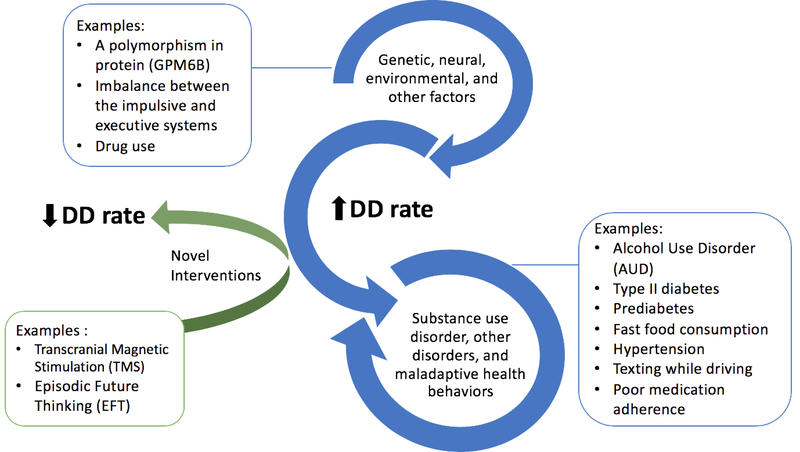
Delay discounting, or the process by which reinforcers lose value with delay to their receipt, has been identified as a trans-disease process underlying addiction, other disorders, and maladaptive health behaviors. Delay discounting has been identified as an endophenotype for multiple psychiatric disorders including substance use disorder, ADHD, and major depressive disorder, with this endophenotype being linked to deficits in dopaminergic and serotonergic neurotransmission. In addition, neuroanatomical and neurophysiological deficits in areas of the executive and impulsive systems have been associated with both steeper discounting and substance use disorders. Delay discounting constitutes a novel target for interventions to change health behaviors. A new theory, termed reinforcer pathology, has been developed uniting these findings and setting the stage for future research.
Copyright © 2019 Elsevier Ltd. All rights reserved.
Conflict of interest statement
Conflict of interest
None declared
Figures
References
-
-
Amlung M, Vedelago L, Acker J, Balodis I, Mackillop J: Steep Delay Discounting and Addictive Behavior: A Meta-Analysis of Continuous Associations. Addiction 2016, doi: 10.1111/add.13535.
** This Meta-analysis provides an impartially comprehensive examination of delay discounting in cross-sectional addiction studies using continuous designs. The study aggregates the diverse findings in the literature to investigate the extent to which delay discounting is associated with addiction-related variables (e.g., psychoactive drugs and gambling behavior), and with indices of engagement in addictive behaviors (i.e., quantity-frequency) or level of clinical severity across studies. Findings from 64 studies (138 effect sizes) indicate a robust association between delayed reward discounting (across type of addictive behavior) and measures of addiction severity and indices of engagement in addictive behaviors. Importantly, the magnitude of this relation did not significantly differ across the types of addictive behavior examined supporting delay discounting as a trans-disease process in addiction.
-
-
- Petry NM. Delay discounting of money and alcohol in actively using alcoholics, currently abstinent alcoholics, and controls. Psychopharmacology 2001, 154: 243–250 - PubMed
-
- Sheffer C, Mackillop J, McGeary J, Landes R, Carter L, Yi R, Jones B, Christensen D, Stitzer M, Jackson L, et al. : Delay discounting, locus of control, and cognitive impulsiveness independently predict tobacco dependence treatment outcomes in a highly dependent, lower socioeconomic group of smokers. Am J Addict 2012, 21:221–232. - PMC - PubMed
Publication types
MeSH terms
Grants and funding
LinkOut - more resources
Full Text Sources
Medical
