


HeART of Stroke: randomised controlled, parallel-arm, feasibility study of a community-based arts and health intervention plus usual care compared with usual care to increase psychological well-being in people following a stroke
- PMID: 30852528
- PMCID: PMC6429750
- DOI: 10.1136/bmjopen-2017-021098
HeART of Stroke: randomised controlled, parallel-arm, feasibility study of a community-based arts and health intervention plus usual care compared with usual care to increase psychological well-being in people following a stroke
Abstract
Introduction: People often experience distress following stroke due to fundamental challenges to their identity.
Objectives: To evaluate (1) the acceptability of 'HeART of Stroke' (HoS), a community-based arts and health group intervention, to increase psychological well-being; and (2) the feasibility of a definitive randomised controlled trial (RCT).
Design: Two-centre, 24-month, parallel-arm RCT with qualitative and economic components. Randomisation was stratified by centre and stroke severity. Participant blinding was not possible. Outcome assessment blinding was attempted.
Setting: Community.
Participants: Community-dwelling adults ≤2 years poststroke recruited via hospital clinical teams/databases or community stroke/rehabilitation teams.
Interventions: Artist-facilitated arts and health group intervention (HoS) (ten 2-hour sessions over 14 weeks) plus usual care (UC) versus UC.
Outcomes: The outcomes were self-reported measures of well-being, mood, capability, health-related quality of life, self-esteem and self-concept (baseline and 5 months postrandomisation). Key feasibility parameters were gathered, data collection methods were piloted, and participant interviews (n=24) explored the acceptability of the intervention and study processes.
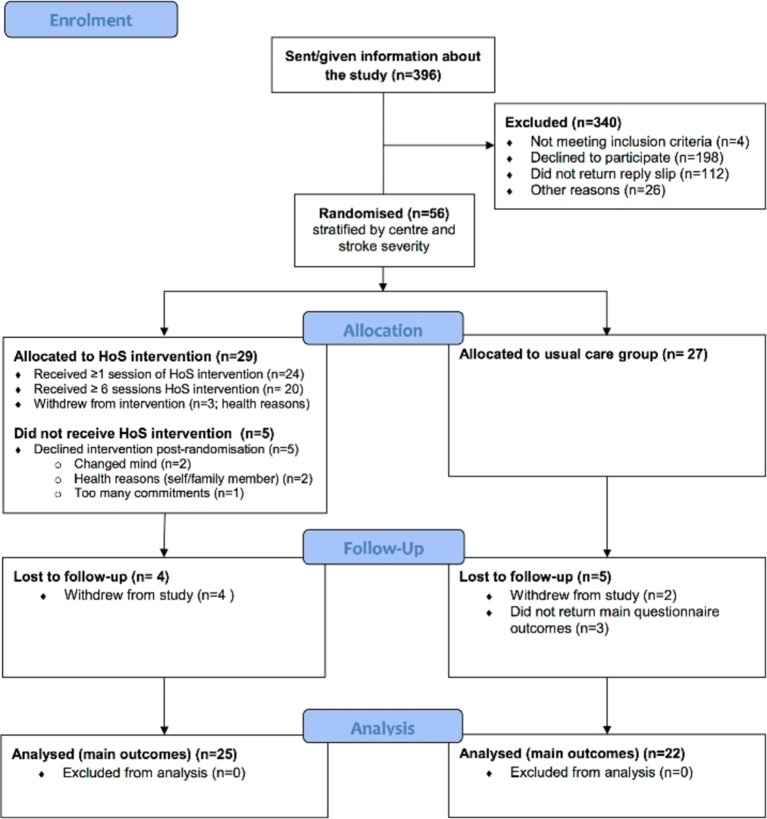
Results: Despite a low recruitment rate (14%; 95% CI 11% to 18%), 88% of the recruitment target was met, with 29 participants randomised to HoS and 27 to UC (57% male; mean (SD) age=70 (12.1) years; time since stroke=9 (6.1) months). Follow-up data were available for 47 of 56 (84%; 95% CI 72% to 91%). Completion rates for a study-specific resource use questionnaire were 79% and 68% (National Health Service and societal perspectives). Five people declined HoS postrandomisation; of the remaining 24 who attended, 83% attended ≥6 sessions. Preliminary effect sizes for candidate primary outcomes were in the direction of benefit for the HoS arm. Participants found study processes acceptable. The intervention cost an estimated £456 per person and was well-received (no intervention-related serious adverse events were reported).
Conclusions: Findings from this first community-based study of an arts and health intervention for people poststroke suggest a definitive RCT is feasible. Recruitment methods will be revised.
Trial registration number: ISRCTN99728983.
Keywords: feasibility study; identity; stroke; wellbeing.
© Author(s) (or their employer(s)) 2018. Re-use permitted under CC BY-NC. No commercial re-use. See rights and permissions. Published by BMJ.
Conflict of interest statement
Competing interests: None declared.
Figures
References
-
- Townsend N, Wickramasinghe K, Bhatnagar P, et al. Coronary heart disease statistics. A compendium of health statistics. 2012 Edn. London: British Heart Foundation, 2012.
-
- Department of Health. National stroke strategy. London: Department of Health, 2007.
Publication types
MeSH terms
Associated data
Grants and funding
LinkOut - more resources
Full Text Sources
Medical
Miscellaneous
