


Students' self-assessment of achievement of terminal competency and 4-year trend of student evaluation on outcome-based education
- PMID: 30852860
- PMCID: PMC6589633
- DOI: 10.3946/kjme.2019.117
Students' self-assessment of achievement of terminal competency and 4-year trend of student evaluation on outcome-based education
Abstract
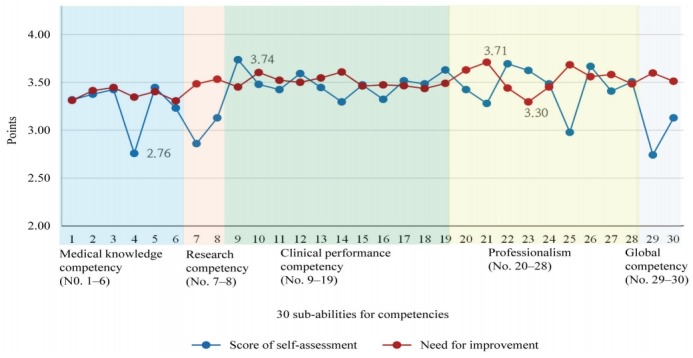
Purpose: This study was designed to allow a student at School of Medicine, Kyungpook National University (KNUSOM) to self-assess how well they had achieved competency and to analyze the differences and trends of the scores by year. Furthermore, students are asked to evaluate the need for curriculum improvement by competency, the tendency of the score is analyzed by year, and the results are reflected in the improvement of the curriculum.
Methods: We conducted a questionnaire survey for fourth-year students of KNUSOM who took medical education classes from 2015 to 2018. Questionnaire items were evaluated on the basis of their current achievement of 30 subordinate competencies of competency and the degree of necessity with respect to revising the curriculum. One-way analysis of variance was performed for the yearly difference analysis.
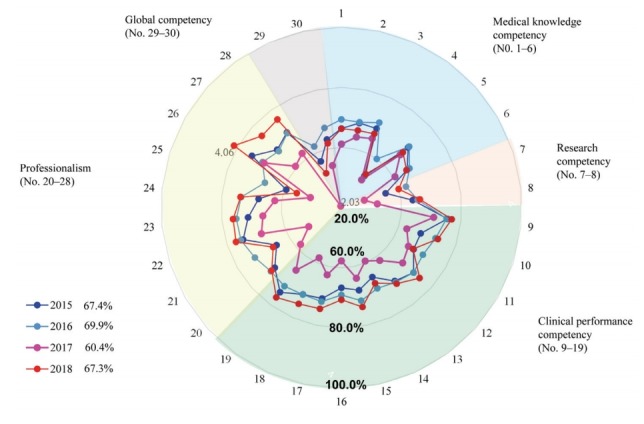
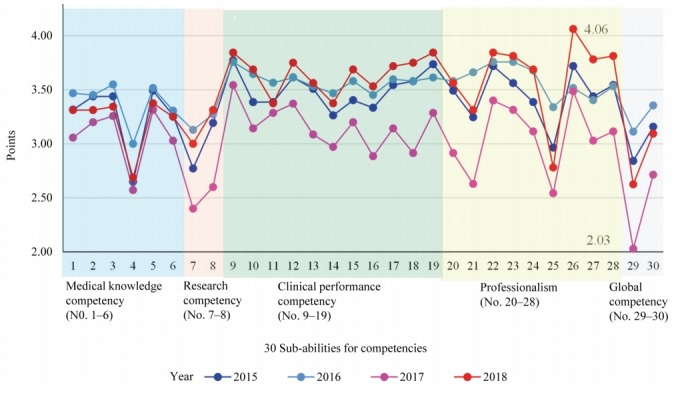
Results: The students' scores on the graduation competency were 2.03 to 4.06. In the yearly difference analysis, there was no significant difference in the average of 30 total competencies, but 16 of the sub-competencies showed significant year-to-year differences. The scores for the 30 graduation competencies were different for each year, but the competencies showing high scores and low scores were found to be similar each year.
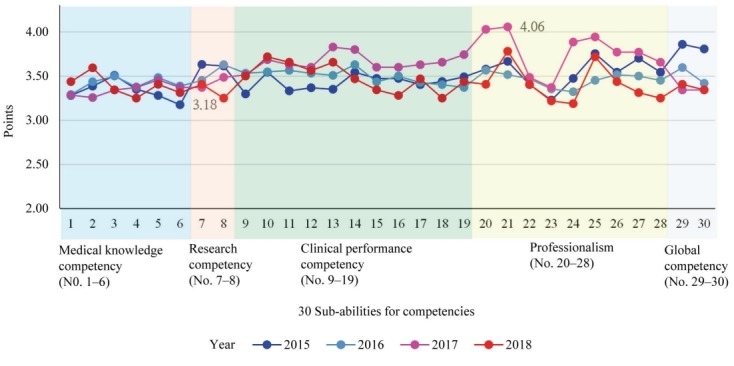
Conclusion: We found that the achievement level of the students was approximately 60% to 70%. We were able to confirm the contents of the education that the students continuously demand. The curriculum trend graphs for each year showed that the students' scores improved when the curriculum was being revised. We found that it is necessary to accept the students' self-evaluation reliable as the students indicated that the contents of the curriculum should be added to the areas where the contents were lacking in the present curriculum.
Keywords: Competency-based curriculum; Curriculum assessment; Outcome-based curriculum; Self-assessment.
Conflict of interest statement
No potential conflict of interest relevant to this article was reported.
Figures
References
-
- Boulet JR, Durning SJ. What we measure … and what we should measure in medical education. Med Educ. 2019;53(1):86–94. - PubMed
-
- Hodges BD, Ginsburg S, Cruess R, et al. Assessment of professionalism: recommendations from the Ottawa 2010 Conference. Med Teach. 2011;33(5):354–363. - PubMed
-
- Lynch DC, Surdyk PM, Eiser AR. Assessing professionalism: a review of the literature. Med Teach. 2004;26(4):366–373. - PubMed
-
- Leonardi M, Luketic L, Sobel ML, Toor K, D’Souza R, Murji A. Evaluation of obstetrics & gynecology ultrasound curriculum and self-reported competency of final-year Canadian residents. J Obstet Gynaecol Can. 2018;40(12):1580–1585. - PubMed
-
- Sureda-Demeulemeester E, Ramis-Palmer C, Sesé-Abad A. The assessment of medical competencies. Rev Clin Esp. 2017;217(9):534–542. - PubMed
MeSH terms
LinkOut - more resources
Full Text Sources
