Long-Term Efficacy of Mirabegron Add-On Therapy to Antimuscarinic Agents in Patients With Spinal Cord Injury
- PMID: 30852871
- PMCID: PMC6409660
- DOI: 10.5535/arm.2019.43.1.54
Long-Term Efficacy of Mirabegron Add-On Therapy to Antimuscarinic Agents in Patients With Spinal Cord Injury
Abstract
Objective: To evaluate the long-term efficacy of mirabegron add-on therapy in patients with spinal cord injury (SCI) based on an urodynamic study.
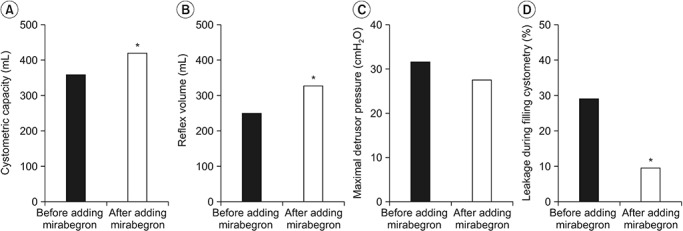
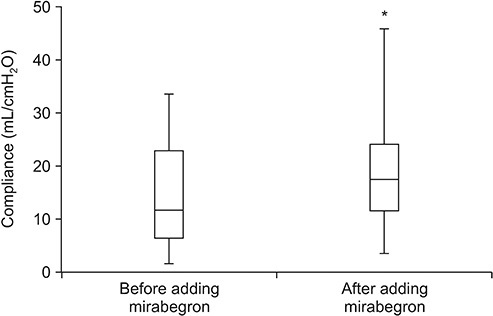
Methods: This retrospective study involved a chart audit of individuals with SCI who underwent two consecutive urodynamic studies between April 1, 2015 and April 1, 2018. After adding 50 mg of mirabegron once a day to the pre-existing antimuscarinic therapy for a period of, at least 6 months, the following variables were analyzed: change in cystometric capacity, change in bladder compliance, change in maximal detrusor pressure, change in reflex volume, and presence of significant leakage during filling cystometry.
Results: A total of 31 participants with a mean age of 41±15 years were included in the analysis. A significant increase in cystometric capacity (mean, 362 to 424 mL; p=0.03), reflex volume (mean, 251 to 329 mL; p=0.02), and bladder compliance (median, 12 to 18 mL/cmH2O; p=0.04) was observed. The presence of leakage during filling cystometry was significantly reduced (29% to 10%; p=0.03). Likewise, a non-significant decrease in the change in maximal detrusor pressure was observed (mean, 31 to 27 cmH2O; p=0.39).
Conclusion: Adding mirabegron to conventional antimuscarinics further improved urodynamic parameters in patients with chronic SCI, and sustained efficacy was observed in long-term use.
Keywords: Mirabegron; Muscarinic antagonists; Spinal cord injuries; Urodynamics.
Conflict of interest statement
No potential conflict of interest relevant to this article was reported.
Figures
References
-
- Gerridzen RG, Thijssen AM, Dehoux E. Risk factors for upper tract deterioration in chronic spinal cord injury patients. J Urol. 1992;147:416–8. - PubMed
-
- Goldmark E, Niver B, Ginsberg DA. Neurogenic bladder: from diagnosis to management. Curr Urol Rep. 2014;15:448. - PubMed
-
- Abrams P, Artibani W, Gajewski JB, Hussain I. Assessment of treatment outcomes in patients with overactive bladder: importance of objective and subjective measures. Urology. 2006;68(2 Suppl):17–28. - PubMed
-
- del Popolo G, Mencarini M, Nelli F, Lazzeri M. Controversy over the pharmacological treatments of storage symptoms in spinal cord injury patients: a literature overview. Spinal Cord. 2012;50:8–13. - PubMed
-
- Benner JS, Nichol MB, Rovner ES, Jumadilova Z, Alvir J, Hussein M, et al. Patient-reported reasons for discontinuing overactive bladder medication. BJU Int. 2010;105:1276–82. - PubMed
LinkOut - more resources
Full Text Sources
Miscellaneous