. 2019 Apr 11;62(7):3475-3502.
doi: 10.1021/acs.jmedchem.8b01961. Epub 2019 Mar 21.

Discovery and Structural Optimization of Acridones as Broad-Spectrum Antimalarials

Affiliations

Discovery and Structural Optimization of Acridones as Broad-Spectrum Antimalarials

Rozalia A Dodean et al. J Med Chem. .

Abstract

Malaria remains one of the deadliest diseases in the world today. Novel chemoprophylactic and chemotherapeutic antimalarials are needed to support the renewed eradication agenda. We have discovered a novel antimalarial acridone chemotype with dual-stage activity against both liver-stage and blood-stage malaria. Several lead compounds generated from structural optimization of a large library of novel acridones exhibit efficacy in the following systems: (1) picomolar inhibition of in vitro Plasmodium falciparum blood-stage growth against multidrug-resistant parasites; (2) curative efficacy after oral administration in an erythrocytic Plasmodium yoelii murine malaria model; (3) prevention of in vitro Plasmodium berghei sporozoite-induced development in human hepatocytes; and (4) protection of in vivo P. berghei sporozoite-induced infection in mice. This study offers the first account of liver-stage antimalarial activity in an acridone chemotype. Details of the design, chemistry, structure-activity relationships, safety, metabolic/pharmacokinetic studies, and mechanistic investigation are presented herein.


Conflict of interest statement

The authors declare no competing financial interest.

Figures
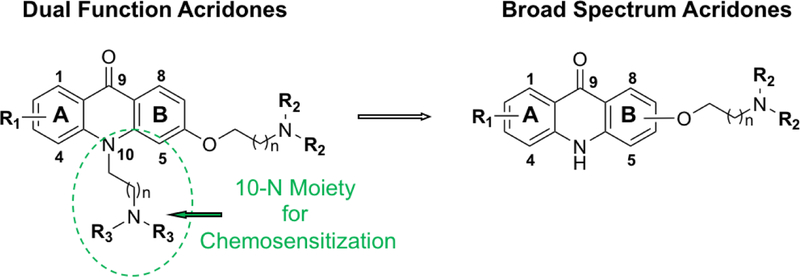
Figure 1.
Figure 1.
Transition from dual-function acridone to broad-spectrum acridone chemotype.
Figure 2.
Figure 2.
Structures of 1,4/2,4/3,4-dichloro-acridones 100–102.
Figure 3.
Figure 3.
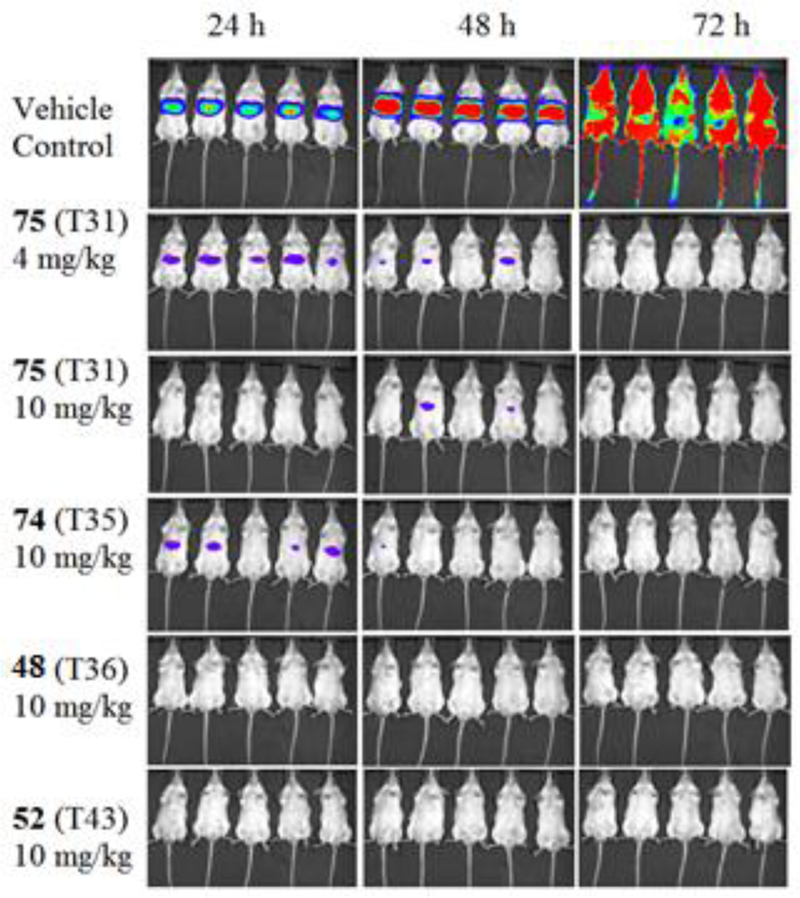
Acridones efficacy in the in vivo liver stage model in C57BL/6 male Albino mice infected with 50000 luciferase-expressing P. berghei sporozoites.
Scheme 1.
Scheme 1.
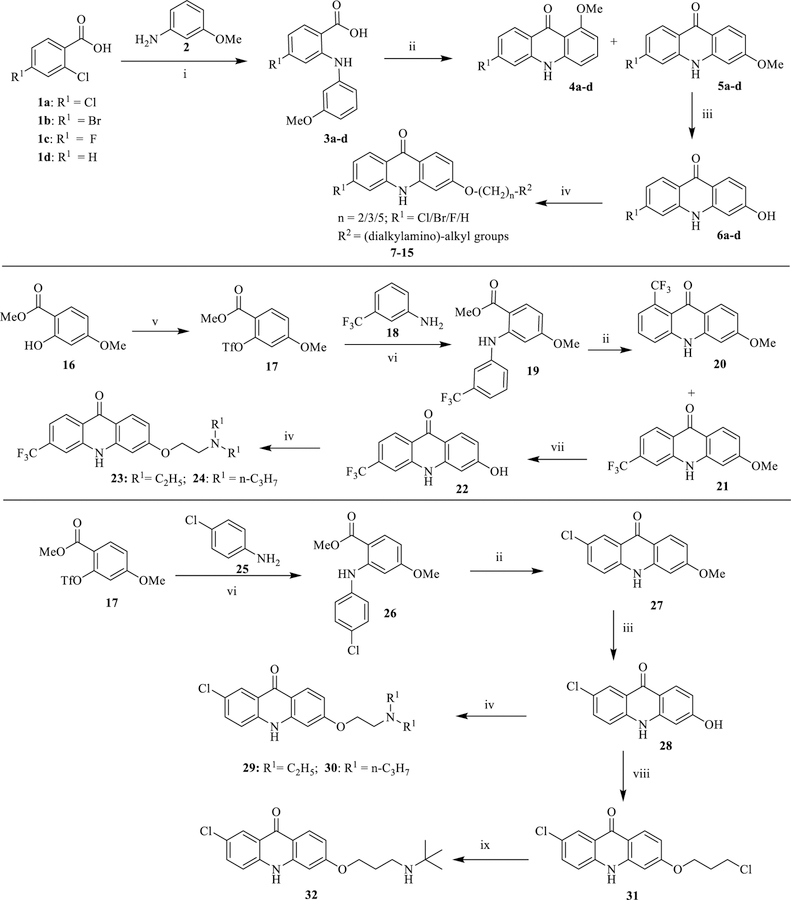
Synthesis of acridones 7–15, 23, 24, and 29–32 with a substitution at the 2/3 position of ring-A and (dialkylamino)alkoxy/chloroalkoxy moiety at the 6 position of ring-Ba aReagents and conditions: (i) Cu powder, K2CO3, pentanol, reflux, 5 h; (ii) Eaton’s acid, 90 °C, 5-24 h; (iii) HI, phenol, reflux, 3 h; (iv) C1-(CH2)n-R1/R2. HC1, K2CO3, acetone, reflux, 5-12 h; (v) Tf2O, pyridine, CH2C12, 0 °C-rt, 5 h; (vi) Pd(dba)2, DPPF, KOtBu, toluene, 100 °C, 8-12 h; (vii) BBr3, CH2C12, −78 °C-rt, 12 h; (viii) Br-(CH2)3-C1, K2CO3, acetone, reflux, 24 h; (ix) tert-butylamine, NaI, DMSO, 145 °C, 2 h.
Scheme 2.
Scheme 2.
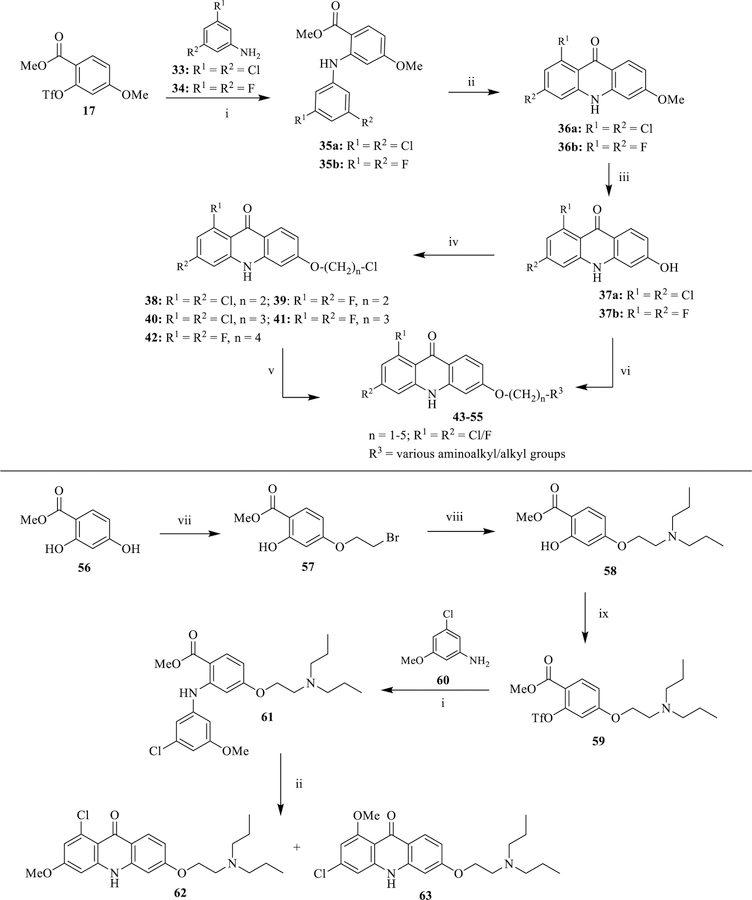
Synthesis of acridones 38–55, 62 and 63 with disubstitutions at the 1 and 3 positions of ring-A, and alkoxy/(dialkylamino)alkoxy/chloroalkoxy moiety at the 6 position of ring-Ba aReagents and conditions: (i) Pd(dba)2, DPPF, KOtBu, toluene, 100 °C, 8-12 h; (ii) Eaton’s acid, 90 °C, 5-24 h; (iii) HI, phenol, reflux, 3 h; (iv) Br-(CH2)n-C1, K2CO3, acetone, reflux, 24 h; (v) alkylamine, NaI, DMSO, 145 °C, 2 h; (vi) C1-(CH2)n-R3.HC1, K2CO3, acetone, reflux, 3-12 h; (vii) Br-(CH2)2-Br, KI, K2CO3, acetone, reflux, 24 h; (viii) dipropylamine, KI, K2CO3, acetone, reflux, 18 h; (ix) Tf2O, pyridine, CH2C12, 0 °C-rt, 5 h.
Scheme 3.
Scheme 3.
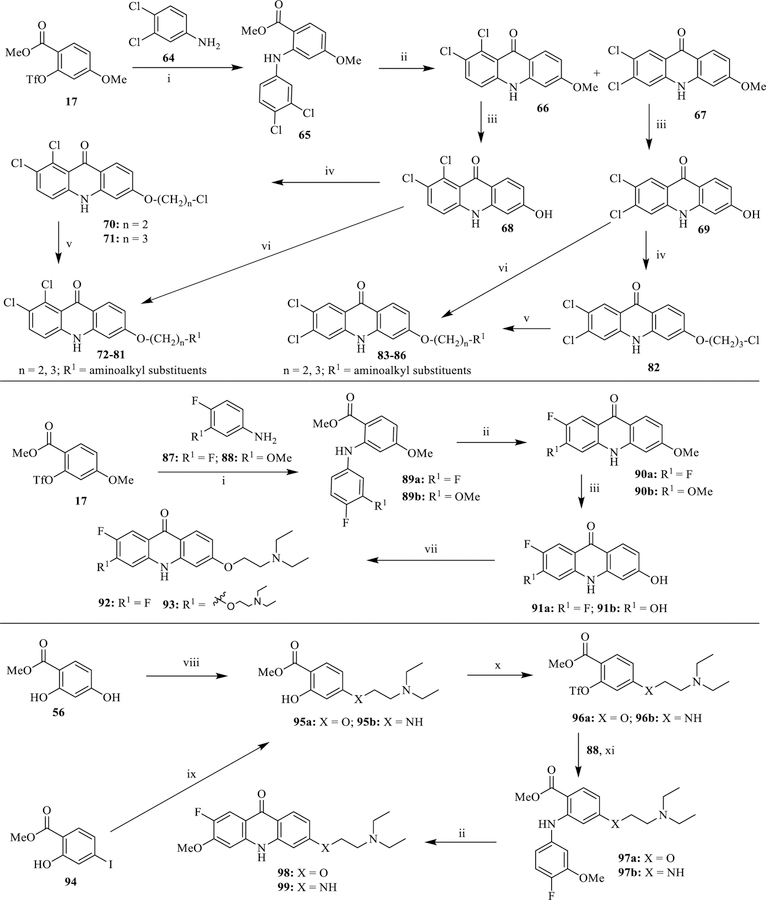
Synthesis of acridones 70–86, 92, 93, 98 and 99 with disubstitutions at the 1 and 2 or the 2 and 3 positions of ring-A and (diethylamino)ethoxy/ethyl-amino/chloroalkoxy at the 6 position of ring-Ba aReagents and conditions: (i) Pd(dba)2, DPPF, KOtBu, toluene, 100 °C, 8-12 h; (ii) Eaton’s acid, 90 °C, 5-24 h; (iii) HI, phenol, reflux, 3 h; (iv) Br-(CH2)n-C1, K2CO3, acetone, reflux, 24 h; (v) alkylamine, NaI, DMSO, 145 °C, 2 h; (vi) C1-(CH2)n-Ri, K2CO3, acetone, reflux, 10-24 h; (vii) C1-(CH2)2-N(Et)2.HC1, K2CO3, acetone, reflux, 10 h; (viii) Br(CH2)2-N(Et)2.HBr, TBAC, K2CO3, acetone, reflux, 4 h; (ix) NH2-(CH2)2-N(Et)2, 2-acetylcyclohexanone, Cs2CO3, CuI, DMF, 100 °C, 4 h; (x) Tf2O, pyridine, CH2C12, 0 °C-rt, 5 h; (xi) Pd(OAc)2, XPhos, Cs2CO3, toluene, 110 °C, 5-8 h.
Scheme 4.
Scheme 4.
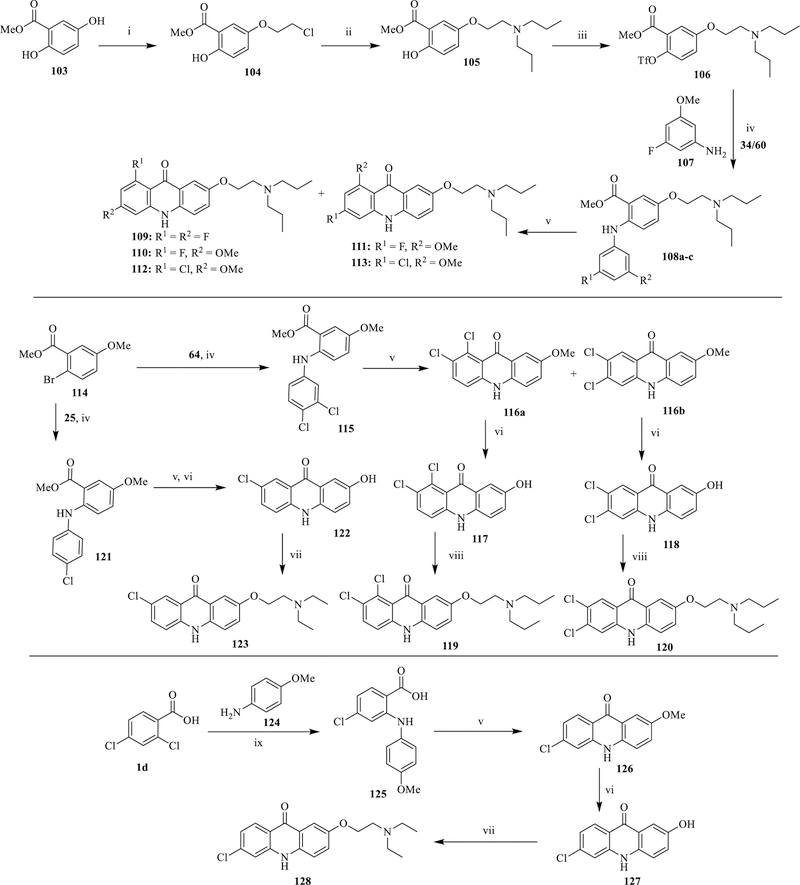
Synthesis of acridones 109–113, 119, 120, 123 and 128 with mono/di-substitutions on ring-A and (dialkylamino)alkoxy moiety at the 7 position of ring-Ba aReagents and Conditions: (i) Br-(CH2)2-C1, K2CO3, acetone, reflux, 10 h; (ii) dipropyl amine, NaI, DMSO, 145 °C, 3 h; (iii) Tf2O, pyridine, CH2C12, 0 °C-rt, 5 h; (iv) Pd(OAc)2, XPhos, Cs2CO3, toluene, 110 °C, 5-8 h; (v) Eaton’s acid, 90 °C, 5-24 h; (vi) BBr3, CH2C12, −78 °C-rt, 12 h; (vii) C1-(CH2)2-N(Et)2.HC1, K2CO3, acetone, reflux, 10 h; (viii) C1-(CH2)2- N(Pr)2.HC1, K2CO3, acetone, reflux, 10 h; (ix) Cu powder, K2CO3, pentanol, reflux, 5 h.

References

    1. WHO. World malaria report. 2016.
    1. Antony HA; Parija SC Antimalarial drug resistance: an overview. Trop. Parasitol. 2016, 6, 30–41. - PMC - PubMed
    1. Sinha S; Medhi B; Sehgal R. Challenges of drug-resistant malaria. Parasite 2014, 21, 61. - PMC - PubMed
    1. Thu AM; Phyo AP; Landier J; Parker DM; Nosten FH. Combating multi-drug resistant Plasmodium falciparum malaria. FEBS J. 2017, 284, 2569–2578. - PMC - PubMed
    1. White NJ; Pukrittayakamee S; Hien TT; Faiz MA; Mokuolu OA; Dondorp AM. Malaria. Lancet 2014, 383, 723–735. - PubMed

Publication types