


Social Factors, Sex, and Mortality Risk After Coronary Artery Bypass Grafting: A Population-Based Cohort Study
- PMID: 30852925
- PMCID: PMC6475039
- DOI: 10.1161/JAHA.118.011490
Social Factors, Sex, and Mortality Risk After Coronary Artery Bypass Grafting: A Population-Based Cohort Study
Abstract
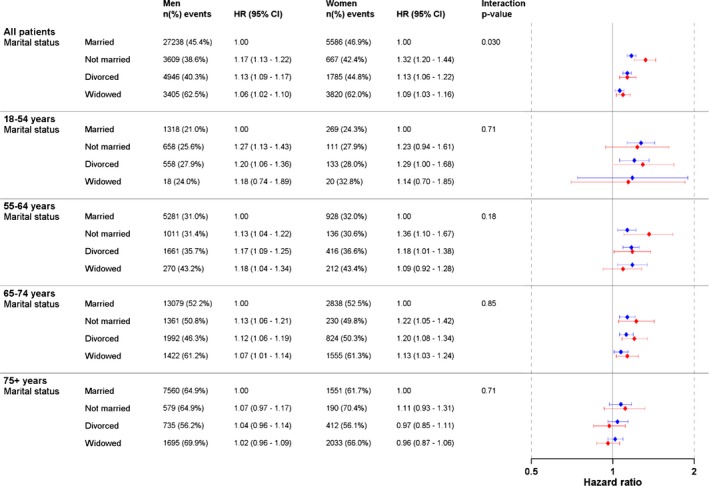
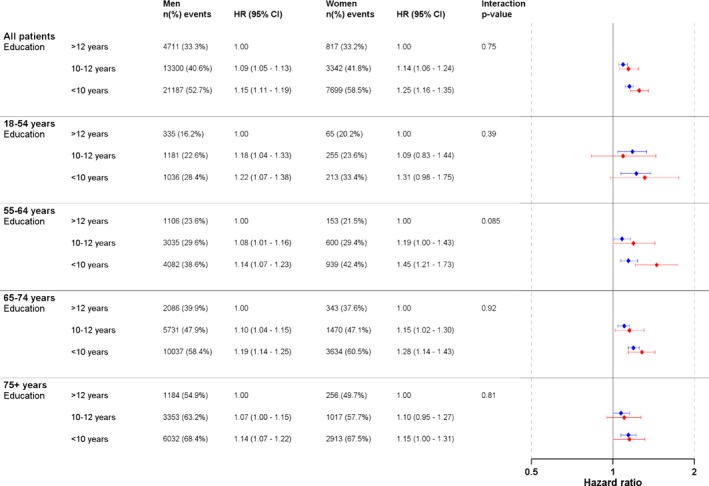
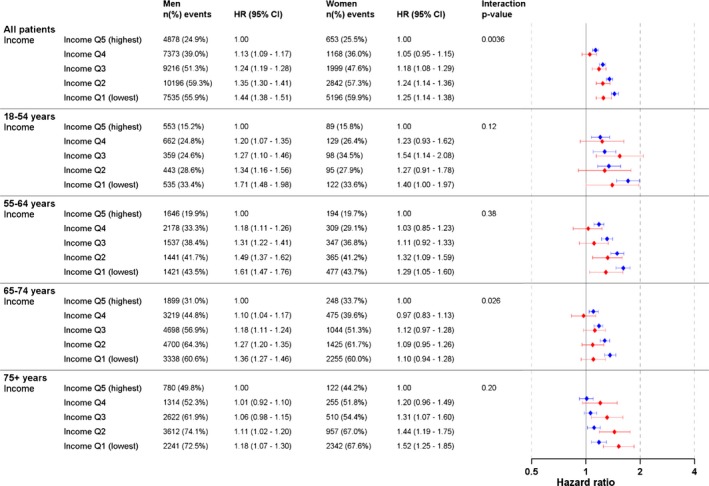
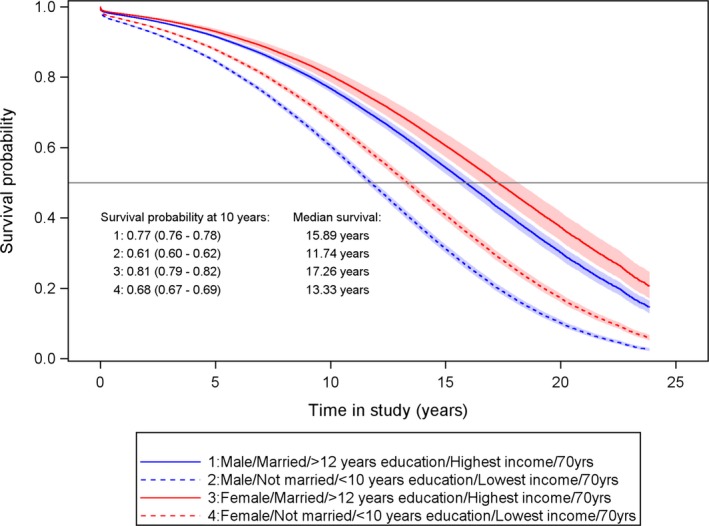
Background Little is known of the impact of social factors on mortality after coronary artery bypass grafting ( CABG ). We explored sex- and age-specific associations between mortality risk after CABG and marital status, income, and education. Methods and Results This population-based register study included 110 742 CABG patients (21.3% women) from the SWEDEHEART registry (Swedish Web-system for Enhancement and Development of Evidence-based Care in Heart Disease Evaluated According to Recommended Therapies) operated 1992 to 2015. Cox regression models were used to study the relation between social factors and all-cause mortality. Never having been married compared with being married/cohabiting was associated with a higher risk in women than in men (hazard ratio 1.32, 95% CI 1.20-1.44) versus 1.17 (1.13-1.22), P=0.030 between sex. The lowest income quintile, compared with the highest, was associated with higher risk in men than in women (hazard ratio 1.44 [1.38-1.51] versus 1.25 [1.14-1.38], P=0.0036). Lowest education level was associated with higher risk without sex difference (hazard ratio 1.15 [1.11-1.19] versus 1.25 [1.16-1.35], P=0.75). For unmarried women aged 60 years at surgery with low income and low education, mortality 10 years after surgery was 18%, compared with 11% in married women with high income and higher education level. The median life expectancy was 4.8 years shorter. Corresponding figures for 60-year-old men were 21% versus 12% mortality risk at 10 years and 5.0 years shorter life expectancy. Conclusions There are strong associations between social factors and mortality risk after CABG in both men and women. These results emphasize the importance of developing and implementing secondary prevention strategies for CABG patients with disadvantages in social factors.
Keywords: coronary artery bypass grafting; mortality; social inequalities; socioeconomic factors.
Figures

References
-
- Havranek EP, Mujahid MS, Barr DA, Blair IV, Cohen MS, Cruz‐Flores S, Davey‐Smith G, Dennison‐Himmelfarb CR, Lauer MS, Lockwood DW, Rosal M, Yancy CW. Social determinants of risk and outcomes for cardiovascular disease: a scientific statement from the American Heart Association. Circulation. 2015;132:873–898. - PubMed
-
- Mackenbach JP, Cavelaars AE, Kunst AE, Groenhof F. Socioeconomic inequalities in cardiovascular disease mortality; an international study. Eur Heart J. 2000;21:1141–1151. - PubMed
-
- Rosengren A, Subramanian SV, Islam S, Chow CK, Avezum A, Kazmi K, Sliwa K, Zubaid M, Rangarajan S, Yusuf S. Education and risk for acute myocardial infarction in 52 high, middle and low‐income countries: INTERHEART case‐control study. Heart. 2009;95:2014–2022. - PubMed
-
- Bergstrom G, Redfors B, Angeras O, Dworeck C, Shao Y, Haraldsson I, Petursson P, Milicic D, Wedel H, Albertsson P, Ramunddal T, Rosengren A, Omerovic E. Low socioeconomic status of a patient's residential area is associated with worse prognosis after acute myocardial infarction in Sweden. Int J Cardiol. 2015;182:141–147. - PubMed
Publication types
MeSH terms
LinkOut - more resources
Full Text Sources
Medical
