


Parenting in Times of War: A Meta-Analysis and Qualitative Synthesis of War Exposure, Parenting, and Child Adjustment
- PMID: 30852950
- PMCID: PMC7675766
- DOI: 10.1177/1524838019833001
Parenting in Times of War: A Meta-Analysis and Qualitative Synthesis of War Exposure, Parenting, and Child Adjustment
Abstract
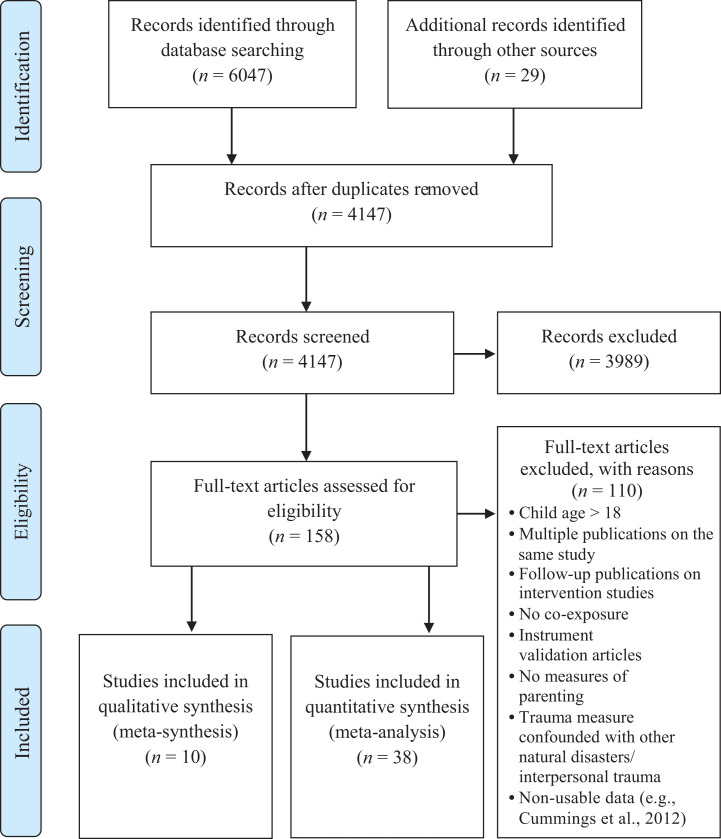
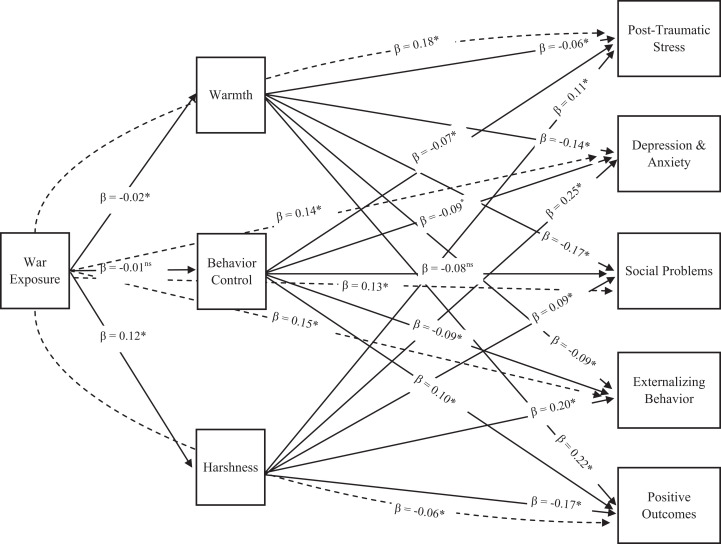
This mixed methods systematic review and meta-analysis sheds more light on the role parenting practices play in children's adjustment after war exposure. Specifically, we quantitatively examined whether parenting behavior explained some of the well-known associations between war exposure and children's adjustment. In addition, we meta-synthesized qualitative evidence answering when and why parenting practices might change for war-affected families. We searched nine electronic databases and contacted experts in the field for relevant studies published until March 2018, identifying 4,147 unique publications that were further screened by title and abstract, resulting in 158 publications being fully screened. By running a meta-analytic structural equation model with 38 quantitative studies (N = 54,372, Mage = 12.00, SDage = 3.54), we found that more war-exposed parents showed less warmth and more harshness toward their children, which partly mediated the association between war exposure and child adjustment, that is, post-traumatic stress symptoms, depression and anxiety, social problems, externalizing behavior, and lower positive outcomes (e.g., quality of life). War exposure was not associated with parents' exercise of behavioral control. By meta-synthesizing 10 qualitative studies (N = 1,042; age range = 0-18), we found that the nature of war-related trauma affected parenting differently. That is, parents showed harshness, hostility, inconsistency, and less warmth in highly dangerous settings and more warmth and overprotection when only living under threat. We conclude that it is both how much and what families have seen that shapes parenting in times of war.
Keywords: child development; mental health; parenting; trauma; war exposure.
Conflict of interest statement
Figures
References
-
- Abbott D. A. (2009). Violent death: A qualitative study of Israeli and Palestinian families. Journal of Loss & Trauma, 14, 117–128. doi:10.1080/15325020802540462
-
- Allwood M. A., Bell-Dolan D., Husain S. A. (2002). Children’s trauma and adjustment reactions to violent and nonviolent war experiences. Journal of the American Academy of Child & Adolescent Psychiatry, 41, 450–457. doi:10.1097/00004583-200204000-00018 - PubMed
-
- Almqvist K., Broberg A. G. (2003). Young children traumatized by organized violence together with their mothers—The critical effects of damaged internal representations. Attachment & Human Development, 5, 367–380. doi:10.1080/14616730310001633447 - PubMed
-
- Barber B. (1999). Political violence, family relations, and Palestinian youth functioning. Journal of Adolescent Research, 14, 206–230. doi:10.1177/0743558499142004
-
- Barber B. (2013). Annual research review: The experience of youth with political conflict—Challenging notions of resilience and encouraging research refinement. Journal of Child Psychology and Psychiatry, 54, 461–473. doi:10.1111/jcpp.12056 - PubMed
Publication types
MeSH terms
LinkOut - more resources
Full Text Sources
Medical
