Disconnection Between Self-Reported and Objective Cognitive Impairment in Obstructive Sleep Apnea
- PMID: 30853044
- PMCID: PMC6411171
- DOI: 10.5664/jcsm.7664
Disconnection Between Self-Reported and Objective Cognitive Impairment in Obstructive Sleep Apnea
Abstract
Study objectives: Recent studies show that obstructive sleep apnea (OSA) is a possible contributor to abnormal cognitive decline in older adults. These new observations create the need to identify older adults with OSA who are at risk of the developing dementia if not treated. This study's goal was to verify whether self-reported cognitive complaints could become a useful tool to screen for objective cognitive deficits in late middle-aged and older adults with OSA.
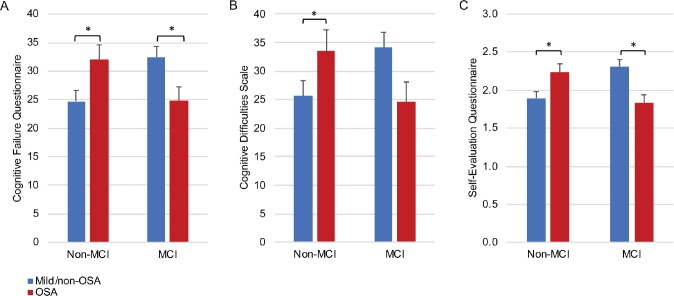
Methods: Fifty-seven participants with OSA with an apnea-hypopnea index (AHI) ≥ 15 events/h (3% or arousal) and aged between 55 and 85 years were compared to 54 participants in a mild/non-OSA group on their ability to evaluate their objective cognitive functioning. They underwent overnight polysomnography followed by a comprehensive neuropsychological assessment. We recruited a similar proportion of participants with mild cognitive impairment (MCI) in both groups (OSA: 36.8%; mild/non-OSA: 35.2%). They filled out questionnaires assessing mood, sleep, and cognition. Group (OSA versus mild/non-OSA) × cognitive status (MCI versus non-MCI) analyses of variance were performed on cognitive complaint questionnaires.
Results: We found that among participants without objective cognitive deficits, participants in the OSA group reported more cognitive complaints compared to those in the mild/non-OSA group. Among participants with objective cognitive deficits, those in the OSA group reported less cognitive complaints compared to those in the mild/non-OSA group.
Conclusions: Participants with OSA and MCI were less aware of their deficits compared to those in the mild/non-OSA group, possibly reflecting a distinctive OSA-associated cognitive impairment. Our results underscore the importance of referring patients with OSA for a comprehensive neuropsychological assessment when an abnormal cognitive decline is suspected.
Keywords: aging; cognitive complaint; mild cognitive impairment; neuropsychology, sleep-disordered breathing; subjective cognitive decline; subjective cognitive impairment.
© 2019 American Academy of Sleep Medicine.
Figures
References
-
- Daulatzai MA. Evidence of neurodegeneration in obstructive sleep apnea: Relationship between obstructive sleep apnea and cognitive dysfunction in the elderly. J Neurosci Res. 2015;93(12):1778–1794. - PubMed
Publication types
MeSH terms
Grants and funding
LinkOut - more resources
Full Text Sources
Medical