


Integrating primary care providers through the seasons of survivorship
- PMID: 30853798
- PMCID: PMC6380650
- DOI: 10.3747/co.26.4687
Integrating primary care providers through the seasons of survivorship
Abstract
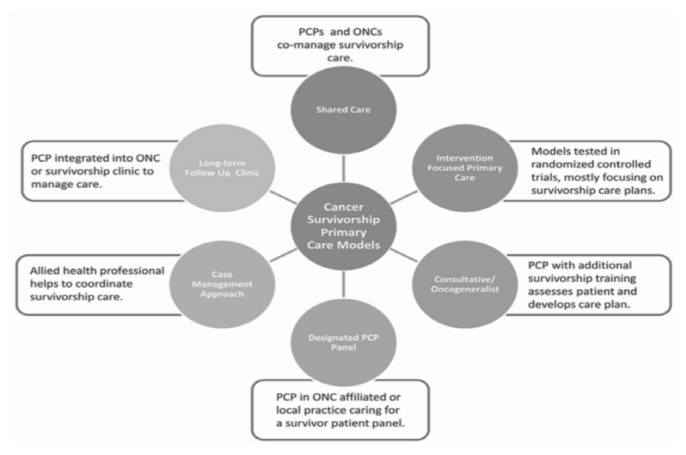
Traditionally, the role of primary care providers (pcps) across the cancer care trajectory has focused on prevention and early detection. In combination with screening initiatives, new and evolving treatment approaches have contributed to significant improvements in survival in a number of cancer types. For Canadian cancer survivors, the 5-year survival rate is now better than it was a decade ago, and the survivor population is expected to reach 2 million by 2031. Notwithstanding those improvements, many cancer survivors experience late and long-term effects, and comorbid conditions have been noted to be increasing in prevalence for this vulnerable population. In view of those observations, and considering the anticipated shortage of oncology providers, increasing reliance is being placed on the primary care workforce for the provision of survivorship care. Despite the willingness of pcps to engage in that role, further substantial efforts to elucidate the landscape of high-quality, sustainable, and comprehensive survivorship care delivery within primary care are required. The present article offers an overview of the integration of pcps into survivorship care provision. More specifically, it outlines known barriers and potential solutions in five categories: ■ Survivorship care coordination■ Knowledge of survivorship■ pcp-led clinical environments■ Models of survivorship care■ Health policy and organizational advocacy.
Keywords: Survivorship; education; primary care providers.
Conflict of interest statement
CONFLICT OF INTEREST DISCLOSURES We have read and understood Current Oncology’s policy on disclosing conflicts of interest, and we declare that we have none.
Figures
References
-
- Canadian Cancer Society’s Advisory Committee on Cancer Statistics. Canadian Cancer Statistics 2017. Toronto, ON: Canadian Cancer Society; 2017.
-
- Canadian Partnership Against Cancer (cpac) Sustaining Action Toward a Shared Vision: 2012–2017 Strategic Plan. Toronto, ON: cpac; 2018.
MeSH terms
LinkOut - more resources
Full Text Sources
Medical
