. 2019 Feb;14(2):69-77.
doi: 10.1055/s-0038-1660818. Epub 2018 Jul 6.

Biofilm biology and vaccine strategies for otitis media due to nontypeable Haemophilus influenzae

Affiliations

Biofilm biology and vaccine strategies for otitis media due to nontypeable Haemophilus influenzae

Laura A Novotny et al. J Pediatr Infect Dis. 2019 Feb.

Abstract

Otitis media (OM) is one of the most common diseases of childhood, and nontypeable Haemophilus influenzae (NTHI) is the predominant causative agent of chronic and recurrent OM, as well as OM for which treatment has failed. Moreover, NTHI is now as important a causative agent of acute OM as the pneumococcus. NTHI colonizes the human nasopharynx asymptomatically. However, upon perturbation of the innate and physical defenses of the airway by upper respiratory tract viral infection, NTHI can replicate, ascend the Eustachian tube, gain access to the normally sterile middle ear space, and cause disease. Bacterial biofilms within the middle ear, including those formed by NTHI, contribute to the chronic and recurrent nature of this disease. These multicomponent structures are highly resistant to clearance by host defenses and elimination by traditional antimicrobial therapies. Herein, we review several strategies utilized by NTHI in order to persist within the human host and interventions currently under investigation to prevent and/or resolve NTHI-induced diseases of the middle ear and uppermost airway.

Keywords: DNABII proteins; EPS; PilA; Type IV pilus; eDNA; integration host factor; phasevarion.


Conflict of interest statement

Competing interest LAN, KLB, EMM and JAJ have no competing interests. LOB is a Scientific Advisor to, and has equity in, ProclaRx, LLC, to whom technology related to the DNABII proteins is licensed. LOB is an inventor of technology related to PilA-derived immunogens which is licensed to GlaxoSmithKline Biologicals.

Figures
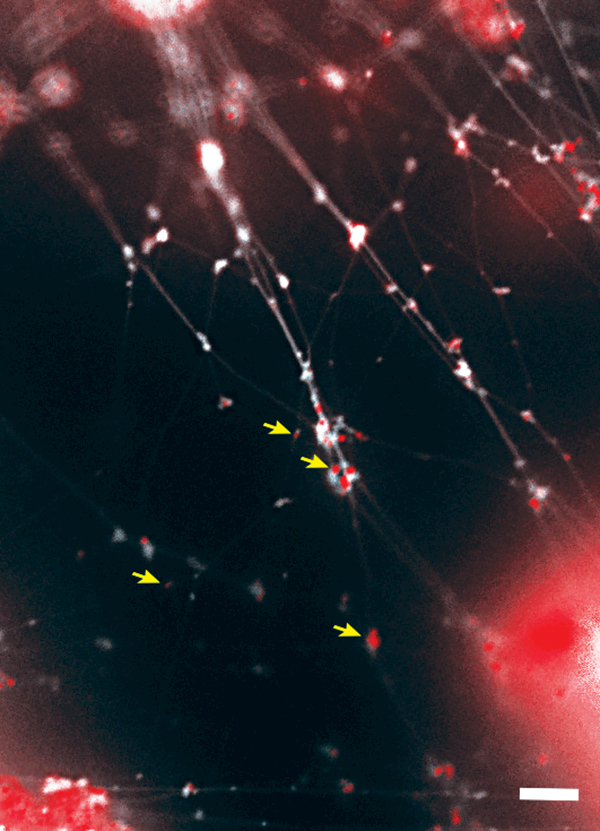
Figure 1.
Figure 1.
NTHI biofilms formed within the chinchilla middle ear during experimental OM contain abundant eDNA and DNABII proteins in association. Crossed strands of eDNA (white) form a lattice-like structure within the biofilm EPS. The eDNA is stabilized by members of the DNABII family of DNA-binding proteins (red, indicated by yellow arrows) which bind at the vertices of DNA strands. Scale bar, 5 μm.
Figure 2.
Figure 2.
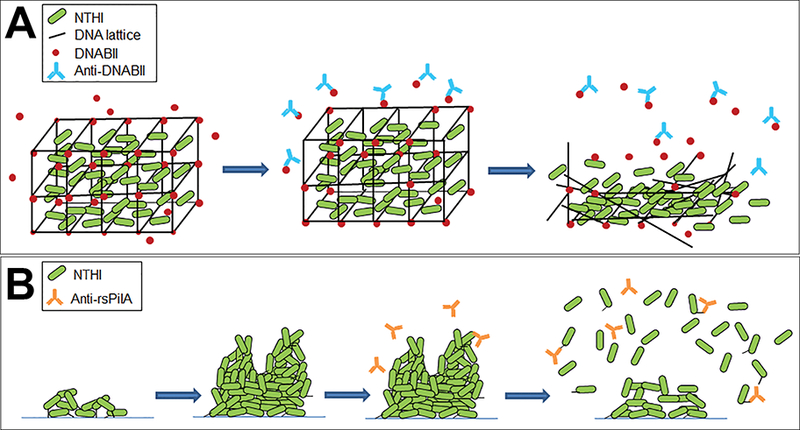
Two distinct mechanisms to disrupt NTHI biofilms. (A) Biofilms formed by many bacterial human pathogens, including NTHI incorporate eDNA (black lines) and DNABII proteins (red circles) within the EPS. Antibodies against DNABII proteins (blue) bind and sequester DNABII molecules from the extracellular milieu and induce an equilibrium imbalance. Release of DNABII proteins from the eDNA scaffold results in catastrophic collapse of the biofilm structure and exposure of resident bacteria. (B) NTHI utilize Tfp to adhere, organize and form a biofilm. Antibodies directed against the majority subunit of NTHI Tfp, PilA, (orange) induce a ‘top-down’ dispersal event that is dependent on quorum signaling.
Figure 3.
Figure 3.
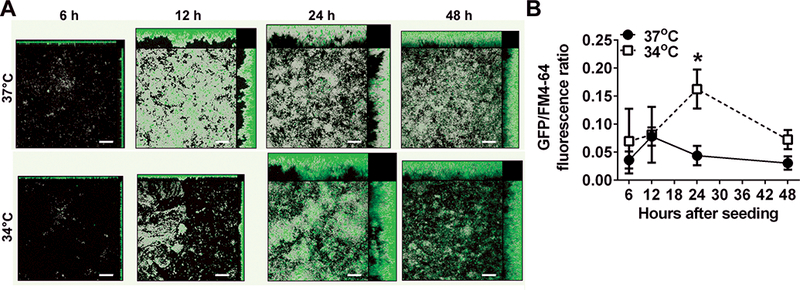
Expression of Tfp, as estimated by pilA promoter activity, reaches a significantly higher maximum value in biofilms formed at 34°C compared to biofilms formed at 37°C in vitro. (A) Biofilms formed with NTHI wherein the pilA promoter drives expression of green fluorescent protein. Total biomass (as indicated by FM-464 fluorescent membrane stain) is shown in gray, and green areas indicate pilA promoter activity. Promoter activity is greatest near the base of the biofilms early on, but as the biofilms mature, regions of intense fluorescence become more prevalent towards the apex of towers. (B) Peak pilA promoter activity is 3.7 times higher in biofilms formed at 34°C vs. 37°C as measured by fluorescent intensity, and this effect is independent of the amount of biomass. * P≤ 0.05. Scale bars, 20 μm. Copyright © American Society for Microbiology, [Journal of Bacteriology, 198, 2016, 2619–2630. doi: 10.1128/JB.01022-15].
Figure 4.
Figure 4.
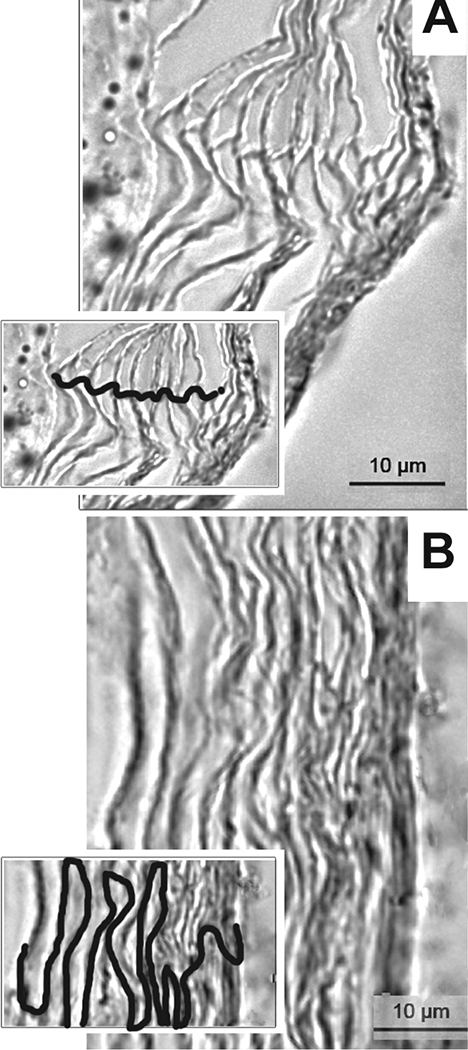
The stratum corneum at the post-auricular region is uniquely organized. To understand any differences in efficacy achieved by TCI via bandaid as related to anatomical placement, skin from the post-auricular region and the nape of the neck on chinchillas was collected and the organization of the cells within the stratum corneum examined by microscopy. (A) The corneocytes at the post-auricular region were linearly aligned whereas (B) at the nape, a classic ‘brick-and-mortar’ arrangement was observed. Insets, visualization of cell stratification with cellular junctions traced. Scale bars, 10 μm. Copyright © American Society for Microbiology, [Clinical and Vaccine Immunology, 22, 2015, 867–874. doi:10.1128/CVI.00090-15].

References

    1. Pichichero ME. Otitis media. Pediatric clinics of North America. April 2013;60(2):391–407. - PubMed
    1. Baldwin RL. Effects of otitis media on child development. The American journal of otology. November 1993;14(6):601–604. - PubMed
    1. Hunter LL, Margolis RH, Giebink GS. Identification of hearing loss in children with otitis media. Ann Otol Rhinol Laryngol Suppl. May 1994;163:59–61. - PubMed
    1. Johnson DL, McCormick DP, Baldwin CD. Early middle ear effusion and language at age seven. J Commun Disord. Jan-Feb 2008;41(1):20–32. - PubMed
    1. Li SF, Kumar A, Thomas S, et al. Safety and efficacy of intravenous combination sedatives in the ED. The American journal of emergency medicine. September 2013;31(9):1402–1404. - PubMed