Review
. 2019 Feb 3:2019:5245034.
doi: 10.1155/2019/5245034. eCollection 2019.

Combinatorial Approach to Improve Cancer Immunotherapy: Rational Drug Design Strategy to Simultaneously Hit Multiple Targets to Kill Tumor Cells and to Activate the Immune System

Affiliations
Review

Combinatorial Approach to Improve Cancer Immunotherapy: Rational Drug Design Strategy to Simultaneously Hit Multiple Targets to Kill Tumor Cells and to Activate the Immune System

Shweta Joshi et al. J Oncol. .

Abstract

Cancer immunotherapy, including immune checkpoint blockade and adoptive CAR T-cell therapy, has clearly established itself as an important modality to treat melanoma and other malignancies. Despite the tremendous clinical success of immunotherapy over other cancer treatments, this approach has shown substantial benefit to only some of the patients while the rest of the patients have not responded due to immune evasion. In recent years, a combination of cancer immunotherapy together with existing anticancer treatments has gained significant attention and has been extensively investigated in preclinical or clinical studies. In this review, we discuss the therapeutic potential of novel regimens combining immune checkpoint inhibitors with therapeutic interventions that (1) increase tumor immunogenicity such as chemotherapy, radiotherapy, and epigenetic therapy; (2) reverse tumor immunosuppression such as TAMs, MDSCs, and Tregs targeted therapy; and (3) reduce tumor burden and increase the immune effector response with rationally designed dual or triple inhibitory chemotypes.


Figures
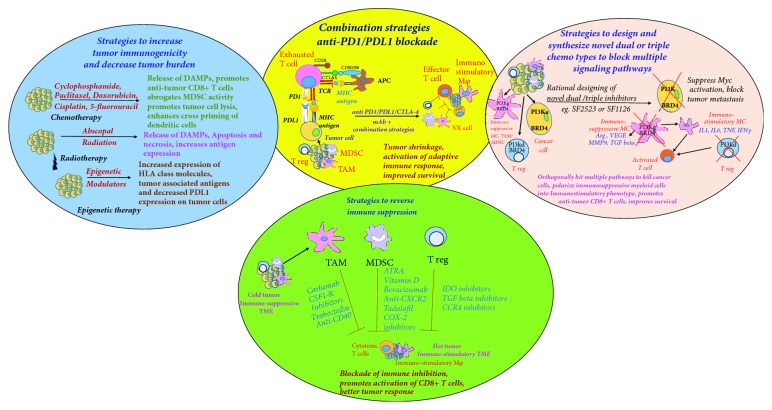
Figure 1
Figure 1
Combination immunotherapy strategies to reduce tumor burden and to activate durable antitumor immune response. Left panel shows cartoon of strategies to increase tumor immunogenicity, including certain chemotherapeutic drugs, radiotherapy, and epigenetic modulators which induce immunogenic cell death and release tumor antigens in TME that activate antitumor immune response. Lower panel shows cartoon of agents targeting Tregs, TAMs, and MDSCs, to block immunosuppression, to skew their polarization to proinflammatory state and to promote effector T cell function and to convert cold immunosuppressive TME into hot immune-stimulatory type. Right panel shows novel strategy of rational designing of dual inhibitory chemotypes, e.g., SF2523, dual PI3K/BRD4 inhibitor targeting multiple signaling pathways to kill tumor cells and simultaneously stimulate immune cells to provide durable adaptive immune response. Middle panel shows cartoon of checkpoint inhibitor therapy and pairing of combination therapies with anti-PD1/PDL1 blockade which may significantly improve clinical efficacy of cancer immunotherapy.
Figure 2
Figure 2
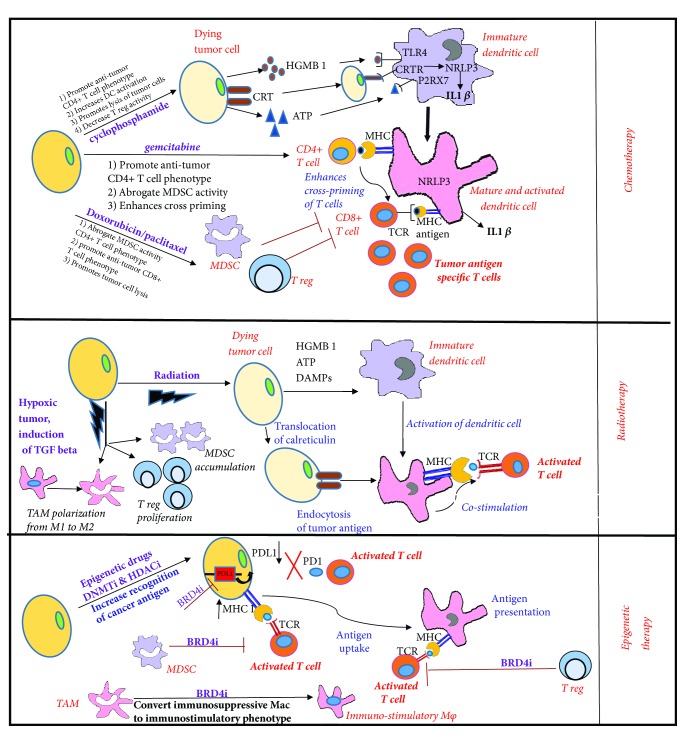
Mechanisms of inducing immunogenic tumor cell death and decreasing tumor burden by chemotherapy, radiotherapy, and epigenetic therapy. Upper panel shows how chemotherapeutic drugs induce immunogenic death through release of tumor antigens, secretion of danger associated signals HGMB1 and ATP, and translocation of calreticulin to cell surface. These death-associated molecules bind to TL4R, P2RX7 receptors, and calreticulin receptors which leads to activation of NRLP3 inflammasome and activation of dendritic cells to induce tumor antigen specific T-cell responses. Some chemotherapeutic drugs decrease infiltration and accumulation of Tregs and MDSCs in the TME leading to activation of adaptive immune responses. Middle panel shows the immunogenic cell death induced by radiotherapy. Figure also shows that radiation induces increased transcription of HIF 1α and activation of latent TGF beta which leads to increased Treg proliferation and polarization of M1 macrophages to M2 macrophages leading to activation of immunosuppressive TME. Lower panel shows how epigenetic therapy promotes antitumor responses by upregulating tumor-associated antigens and downregulating PDL1 expression. BRD4 inhibitors block accumulation of MDSCs in TME and reduce immunosuppression by promoting the polarization of macrophages into immunostimulatory phenotypes.

References

    1. Hodi F. S., O'Day S. J., McDermott D. F., et al. Improved survival with ipilimumab in patients with metastatic melanoma. The New England Journal of Medicine. 2010;363(8):711–723. doi: 10.1056/NEJMoa1003466. - DOI - PMC - PubMed
    1. Topalian S. L., Hodi F. S., Brahmer J. R., et al. Safety, activity, and immune correlates of anti-PD-1 antibody in cancer. The New England Journal of Medicine. 2012;366(26):2443–2454. doi: 10.1056/NEJMoa1200690. - DOI - PMC - PubMed
    1. Brahmer J. R., Tykodi S. S., Chow L. Q. M., et al. Safety and activity of anti-PD-L1 antibody in patients with advanced cancer. The New England Journal of Medicine. 2012;366(26):2455–2465. doi: 10.1056/NEJMoa1200694. - DOI - PMC - PubMed
    1. Pitt J. M., Vétizou M., Daillère R., et al. Resistance Mechanisms to Immune-Checkpoint Blockade in Cancer: Tumor-Intrinsic and -Extrinsic Factors. Immunity. 2016;44(6):1255–1269. doi: 10.1016/j.immuni.2016.06.001. - DOI - PubMed
    1. O'Donnell J. S., Long G. V., Scolyer R. A., Teng M. W., Smyth M. J. Resistance to PD1/PDL1 checkpoint inhibition. Cancer Treatment Reviews. 2017;52:71–81. doi: 10.1016/j.ctrv.2016.11.007. - DOI - PubMed

LinkOut - more resources