


Assessment of Nursing Response to a Real-Time Alerting Tool for Sepsis: A Provider Survey
- PMID: 30854401
- PMCID: PMC6402839
- DOI: 10.24150/ajhm/2017.021
Assessment of Nursing Response to a Real-Time Alerting Tool for Sepsis: A Provider Survey
Abstract
Background: An information technology solution to provide a real-time alert to the nursing staff is necessary to assist in identifying patients who may have sepsis and avoid the devastating effects of its late recognition. The objective of this study is to evaluate the perception and adoption of sepsis clinical decision support.
Methods: A cross-sectional survey over a three-week period in 2015 was conducted in a major tertiary care facility. A sepsis alert was launched into five pilot units (including: surgery, medical-ICU, step-down, general medicine, and oncology). The pilot unit providers consisted of nurses from five inpatient units. Frequency, summary statistics, Chi-square, and nonparametric Kendall tests were used to determine the significance of the association and correlation between six evaluation domains.
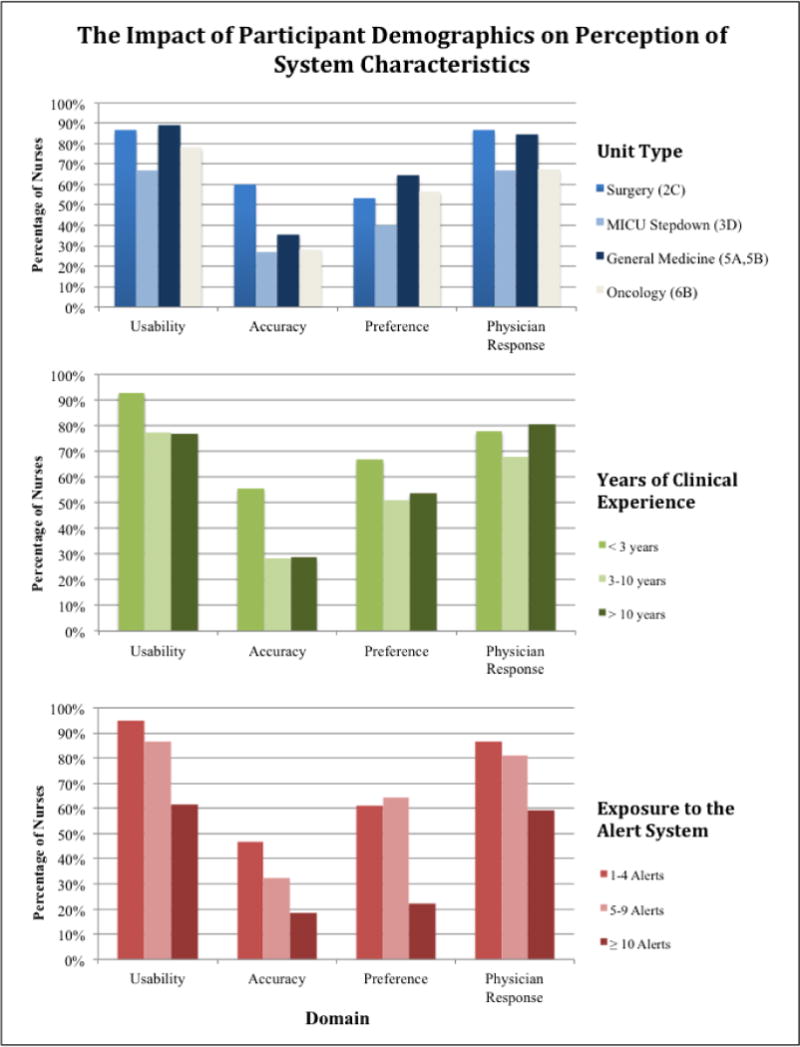
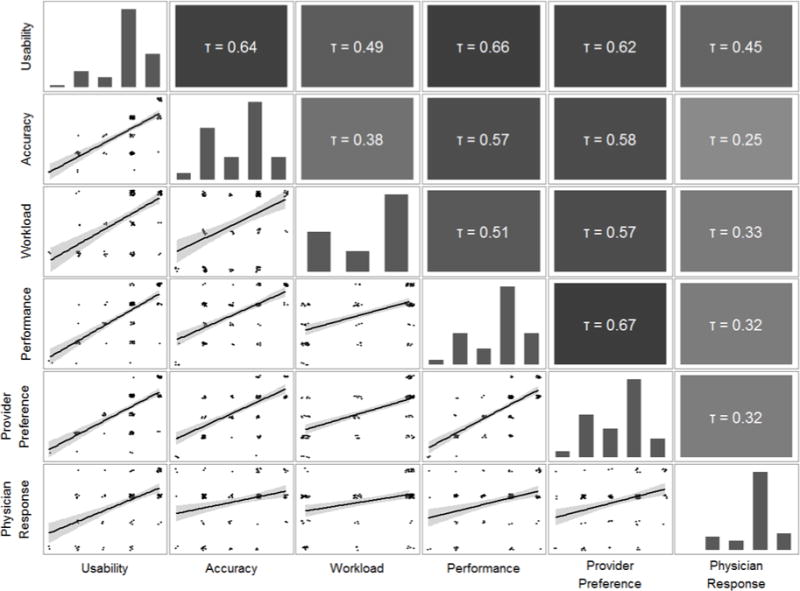
Results: A total of 151 nurses responded (53% response rate). Questions included in the survey addressed the following domains: usability, accuracy, impact on workload, improved performance, provider preference, and physician response. The level of agreeability regarding physician response was significantly different between units (p=0.0136). There were significant differences for improved performance (p=0.0068) and physician response (p=0.0503) across levels of exposure to the alert. The strongest correlations were between questions related to usability and the domains of: accuracy (τ=0.64), performance (τ=0.66), and provider preference (τ=0.62), as well as, between the domains of: provider performance and provider preference (τ=0.67).
Discussion: Performance and preference of providers were evaluated to identify strengths and weaknesses of the sepsis alert. Effective presentation of the alert, including how and what is displayed, may offer better cognitive support in identifying and treating septic patients.
Keywords: Sepsis; alert; clinical decision support tool; usability testing.
Conflict of interest statement
Potential conflicts of interest: Authors declare no conflicts of interest. Authors declare that they have no commercial or proprietary interest in any drug, device, or equipment mentioned in the submitted article.
Figures
References
-
- Elixhauser A, Friedman B, Stranges E. Septicemia in US Hospitals, 2009. Rockville, MD: 2011. (HCUP Statistical Brief #122).
-
- Liu V, Escobar G, Greene J, et al. Hospital deaths in patients with sepsis from 2 independent cohorts. JAMA. 2014;312(1):90–92. - PubMed
-
- Ahrens T, Tuggle D. Surviving severe sepsis: Early recognition and treatment. Crit Care Nurse. 2004;(Suppl):2–13. - PubMed
-
- Snyder-Halpern R. Assessing healthcare setting readiness for point of care computerized clinical decision support system innovations. Outcomes Manag Nurs Pract. 1999;(3):118–127. - PubMed
-
- Spooner S. Mathematical foundations of decision support systems. In: Berner ES, editor. Clinical Decision Support Systems Theory and Practice New York. New York: Springer; 1999. pp. 35–60.
Grants and funding
LinkOut - more resources
Full Text Sources