. 2019 Jan 30;5(1):eaau6947.
doi: 10.1126/sciadv.aau6947. eCollection 2019 Jan.

The comparative genomics and complex population history of Papio baboons

Affiliations

The comparative genomics and complex population history of Papio baboons

Jeffrey Rogers et al. Sci Adv. .

Abstract

Recent studies suggest that closely related species can accumulate substantial genetic and phenotypic differences despite ongoing gene flow, thus challenging traditional ideas regarding the genetics of speciation. Baboons (genus Papio) are Old World monkeys consisting of six readily distinguishable species. Baboon species hybridize in the wild, and prior data imply a complex history of differentiation and introgression. We produced a reference genome assembly for the olive baboon (Papio anubis) and whole-genome sequence data for all six extant species. We document multiple episodes of admixture and introgression during the radiation of Papio baboons, thus demonstrating their value as a model of complex evolutionary divergence, hybridization, and reticulation. These results help inform our understanding of similar cases, including modern humans, Neanderthals, Denisovans, and other ancient hominins.


Figures
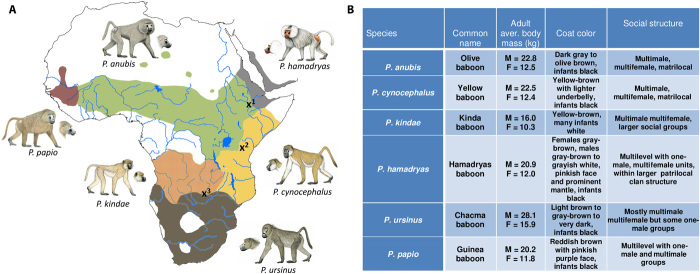
Fig. 1
Fig. 1. Papio baboon species.
(A) The appearance and current distribution of each baboon species, and the locations of three well-documented active hybrid zones are also shown. x1: hybrid zone between P. hamadryas and P. anubis (19, 28), x2: hybrid zone between P. cynocephalus and P. anubis (17, 26), x3: hybrid zone between P. kindae and P. ursinus (18). Drawings of each species by S. Nash. (B) Distinguishing features of Papio species. Body mass data from (16, 59) and unpublished data from J.P.-C., J.R., and C.J.J.
Fig. 2
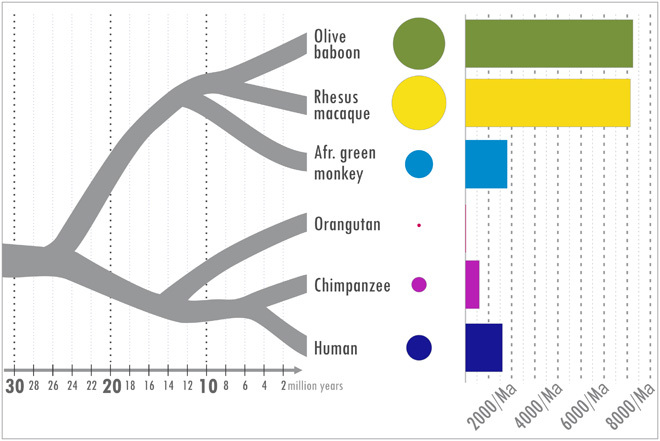
Fig. 2. Comparison of Alu mobilization rates in selected primate genomes.
Only Alu elements specific to each lineage are included. The size of the circle corresponds to the number of near full-length lineage-specific AluY elements in that species. The bars on the right show the estimated number of insertions per million years for each lineage. For baboon (Panu_3.0), rhesus macaque (Mmul_8.0.1), African green monkey (chlSab2), chimpanzee (Pan_tro3), and human (GRCh38/hg38), AluY sequences were retrieved computationally by cross comparisons using the most recent available assemblies. Orangutan estimates are from P_pygmaeus2.0.2 (60). The number of lineage-specific AluY elements is similar in rhesus macaque and baboon, and more than twice that in the African green monkeys, despite a longer period of independent evolution for the African green monkeys.
Fig. 3
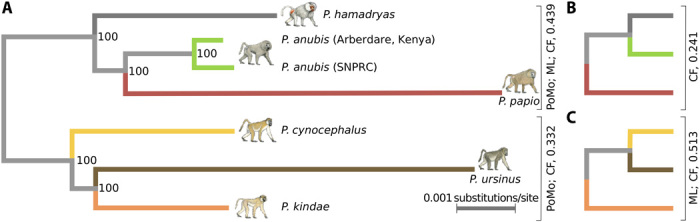
Fig. 3. Phylogenetic relationships among baboon species.
(A) Phylogeny generated using the polymorphism-aware phylogenetic method (PoMo) (23, 24). This topology for the three northern species is also supported by ML analysis of concatenated SNVs and by 43.9% of informative gene trees filtered to exclude any coding sequence genes [scaled concordance factor (CF) of 0.439, greater than the other two alternatives]. The topology shown for the three southern clade species is supported by the PoMo analysis and has a scaled CF score of 0.332. (B) One alternative topology for the northern species, supported by a scaled CF of 0.241. (C) One alternative topology for the southern species, supported by ML analysis of concatenated SNVs and a scaled CF score of 0.513, i.e., a larger proportion of gene trees that are devoid of coding genes than the other two alternative trees.
Fig. 4
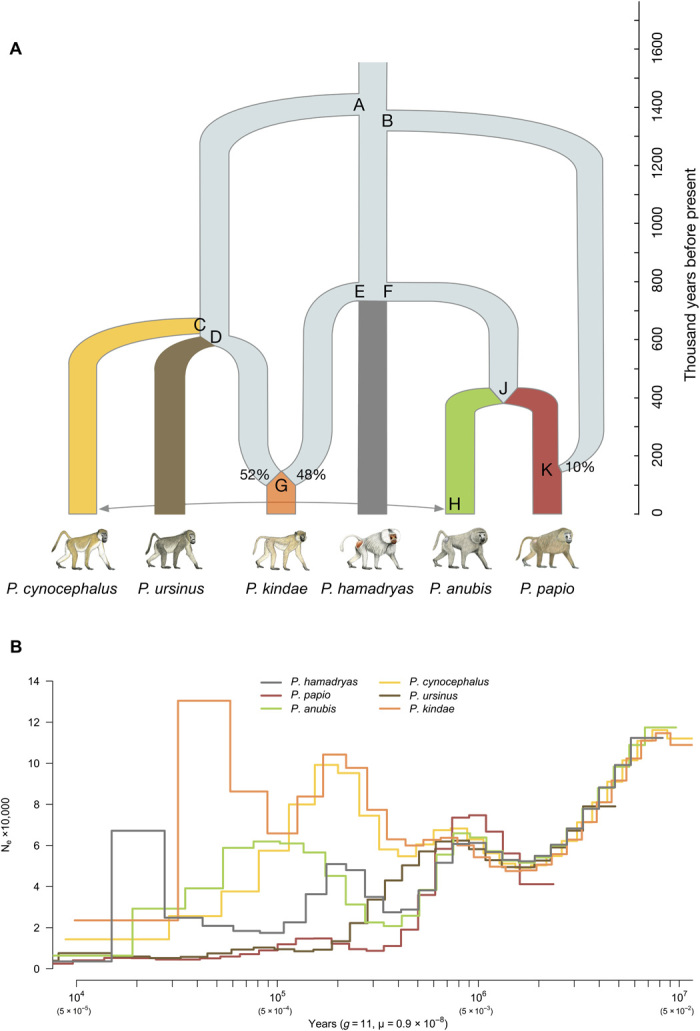
Fig. 4. Evolutionary and demographic history for Papio baboons.
(A) Analyses using f-statistics indicate that P. kindae was formed via input from both a southern clade lineage and a northern clade lineage, with contributions estimated to be 52 and 48%. P. papio is inferred to have been produced through 10% introgression from an unidentified ancient northern lineage into a population related to P. anubis. Dates for divergence and admixture events were inferred through CoalHMM, and internal nodes representing those divergence or admixture events are labeled A through K. Our analyses of asymmetric haplotype sharing also inferred admixture from P. cynocephalus into P. anubis approximately 21 generations ago. (B) Reconstruction of baboon demographic history using PSMC methods. A prolonged bottleneck was observed in the lineage ancestral to P. papio beginning ~400 thousand years (ka) ago, while the populations ancestral to P. hamadryas and P. anubis increased between ~280 and ~160 ka ago. After diverging, P. anubis followed an upward trend whereas P. hamadryas declined. At ~400 ka ago, Ne for P. ursinus diverged from estimates for the populations ancestral to P. cynocephalus and P. kindae, and underwent a species-specific prolonged bottleneck. At ~300 ka ago, the Ne reconstructed for both P. cynocephalus and P. kindae increased, peaking ~150 ka ago before experiencing a subsequent decline. PSMC methods are not always reliable for the most recent time periods.

References

    1. Seehausen O., Butlin R. K., Keller I., Wagner C. E., Boughman J. W., Hohenlohe P. A., Peichel C. L., Saetre G.-P., Bank C., Brännström Å., Brelsford A., Clarkson C. S., Eroukhmanoff F., Feder J. L., Fischer M. C., Foote A. D., Franchini P., Jiggins C. D., Jones F. C., Lindholm A. K., Lucek K., Maan M. E., Marques D. A., Martin S. H., Matthews B., Meier J. I., Möst M., Nachman M. W., Nonaka E., Rennison D. J., Schwarzer J., Watson E. T., Westram A. M., Widmer A., Genomics and the origin of species. Nat. Rev. Genet. 15, 176–192 (2014). - PubMed
    1. Wolf J. B. W., Ellegren H., Making sense of genomic islands of differentiation in light of speciation. Nat. Rev. Genet. 18, 87–100 (2017). - PubMed
    1. D. Otte, J. A. Endler, Speciation and Its Consequences (Sinauer Associates, Inc., 1989).
    1. E. Mayr, Systematics and the Origin of Species (Columbia Univ. Press, 1942).
    1. M. L. Arnold, Divergence with Genetic Exchange (Oxford Univ. Press, 2015).

Publication types